


Hi, I’m Peter, and you’re reading Anywhere Italy.
Our mission is to cover the 1,000 Italian towns most travelers skip, in person, one at a time. Come along for free, or pay to keep us on the road.
When I first visited Todi, in Umbria, I knew this was different. Before that, my Italian experience was a collection of short and long trips, tours around the usual suspects: Tuscany, Liguria, Veneto, and spending months in Rome. I was familiar with the other Italy by that time, I had my baptism to it in Ronciglione. But Todi showed me that the experience most people (including me) search for or imagine in Italy is available on, well, better terms.
I’m not the first one who’s saying this, of course. So much so that others are arguing that the Marche and Abruzzo are even better deals. Might be. But most expats arrive in Italy with Tuscan countryside images in their heads, with hilltop towns, medieval cities, and slow life. And they end up first in theme parks like Montepulciano, San Gimignano, and Pienza. Maybe those are great if you are a tourist, sure, but to live there? I don’t think so.
But, and you’ve heard this 100X: living in a place is fundamentally different from visiting one.
And what do most expats want? It’s quite universal, to be honest.
Good prices on housing (rent or buy). Safety and low crime rates. Functioning basic services. Clean, livable towns that retain their own character, which in Italy means that the hilltop town is a living, breathing, functioning town, not an old rundown borgo. Great food and unique culture. And proximity to a Tier 1 or 2 city with an international airport and global high-end services.
You might know that I collect many data points on the best 1,000 Italian towns on my main site here. Among those data points, I have official government stats and others.
Here is how Umbria is doing compared to its neighboring regions:
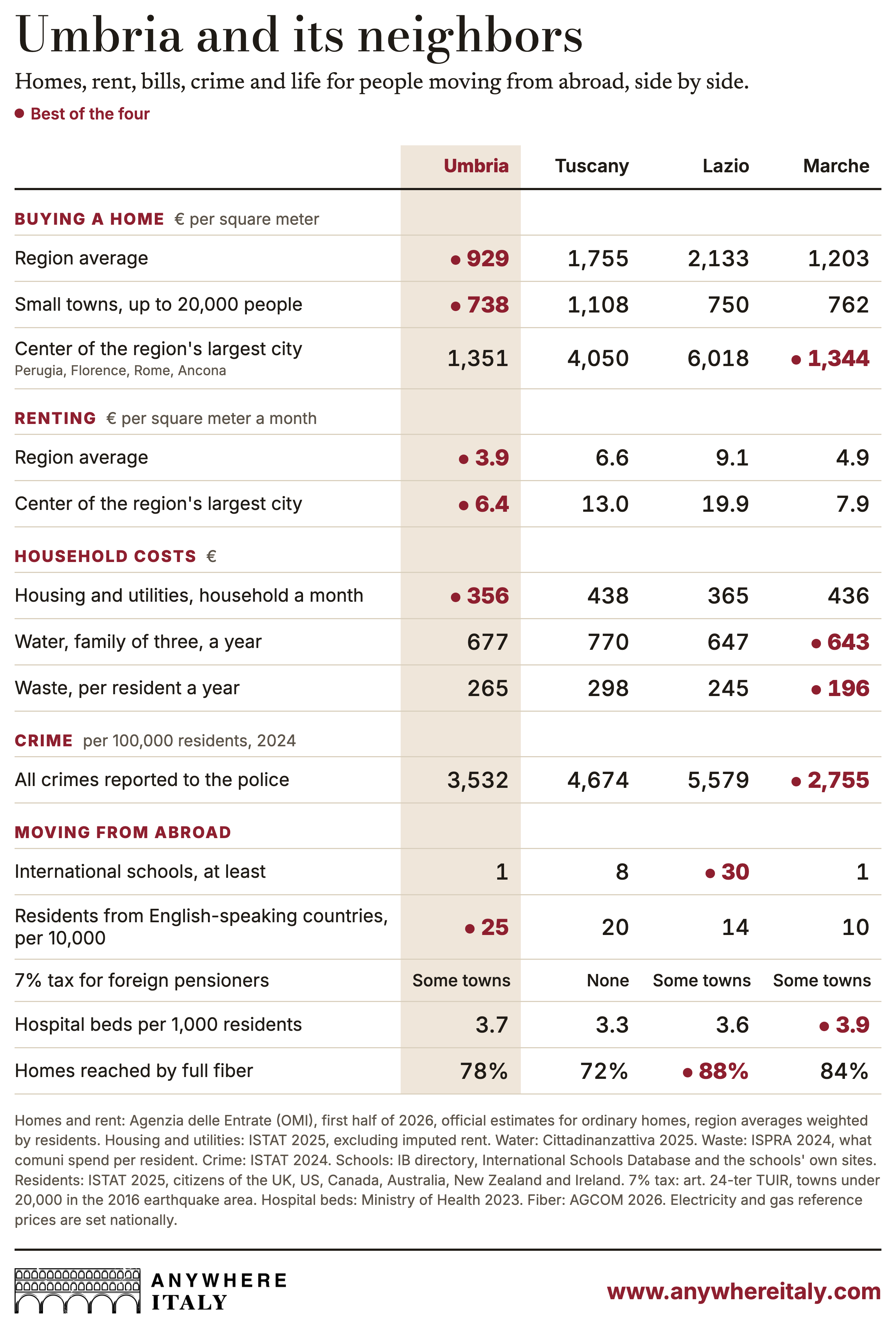
Umbria is surrounded by Marche from the east, Tuscany from the north-west, and Lazio from the south-west. Now, Lazio itself is a big distortion, because its regional capital is also the country’s capital, Rome, which hikes prices up to the sky. But the countryside of Lazio can be equivalent to Umbria in most figures.
From the figures, it is clear that Umbria is a much better deal than Tuscany, which I think we have all known or sensed by now. But what is surprising, at least to me, is that it leads over the somewhat newly popular Marche region as well. Of course, Marche has the Adriatic coast, and seaside always ramps up prices, but not that much, as you can see.
I think 200,000 EUR is a good figure because it is readily available to most expats and it is a median number most foreigners (and Italians) pay for a home in Italy. For that, Umbria gives you a 200m² villa, while Tuscany barely gives you a country house with 100m². In rent, it’s even wilder. I have friends who pay 500 EUR per month for a giant house in Umbria, inside a popular town’s center.
Simply put, Umbria is better. There are only three situations where it can be a compromise:
You want the sea. In Tuscany, even from deep inland, you can reach the sea in about an hour. In Umbria, due to its more rugged terrain, the coast needs a bit more driving: the Adriatic in Marche from the east, the Lazio coast from the south-west. And you clearly can’t pick a seaside home here, because Umbria has no sea access.
You have small kids. It depends on your preferences, as always, but most expats put their kids into international schools. Umbria has very few of those, mostly in the regional capital, Perugia. Also, I don’t know, but I imagine supporting services for kids are also scarcer in Umbria (nannies, staff, etc.).
You travel home often. Which means you want an international airport nearby. Perugia has one, but it almost always means a connection to a bigger hub. From southern Umbria, Rome Fiumicino is under two hours by car, but around Perugia it’s a long drive. I know this can be an issue for expats, because it was an issue for me, hence why I lived near Pisa airport and now Turin. Both of them are excellent for EU travel, and Milan is a short ride for global flights.
So that’s the price you pay for a better deal. I’ll put it bluntly: I think Umbria is the perfect place for people over 50. Kids mostly grown up. Career is quieter, or you are a pensioner anyway. You want a calm, relaxed Italian vibe, without mass tourism and crowds. And you don’t go home too often. In that case, Umbria is a better pick than anything in Tuscany, a hundred times over.
In the last weeks, I finished writing up my experiences there. All the towns worth visiting. To check the 48 towns I recommend in Umbria, visit my main site where each town has detailed data. To read the first-hand experiences, scroll down for the articles.
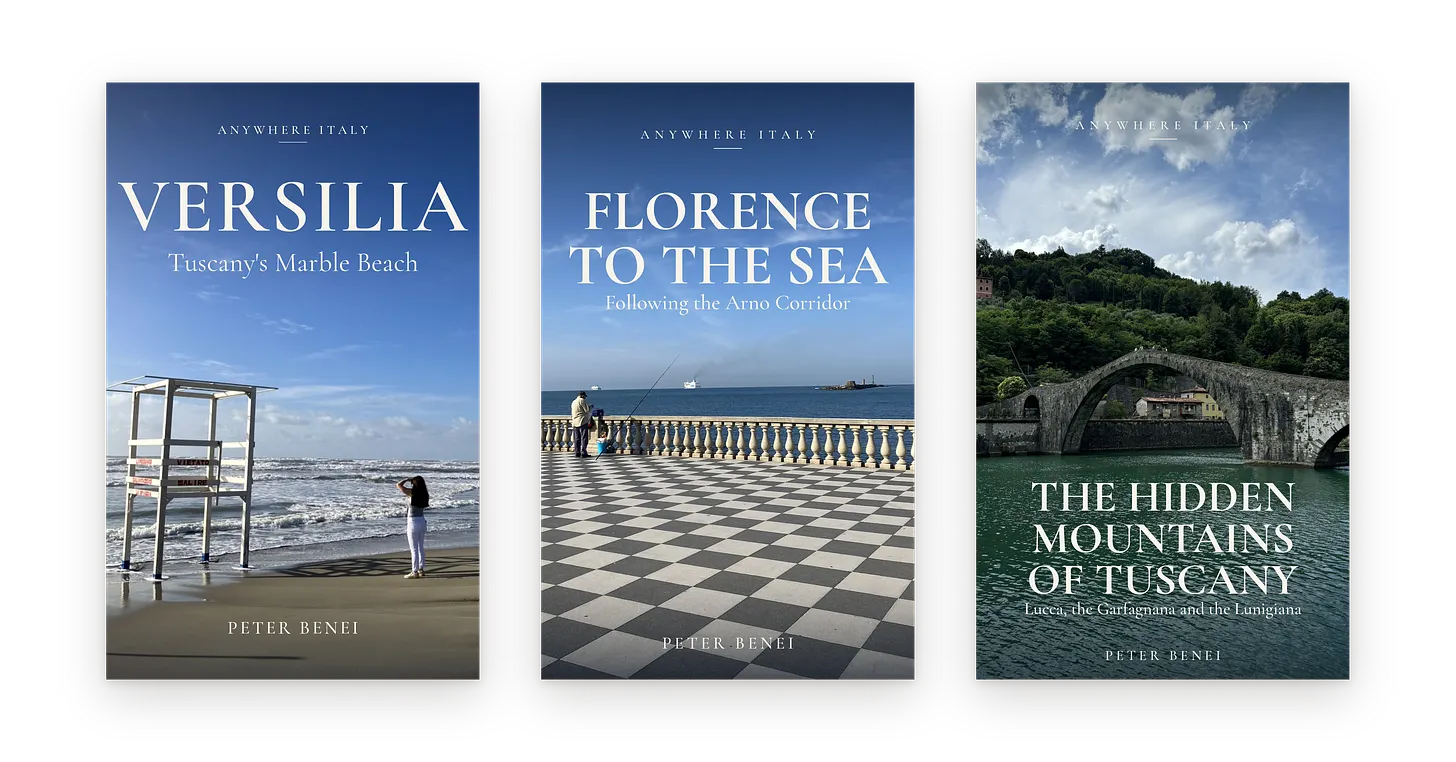
Everything I write is free for its first four weeks. After that, only paid readers can access all the guides and dispatches, as well as the books I write, like these three, and the ones still come.
To gain access, get the annual plan and pay 10% less, forever.
Updates of this week
The last piece went up this week for the Umbria guide: Gubbio.

And, once that was done, as usual, I combined all Umbrian articles into a guide. I’d recommend checking it out, as it gives you everything I have on this topic. It’s written mostly for travelers, but it gives great location ideas for expats too.

On top of these, I guess this week was more about food and cooking. Not a surprise: it’s all-out fall in Turin, the skies have turned gray, and it rained most days. At-home cooking peaks during these days. So I wrote about Calabria’s treasure, ‘nduja here, and launched a new side-series, cooking from old Italian books:

We still maintain our home in Pietrasanta. It was a rental with a six-month notice period, so we need to keep it until January. It’s quite an expensive seaside vacation home for us now. Never mind, at least we can use it as it is. So next week, we are going there for a few weeks. November was always one of my favorite months there. Everything is empty. Only locals stay. Perfect place to chill and reflect.
Alla prossima,
Peter
Turin, November 8, 2026
