

Hi, I’m Peter, and you’re reading Anywhere Italy. Our mission is to cover the 1,000 Italian towns most travelers skip, in person, one at a time. Come along for free, or pay to keep us on the road.
A few months ago, before I moved to Turin, I was still living in Tuscany, in Pietrasanta. I took a train from Turin to Viareggio, close to Pietrasanta. It turned out that the train was a night train, going from Turin to Reggio Calabria. Turin is full of people from the South.
So, I took my seat among a group of Calabrians. Various ages: a young dude studying at Turin’s Politecnico, a middle-aged lady, an old grandpa, a young mom, a couple, really, it was everyone. Within minutes of the train leaving the station, as if it were a ritual, a sign, or a mandatory exercise, every Calabrian pulled out their sandwiches.
Tinfoil crackling, boxes opening up, bags out. And the entire cabin smells of ‘nduja. And then, as if this weren’t enough, they started to show their ‘ndujas to each other. Even more, they started sharing them, tasting them, and talking about them as if they were ‘nduja sommeliers.
From what I could understand, the main theme of the conversation was the meat-to-fat ratio, and where they hang it up to cure. Some families do it in the attic, others in the wine cellar. They argued about which one is better.
It was a hilarious scene, and it reminded me of my weeks in Calabria. The spiciest, warmest, and friendliest people I have met. And this is Italy, where the bar is already high. Maybe it’s because of something else. Maybe it’s because of the extreme consumption of ‘nduja.
So let’s start with the basics.
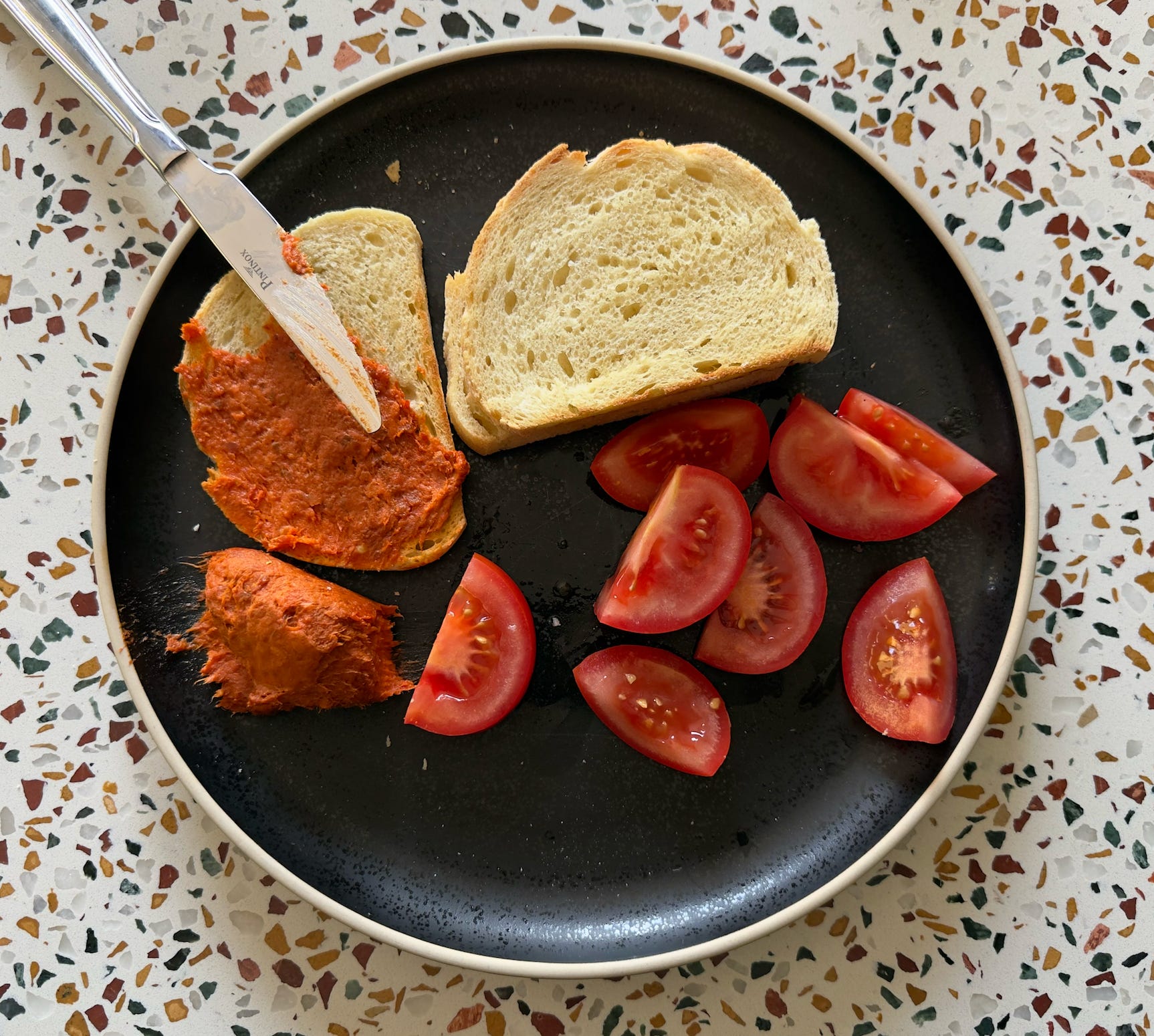
This is how I like to eat it. A very basic white bread that is not overpowering, with no extra cereals or anything fancy going on. It’s a carrier for the Main Thing. I sometimes toast it. If I toast it, I rub a garlic clove on it. Big, meaty tomatoes, the ones you would use to make sauce. Maybe onions from Tropea; they are red and very sweet. They should serve as a balance between the fat and the heat of the Main Thing. And then, the Main Thing, ‘nduja. Spread it generously. Another treat of mine is ‘nduja pasta. It’s also super simple: some pasta (the classic recipe calls for fileja), tomato sauce, garlic, oil, that’s it. Pecorino on top.

Everything I write is free for its first four weeks. After that, only paid readers can access all the guides and dispatches, as well as the books I write, like these three, and the ones still come.
To gain access, get the annual plan and pay 10% less, forever.
Calabrians eat it kind of the same way: fewer vegetables, more pecorino. A glass of local heavy red wine. There is also the scalda ‘nduja, or ‘nduja warmer, a terracotta dish. A small candle at the bottom, a small plate on top, and the ‘nduja melts into a salami sauce which you spread hot on your bread. The idea is that you sit around it with family or friends, and you’ll also see it in restaurants.
‘Nduja is in the long line of Italian foods which are connected to a town. I wrote about the Lardo of Colonnata, which is basically pig fat aged in marble basins, the Biroldo from Garfagnana, and there are many other examples, like the Porchetta from Ariccia or the Amatriciana pasta from Amatrice. ‘Nduja comes from Spilinga, a small town in Calabria. They have an annual festival celebrating it. Some state that ‘nduja is DOP/IGP protected, but nah, only the chilli in it has any sort of designation. And ‘nduja is made across the local area, in many other towns as well.
So there are three things that are interesting about ‘nduja, I think. Aside from the fact that it is awesome and I’m pretty much addicted to it.
The Hungarian connection
Coming out: I have never ever felt homesick. I have some problems with my home country, but I have never had any problems with my family or the area where I grew up. I miss them sometimes. But drop the names of the famous Hungarian kitchen staples, and I want to buy a plane ticket just to go home and do some shopping.
Luckily, almost all Hungarian food staples can be substituted with better alternatives from French and Italian cuisine. I buy better cottage cheese, sour cream, lard, and salamis in a random Italian grocery shop than anywhere in Hungary — sorry Hungarians. But, there’s one thing where it’s hard to get the real one, and it is the dry sausage, which we call simply as kolbász. If you’ve ever had Spanish chorizo, it’s pretty much 90% there; ours has even more paprika and garlic. Most of Italy never had this chorizo culture. Chorizo and Hungarian sausages are smoked and come with paprika. Italians use salt and simply air to cure their meats, the North especially.
There are only two places in Italy where you can get something similar to chorizo: the South in general, because they use chilli and pepper powder as part of the curing and preservation, and the Alpine areas. In South Tyrol and Friuli (both autonomous areas of Italy with very strong German and Austrian ties), you can find the classic smoked sausages, sometimes with paprika.
So for us Hungarians, some parts of Calabrian cooking, especially up in the mountains, are really close to home. Just look at ‘nduja! It comes with chilli (the hot cousin of our paprika), a mega amount of it to be precise, it is cured, raw, and full of fat. They eat it with the next town’s (Tropea) onions, and they drink the other next town’s hard red wine. It screams countryside Hungary.
Also, one other connection comes from how it’s made (traditionally). The rural butchering of the entire pig (in Hungarian: disznóvágás) is not really Italian, since the process is pretty much similar in every country. But what comes first and last is unique to every culture.
In every country, the butchering is done in the winter months, because you can take it easy and do it throughout the entire day. The meat won’t spoil due to hot weather. Also, in every country, this is a family event; sometimes even the entire street comes. The reason for it is simple: butcher a whole pig and put it in jars, basically. Or hang the meat in the attic.
But, as I said, what comes first and goes last differs by culture. The TL;DR version of a pig butchering is this. Oh, wait, I know this from? Yeah, so, I grew up in a small village in Hungary. In the 80s and 90s, this was a regular event every year…
The piggie is killed at dawn. The blood is saved for sausages or cooked immediately with lard. In Tuscany, they put cheese on it; in Calabria, it’s onion and chilli. In Hungary, we cook it with onions and sometimes with eggs. Breakfast of champions. I still miss this…
The pig’s bristles are removed. In Italy, it’s done with boiling water. In Hungary, we set it on fire, yeah. In Italy you smell steam. In Hungary you smell burnt skin. Nice.
In Italy, the pig is then hung and cut open. In Hungary, it’s the same, but we usually don’t hang it; it just lies on a big table. The intestines are washed with salt and vinegar.
A giant copper cauldron gets fired up, and people start cooking lard, the head, and other stuff in it. It’s the same in both cultures.
The big cuts are preserved first. Butchering techniques are different: Italians are more interested in meaty cuts, we are more interested in fatty cuts. Also, by the way, the traditional Hungarian pig, the mangalica, is a lard breed, and we seriously fatten our pigs up before butchering, while Italians breed theirs for meat and ham.
This is mainly because of how we use fat: while most of Italy nowadays uses olive oil for cooking, as France and Britain do with butter, Hungarian cooking is mostly lard-based. So we simply need more fat out of a butchering.
Some meat and the meaty leftovers get minced and stuffed back into the cleaned intestines. This is the sausage-making. As said above, we use different flavors and a different fat-to-meat ratio, plus we also put rice in some. This is where cultures have their own recipes.
At the end, what’s left over is the head, scraps, tail, etc., things that wouldn’t make it into a sausage. In Hungary, most of this ends up in disznósajt (pork cheese, literal translation; Brits might know it as brawn, Americans as head cheese): basically the scraps cooked, stuffed inside the stomach, pressed, then smoked. It’s a slice of heaven. The Scottish haggis is somewhat similar to this. In Italy, this either ends up in a similar product (the Tuscan version is basically the same but without paprika), or, in Calabria, in ‘nduja. But ‘nduja you don’t cook, you only smoke it lightly, and it’s more meaty-fatty.
The butchery ends with a feast. I have never eaten better meat, ever, than during these feasts. It’s so fresh that it is almost still alive.
‘Nduja nowadays is made without offal or cheaper meat scraps. Regulations, hygiene, and simply the fact that people run away if they hear “we put everything in it”. So it’s more proper meat and fat now. It’s more like a salami.
It’s called a salami, but it is not like most salami
Ok, what is salami? Salami is minced meat (pork mostly), salted, seasoned, stuffed into a casing, fermented, and cured. How is it seasoned? Up to your culture or preference. How hard or soft is it? Up to your culture or preference. How is it cured? Air, smoke, or something else? Up to your culture or preference.
‘Nduja is a salami by all standards. But when I say salami, you want to cut something. Or at least, that is how I think about it. If I eat salami, I go for a knife that can cut. It’s a blade.
But ‘nduja is more like a spread. It’s like butter, but made with pork fat instead of dairy. The best tool for that is a butter knife. You don’t cut into ‘nduja, you open it up and spread it out.
And this is where melting comes in. You don’t melt a salami. You melt butter. ‘Nduja screams and demands to be melted. And there is a tool for that, called the scalda ‘nduja (‘nduja warmer).
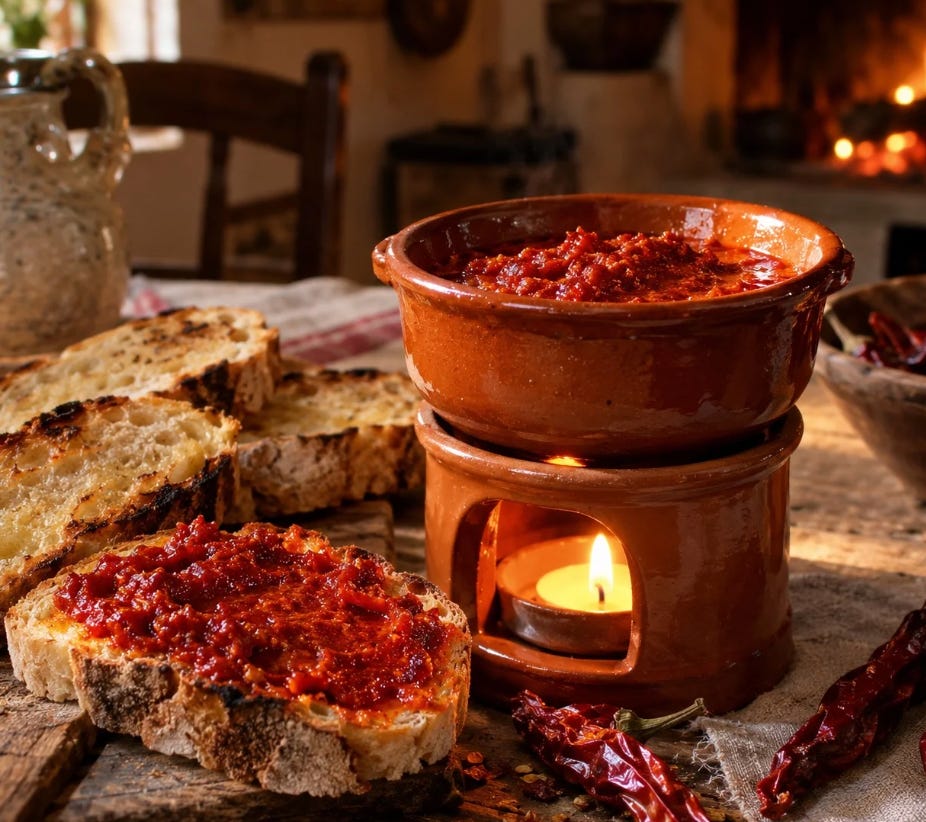
It’s controversial, because it has become more of a tourist thing, sold as a souvenir. I can’t confirm that Calabrians use it in real life. But I can confirm that ‘nduja demands melting. It’s simply better not to eat it straight out of the fridge: keep it at room temperature for half an hour, then eat it (much like butter), because it spreads better. And it’s creamy when melted. So this warming option makes sense. Sit around it, open a bottle of wine, have a big loaf of bread, and it becomes the perfect appetizer.
What I can confirm: Italians eat it with pasta. Every pasta dish is super simple, and ‘nduja pasta is no different: tomato base, garlic, oil, and a big spoon of ‘nduja, with a local pasta shape (fileja, but it works with almost any pasta), pecorino grated on top. It works because ‘nduja melts into the sauce.
I personally love this pasta, obviously. But it shows how ‘nduja is used as an ingredient, not as the main product. It’s basically spiced sausage and fat, so it works amazingly in stews (looking at you, Hungarians, gulyáskrém & pörköltkrém), or in anything that can be enriched by this flavor.
It’s part of the Calabrian identity
‘Nduja is not protected by any official designation. But the chilli that goes into it is: Peperoncino di Calabria is IGP. It is what makes ‘nduja spicy. Not just ‘nduja: try any other Calabrian sausage (dry ones as well), and you’ll see they are super red and super spicy.
Speaking of spicy, last week I bought a head-sized ‘nduja and a few pairs of dry Calabrian sausages at a farmers market in Turin. I knew I’d bought a good one, because it was only two guys, a son and his father, speaking Calabrese dialect, I did not get a proper invoice, I paid in cash, and they only had sausages, ‘nduja, pecorino, and dried peperoncino. I’m addicted to it, so even while writing this article, I had to get up, take a break, and eat some.
The Calabrian guys, by the way, told me that they had two kinds of sausages for sale: one spicy and the other extra spicy. Without hesitation, I pointed at the extra spicy, and the ‘nduja. They tried to explain what ‘nduja is, but I said, yeah, I know.
They were so happy that they tapped me on the shoulder, and I know it may be a sales trick, but I felt as if I were already part of their family. I know ‘nduja, so I know them.