

Hi, I’m Peter, and you’re reading Anywhere Italy. Our mission is to cover the 1,000 Italian towns most travelers skip, in person, one at a time. Come along for free, or pay to keep us on the road.
Let’s talk about recipes and food. As winter approaches, my wife and I are cooking a bit more at home. We don’t cook Italian that much, because it’s just so easy to eat out here. But when we do cook Italian, we go full, almost Tea Party level conservative with it. We do cook some modern Italian dishes, like carbonara (so new, it only entered kitchens after WW2), and others. But we prefer the old ones, especially the very regional ones from where we live. Which means a lot of Tuscan, Umbrian, Roman and Piedmontese dishes (we are learning the latter, as we’ve just moved to Turin).
So, Anywhere Italy won’t become a recipe or cooking blog, God forbid, but I wanted to feature some of the home cooking we do. And I wanted to do it in a special series, because structurally, I want to preserve Anywhere Italy as an expat and travel publication. But I know many of you enter Italy through its food, which is totally understandable. I’ll die on this hill: it is the best cuisine in the entire world.
This is also a publication I do because I have fun with it. The entire point, call me an egoist, is to be able to have fun. This is why most of my articles are overwritten, funny, and have too many anecdotes. So if there are going to be recipes here, they should not be ordinary recipes, but recipes with stories and roots in history.
Because of this, I picked 5 books from which I will cook from time to time.
Ippolito Cavalcanti | Cucina teorico-pratica, 1837
Giovanni Valardi | Trattato di cucina, 1854
Pellegrino Artusi | La scienza in cucina e l’arte di mangiar bene, 1891
Olindo Guerrini | L’arte di utilizzare gli avanzi della mensa, 1918
Ada Boni | Il talismano di felicitá, 1929
Apart from Artusi and Ada Boni’s super popular Talisman of Happiness, none of these are available in English. But it’s 2026, I use AI on a daily basis anyway, so I’ve got digital copies of all of them, gave them to my bot, and interpreting them should not be a problem.
Before I jump into introducing these five authors, I want to explain why them.
First, historic cooking is awesome, fun and traditional. Apart from Ada Boni, who is basically the Italian Julia Child and Martha Stewart, all of these books are more than a hundred years old.
Second, I wanted to cover many regions of Italy. I’m sure you’re bored of reading this by now, but there is no Italian cuisine. There is Tuscan, Roman, Umbrian, Neapolitan, Sicilian, and so on. There is upper-class cooking and there is poverty food. And there is the North and the South.
So these five names cover the North, the Centre and the South, the palace and the leftovers. In my humble opinion, that’s Italy.
The format, we will see. I’ll probably go to the grocery shop, buy a hero ingredient, and cook it different ways according to the books. Or I’ll just cook one flagship dish. Again, we will see. This is cooking, so it’s 200% experimentation and 500% fun.
So let’s see who these people are, so you’ll have a sense of what’s coming.

Everything I write is free for its first four weeks. After that, only paid readers can access all the guides and dispatches, as well as the books I write, like these three, and the ones still come.
To gain access, get the annual plan and pay 10% less, forever.
Ippolito Cavalcanti | Cucina teorico-pratica
It’s the oldest book on the list and the only one from the South, published in Naples in 1837. I have the second edition, from 1839, which adds a whole section on home cooking.
Cavalcanti was the Duke of Buonvicino, a small Calabrian town, beautiful, still exists. He was a well-off aristocrat in the Kingdom of Naples. And he was a bit bored, I guess. He explains in his own words why he wrote the book:
‘To amuse myself in idle moments I took up this pleasant occupation, and guided by simple principles learned through very long experience, I put together various precepts of gastronomy…”
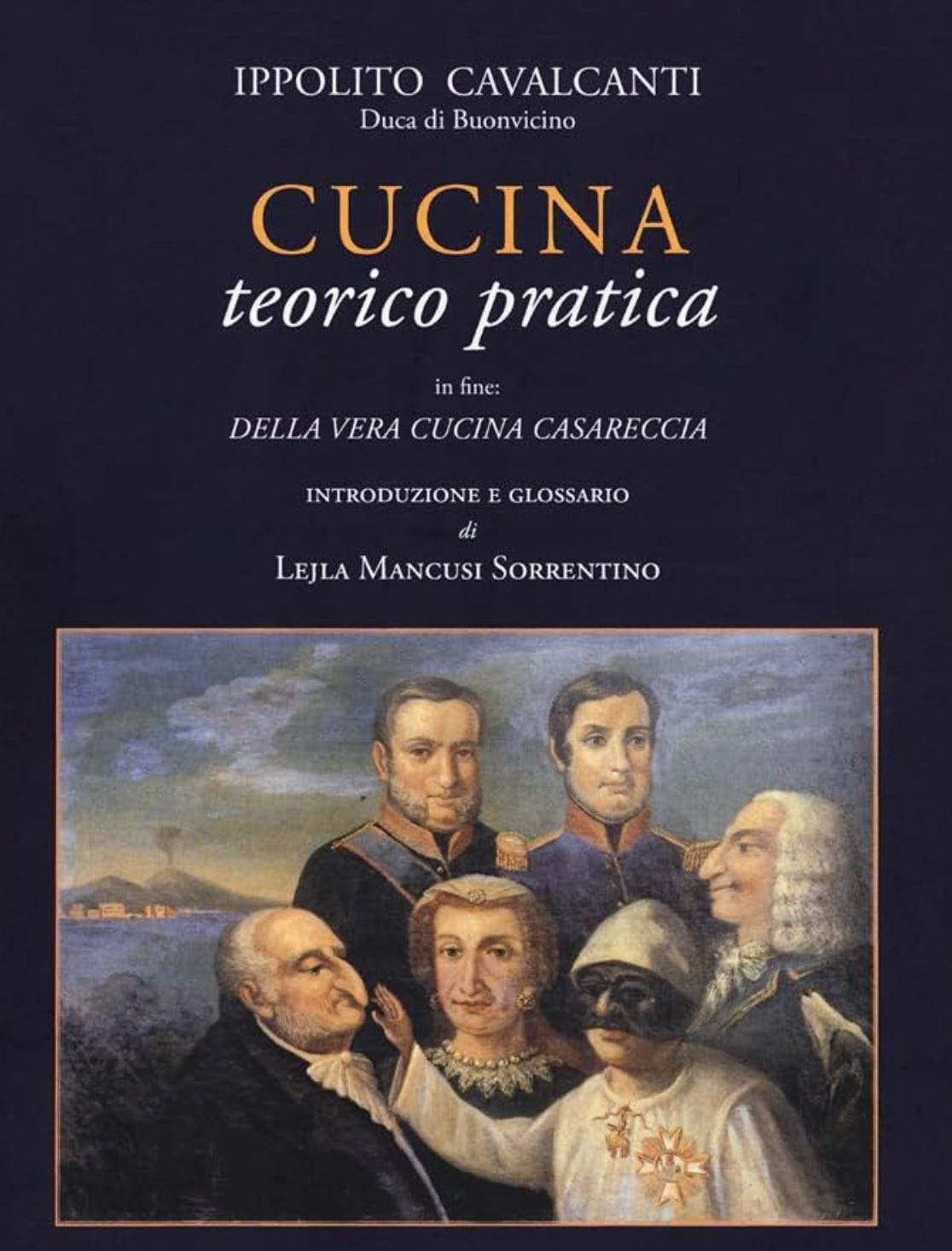
Now, don’t expect an aristocrat who picks up the pans and cooks. Most of the book is about how to run a kitchen: how to equip it, how to stock it, how to carve and serve, plus a menu of four dishes a day for an entire year. He was instructing his staff, not cooking by hand. It was a gentleman’s skill, like knowing your wine.
The second edition ends with a home cooking section written in full-blown Neapolitan dialect, so even if you know Italian, I don’t recommend reading it. My AI obviously helped a lot here. His reason for the dialect is the best part: literary Italian simply had no words for home cooking, and the dictionaries, he says, drove him mad. So he wrote it the way Naples said it. Bonus: his relatives complained that his year of menus had too much salt cod and cost too much, so he added a second year of menus, three dishes a day, “truly home-style.”
I included him for three reasons:
He is the South. No other book on my list deals with it.
His emphasis is on running a kitchen, not just cooking, and he is the only actual aristocrat on the list.
It has pasta, including one of the earliest printed recipes for pasta with tomato (made with lard, no garlic, no basil). Everyone associates pasta with Italy, which is fine, but traditionally, pasta came from the South and the Centre first.
Giovanni Vialardi | Trattato di cucina
Published in 1854 in Turin. He is the only professional cook on the list: cook and pastry chef to the Savoy kings at their court in Turin for nearly thirty years. Few people know him outside Piedmont.
Because of the Savoys and Turin, you’ll most likely scream now: “but it’s French cuisine!” Yeah, kinda, but Vialardi argued differently. He said Italians invented fine cooking, and that French princes and grandees brought Italian cooks to France, where they taught the French. The French just built better cooking schools out of it later, while Italy’s withered. And he said Italy could take back first place, because “no region of the world is better favoured by heaven.” I can argue with the first statement, and if you are French, you’re probably angry reading this, and I understand you. But I won’t argue with the second. When it comes to ingredients, Italy is truly above everyone.
One more important note: this is not only a haute cuisine book. Yes, Vialardi cooked for kings, but he wrote it as a teaching manual “for young cooks and amateurs of gastronomy,” and he even added a section of food for small children, dedicated to mothers. My reasons for including him:
I’ve just moved to Turin and honestly, this city is either about the Savoys or about FIAT. I love cars, sure, but to me the monarchy is 10X more interesting. Eating the local food is one way to know your town.
It’s a professional book written by a professional chef to teach young chefs, so it’s the most straightforward in language.
It’s not just Piedmont. It covers the whole Kingdom of Sardinia of the time: Piedmont, the Aosta Valley, Liguria, Nice (Italian until 1860) and Sardinia itself. And yes, it shows the French influence on Italian cooking. You think Italians cook everything with EVOO? Well, Turin is pretty much married to butter…
Pellegrino Artusi | La scienza in cucina
Published in 1891 in Florence by a silk merchant. As any rich man of his age (or any age, for that matter) would do, once he made his money, he retired to write. I’d be lying if I said I can’t relate. He wrote two books, a life of the poet Foscolo and a study of the letters of the poet Giusti. Both flopped. But he loved being around the kitchen, noticed that most cookbooks of his time were bad (“especially the Italian ones”), and wrote down recipes for his own use. Later he made a book out of them.
It was no overnight success. A professor friend read the manuscript and declared it “a book that will have little success.” Every publisher said no, and one offered him 200 lire if he gave up all his rights. So he printed 1,000 copies at his own risk, expecting a flop. He donated two copies to a charity fair in his hometown, Forlimpopoli, and the winners sold them to the tobacconist. Then the scientist Paolo Mantegazza praised the book in public and wished him a hundred editions. Artusi replied that two would do.
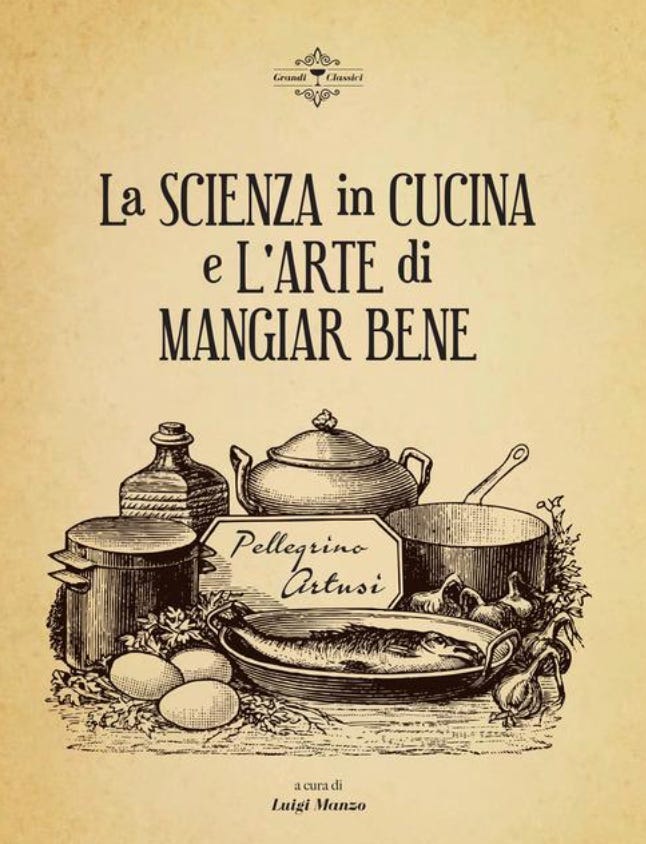
He was also an early crowdsourcer of content. Readers mailed in recipes, he tested them and added them to later editions, growing the book from 475 recipes to 790. He also wrote in national Italian, at a time when kitchens spoke dialect and French. The critic Piero Camporesi said the book did more to unify Italy than I Promessi Sposi, the national novel. It is still in print today, and every Italian knows “the Artusi.”
The only problem with his work is that it’s more like a guidebook for people who already work in a kitchen. He doesn’t explain how to make a soffritto, because he assumes whoever cooks knows the basics. So in a traditional sense, it’s not a recipe collection, and from the examples I’ve seen, it’s the hardest to replicate word for word. Also, he wrote for his own amusement. On some dishes he wrote pages. On others, two or three sentences, tops.
I added him because:
It’s the first national household cookbook of Italy and the best-known source among Italians. Fair warning: it’s heavy on Emilia-Romagna and Tuscany, and the South barely shows up. That’s what Cavalcanti is for.
It’s still in print. He lived to see 15 editions, and God knows how many there are today. Mantegazza wished him a hundred. Mantegazza won.
Heavily edited versions are in Italian kitchens today, expanding his advice into full recipes and guides. People still use it.
Olindo Guerrini | L’arte di utilizzare gli avanzi della mensa
Published in Rome in 1918. He was an intellectual who ran the University of Bologna’s library for nearly four decades, a poet (a scandalous one, under fake names), and a collector of cookbooks. Reading through his collection, he found a gap: nobody wrote properly about cooking with leftovers. So his book is all about what you can cook the day after the massive dinner, mostly from what’s left.
Why this topic? Two reasons. Italian dining is an institution, especially the way the upper middle class used to have their dinners. Cavalcanti writes every recipe for twelve people. This is hedonism at its best. But what happens the day after? You reuse the leftovers, as many Italians did. The other reason is that it’s popular anyway. We call it zero-waste cooking now. And let’s be honest, I cook maybe one big meal a week, and the rest of the week we eat the leftovers and “OK, what’s in the fridge?” items, prepared in any creative way.
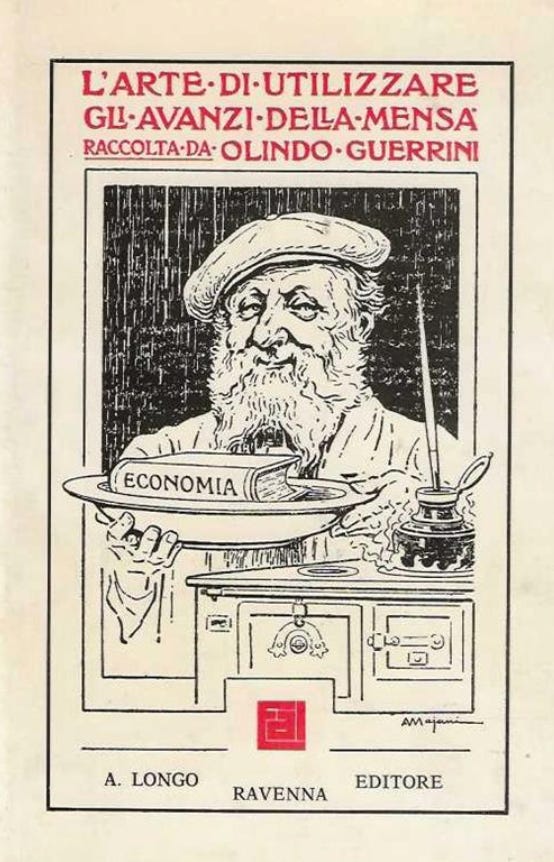
Guerrini knew Artusi, and Artusi told him to write the book. That’s not legend: Guerrini says so himself in the introduction. At lunch at Artusi’s home in Florence, “the good old man advised and encouraged me.” Guerrini died in 1916 and never saw his book in print.
I added this book for fun, to be honest. It’s an anthology: he went through his own cookbook collection, picked recipes and put them in his book, and he says so openly, “so that no one later calls me a plagiarist.” It’s all about creative cooking, which I like anyway. I’m sure only a few dishes will be cooked from this one, but I wanted it as a source.
Ada Boni | Il talismano della felicità
The 1929 original, published in Rome. As a source, I’ll use two versions: the original and the latest updated edition. Why both? Because her book changed with Italy. Later editions picked up dishes, carbonara among them, that didn’t exist in 1929.
Ada Boni is the Italian version of every country’s mamma who wrote the cookbook every housewife uses. The Italian Julia Child or Martha Stewart or Nigella Lawson. Every country has someone like her. In Italy, the Talismano was handed to almost every newlywed bride as a gift. It’s in almost every household, and it’s the one you pick up when you want that “nonna cooking.” It is basically the Italian version of The Joy of Cooking.
She ran a magazine and a cooking school in Rome, had a radio show, wrote many editions of this book and plenty of others, and overall, she was very popular. An English version appeared in 1950, but it was heavily abridged. The first complete English translation only came out last year, in October 2025. Here is the NYT article on the book.
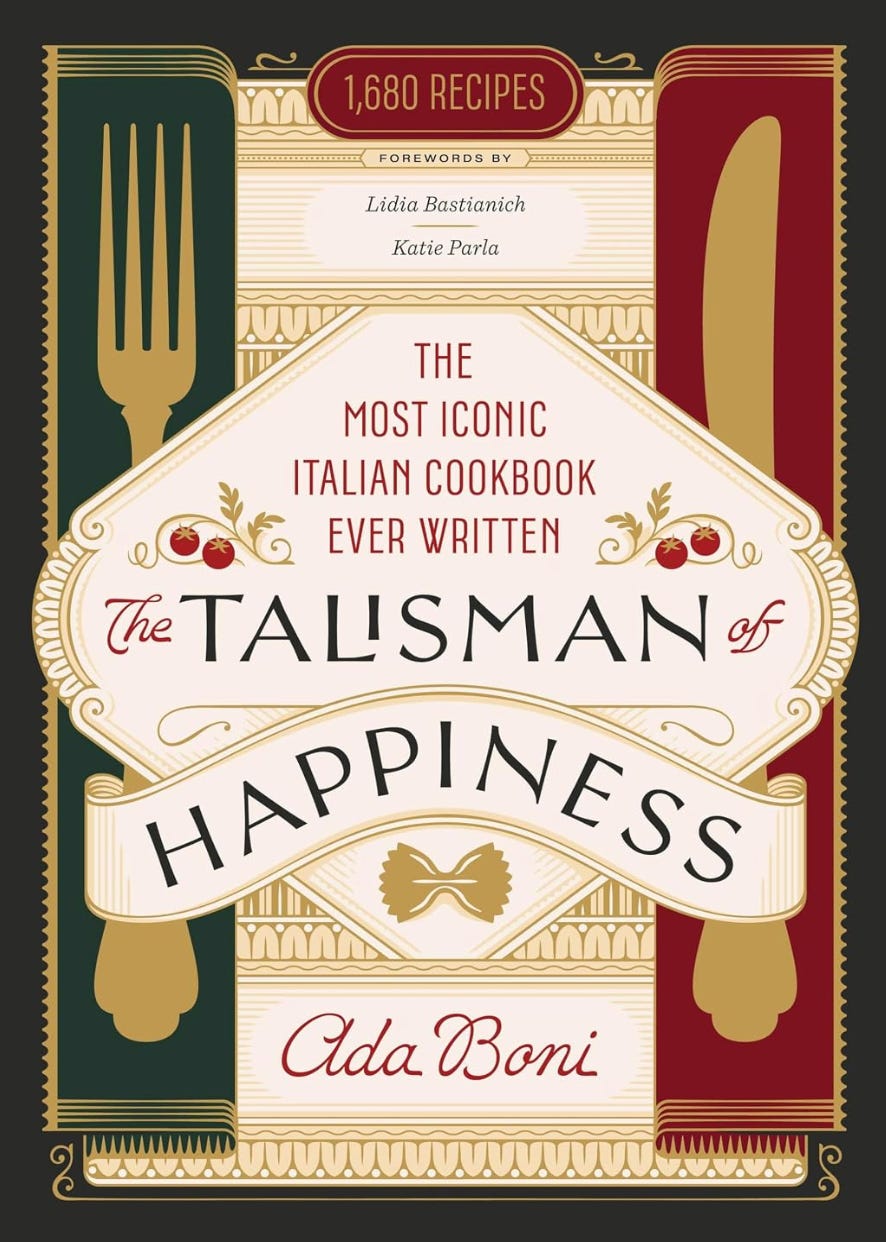
Rather tasteless book cover, if you ask me, but it’s here and available. Here you can buy it on Amazon.
I wanted to add her because sometimes you just want to cook something that’s on the menu of every Italian restaurant. It’s also the only modern book here, at least in its later editions. It’s the most popular, and the best known outside Italy. It’s kinda basic compared to the other books, but it’s an authentic basic.
One last note, why cookbooks? Why not just wing it?
For two reasons. One, I’m trying to be very respectful of Italian cuisine, because I know it matters to Italians. It also matters to me, because I firmly believe some things don’t need reinvention, only improvement, and once something is perfected, doing anything further to it just ruins it. Traditions are important to me as a person in general, and I think they’re important in the kitchen as well. I say this after visiting 100+ haute cuisine fine dining restaurants. Frankly, fine dining is great, but I default to my local trattoria, any time, for any occasion.
Two, when you interpret a cuisine, you have to be as conservative as you can. I became this way after traveling through endless countries.
This might upset a couple of people, but there is a thing about a nation’s cuisine when it’s cooked by and for people of other nations. I think a national cuisine only works abroad if there’s a solid immigrant base from that nation in the new country. The best Italian restaurants in the USA are visited by first- or second-generation Italians. The best Indian or Chinese restaurants in London are run and visited by the local Indian and Chinese communities. In other words: Olive Garden is as Italian as McDonald’s.
And there is nothing wrong with this, by the way. Most cuisines abroad tailor their flavors to the host country’s taste buds. But it’s a simple fact that most international versions have nothing to do with the originals. And Italian food is the easiest to get wrong, because most dishes work with five ingredients, and oil and salt are two of those five. So my advice: if you want to eat Italian, eat real Italian. And to eat or cook real Italian, use real Italian recipes.
The clearest example is sushi: raw fish on rice. Because it’s so simple, it’s everywhere. There’s a sushi place just around your corner too, I bet. And precisely because it’s so simple, it’s so easy to mess up. Visit Japan once, and you will never eat sushi the same way again. I know I didn’t.