


Hi, I’m Peter, and you’re reading Anywhere Italy. Our mission is to cover the 1,000 Italian towns most travelers skip, in person, one at a time. Come along for free, or pay to keep us on the road.
This article is part of a series that helps those who are considering moving to Italy for the longer term, but are not quite sure where. For more information about the series, my POV, and to read the overall intro (it is important!), start from the first part.

For tracking, here are the other parts (will be links once all of them are written):
Part 3 - The city
Part 4 - The postcard
Part 5 - The other half
Part 6 - The Best Towns
The city
In other parts of this series, this is where I start with an article that serves as proof and/or an example of my experiences. I don’t have one for this type of location, simply because I either lived in a big city (Rome, Florence, Verona), which will be covered in the next part, or I lived in a small town, which was covered in the previous part. But I’ve spent years near the type of cities I am going to talk about now. Some examples that I have already covered: Lucca, Arezzo, Livorno, Siena, Pisa, Viterbo, and many more will come. Also, it was truly just a chance or luck that we ended up in Pietrasanta, and not in Treviso, we almost bought an apartment there.
So when I say city, what do I mean? Because in the next part of this series, we will talk about the postcard, which is mostly the big names that we all know and visit for travel (Rome, Florence, Naples, Venice, etc.). Where is the line between a city and a postcard?
This is not a geography or demography classroom, so the way I segmented my parts is simply based on the experience of living in these places, not on actual terms. In Italy, you have 3 tiers of administration: the national level (Rome as the capital), the regional level (Florence, for example, Tuscany’s regional capital), and the provincial level (Lucca, for example, serving as the capital of Lucca province). Some regional capitals are also provincial capitals. A province is basically an administrative area surrounding a local city. So when I say city, the closest accurate term I can give you is the provincial capital. Not the regional one. Those are mostly postcards (though I’m not sure any tourists visit or even know which city is the regional capital of, let’s say, Basilicata or Calabria, no offense to people living there).
So, provincial capitals mostly. Lucca, Pisa, Arezzo, Forlì, Grosseto, Massa, Padua, Ravenna, Rimini, Trapani, these are all provincial capitals. As of today, Italy has over 100 of them. Plus, add some other equivalently sized and important cities that somehow didn’t make it (Carrara, for example, is not a provincial capital, but it’s equally important and right next to Massa; also, Viareggio is a sizeable port city, but still, it is part of Lucca province). Anyway, you get the picture. Let’s say there are about 200-300 cities we are talking about here.
In the previous part of the series, I said that the small town is the closest to your dreams. If you have lived in a smaller town before, moving to an Italian small town will be something like moving to Paradise, but with an ID card. In the part before that, the end of the road, I said that the dream of the Tuscan villa in the countryside, or the stone house in the medieval borgo, couldn’t be farther from reality. I would recommend it only to a select few, who are super into renovation, or who are looking for extreme isolation and a deeper connection with mama nature.
The city is different. In the previous two cases, there were gaps between dreams and reality. In the city, I think, most people don’t even have a dream. If I say living in an Italian city, most of you think about living in Rome, Florence, or Bologna. But these are postcards, and we will talk about them in the next chapter. A provincial capital is different.
I need an example city for this explanation, as it will be easier for both of us. Let’s pick a very obvious one, one that almost everyone knows, and I am sure it is on the map for most of you anyway: Pisa.

Pisa has its own province. It’s mostly the lower valley of the Arno river, from the edge of Florence’s province to the sea, plus a bit of the southern edges of this valley, right until you reach the next provinces, such as the province of Livorno. Pisa province pulls in around 420,000 people, and the city of Pisa itself has around 90,000 inhabitants. This is really fluid, since Pisa’s university, one of the oldest in Europe, has a popular international program, so the city is filled with students who stay only for months. I would say it is safe to say that Pisa has around 150K people.
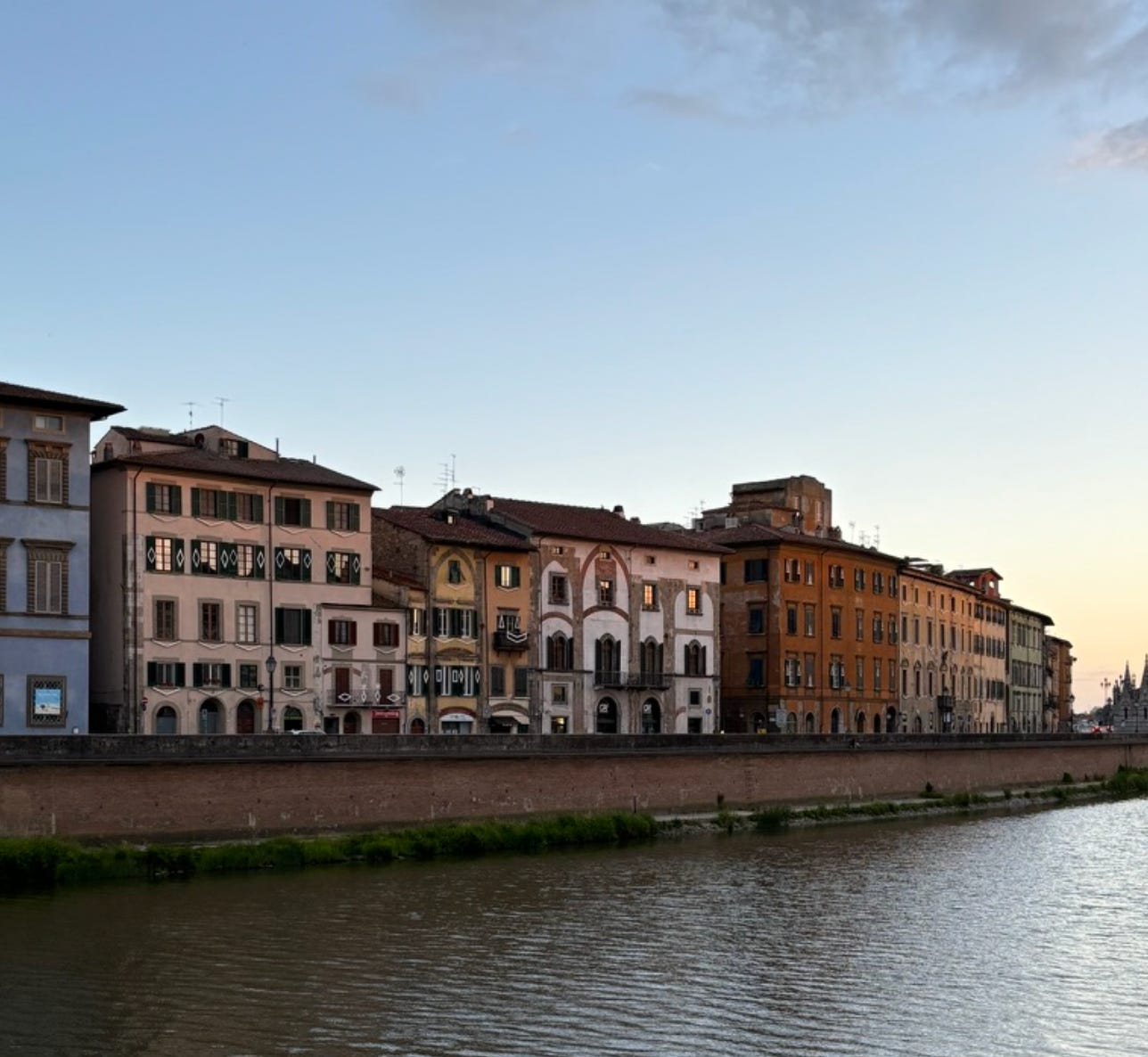
Pisa also has a landmark, you might have heard of it: the tower. The surrounding towns are equally great. Though most people who come on day trips have no idea about these towns, as they only want a selfie with the tower and move on. But in case anyone’s interested, San Miniato has amazing truffles, Pontadera has the Vespa Museum, San Giuliano Terme has Bagni di Pisa, a thermal bath, and some of the famous towns in postcard-countryside-Tuscany, also belong to Pisa, like Volterra. And there is also Marina di Pisa, which is Pisa’s seaport and resort town. The province is 1 hour from Florence, connected to all of Italy by train, has an international airport, and is 30 minutes from amazing areas like the Apuan Alps, Lucca, and Versilia, Tuscany’s marble-luxury stretch of beach, where I lived for years.
I can’t count how many times I’ve been to Pisa, since all our friends who visited us in Versilia wanted to see the tower first. After around the 5th visit, I sat down in a bar on the other side of the Arno and told my friends to find me there once they were done with Disneyland, but no, I’m not going to see that thing again, with all the selfie-tourists who have zero idea what they are photographing. The other side of the Arno (the south side) is better anyway, as it belongs mostly to the locals.
By the way here is a guide on the entire Arno corridor for you:

But enough of Pisa, you get the picture. What is it like to live there?
If a provincial capital has a landmark that is popular with tourists, you have to prepare yourself. In the next chapter, we will talk about tourists generally and how to avoid them, because you have to avoid them like the plague, sorry. But most provincial capitals, aka cities, have no landmark that pulls mass tourism. Yes, Pisa has the tower, which makes its north end a bit crowded (it’s the cathedral’s bell tower, sitting in the far northwest corner of the old city walls, far from the river). But almost no tourists venture into the actual city. Tourists are… well… not that complicated. They think they saw Pisa, but almost none of them actually saw the city. So avoiding them is kinda easy: just go south of the river.
If a provincial capital has no landmark, but it is close to a postcard city, it depends. As I said, most tourists are not that complicated, so in most cases, you are in the green zone. Treviso (which is a provincial capital) is 30 minutes from Venice and also has similar but smaller canals and an amazing historic center. Chioggia is part of Venice’s province, at the southern end of the lagoon, with the same kind of canals, about half an hour from the Grand Canal. Both of them are almost unknown to international tourists (but popular with Italians).
In this series, I usually share some GOOD vs BAD examples. Not here. It all depends on which city you pick and what your preferences are. There are no universal black-and-white cases here. But there are some universal tips that I can share so you can pick the best city that matches your needs.
First, decide if you want a city, or if a small town is enough. In most cases, I believe a small town is enough. It has enough things to do for most people, and if you need some extra service or you want to go shopping or whatever, you go to the provincial capital. This is how we ended up in Pisa most of the time: services, shopping, or a cultural event, etc. It was a quick drive, totally fine to do once a month.
If you are more social, or you want more expats around you, or you really do enjoy the buzz of a city, go for it. Try to live in the center; otherwise, what’s the point? Most of these cities have local public transportation, sure, but never forget that this is Italy. Sometimes it just doesn’t work. So the car is still your best friend. If you are in the suburbs of a city, you could be living in a proper small town instead, with real life in it, not just people sleeping there. So, my advice: if you want a city, be in a city. Do it properly.
Second, look at the economics. I know, not many people do this. I do it all the time. What kind of businesses are in the city? Are there HQs there? Manufacturing? Offices? For example, Pisa, aside from some manufacturing businesses, is mostly a cultural & university town. Half of the city either works for the government or studies there.
Treviso, on the other hand, different region (Veneto), is home to ceramics, textiles, and small appliances. You’ve heard of most of them: De’Longhi, Benetton, Geox, Pasta Zara, Stefanel, and these are just the brands that come from Treviso and its province, there are also plants for Osram, Sisley, and others. Also, Treviso is surrounded by famous agricultural land, which produces the protected denomination of, you might have heard of it, Prosecco.
What does it tell you? It tells me, without visiting the city, just by looking at Wikipedia, that if I had to pick Pisa or Treviso, I would hands-down pick Treviso. Everyone has a job, because they work in manufacturing, agriculture, or offices. The city is rich from the taxes of these companies that keep their HQs there. The city’s brands are also exporting globally. Most of the brands I have told you about, you’ve known them. Oh, and the city is 30 minutes from Venice, it has an international airport which serves as the cheap alternative to Venice’s Marco Polo, it is close to the motorways that go down to Bologna and Milan, and finally, this is where I win: tiramisu was invented here (well, Treviso claims it, and Friuli disagrees). What the heck more do you want?
Meanwhile, Pisa is mostly on government pay, kept afloat only by its university, its tower, and its long-gone glory. If you aimlessly wander around the two cities, you can see it. Pisa looks like the capital of a kingdom that was a thing 500 years ago, which is also pretty much when most of its buildings last saw some renovation. It is glorious and pretty, amazing to visit and stroll around. But would you want to live there? Treviso, on the other hand, looks like a city that still bankrolls kingdoms. Everything is modern, new, renovated, while the medieval glory of the town is all kept. For a tourist, Pisa is the choice. For someone who is looking for a life well spent, Treviso wins.
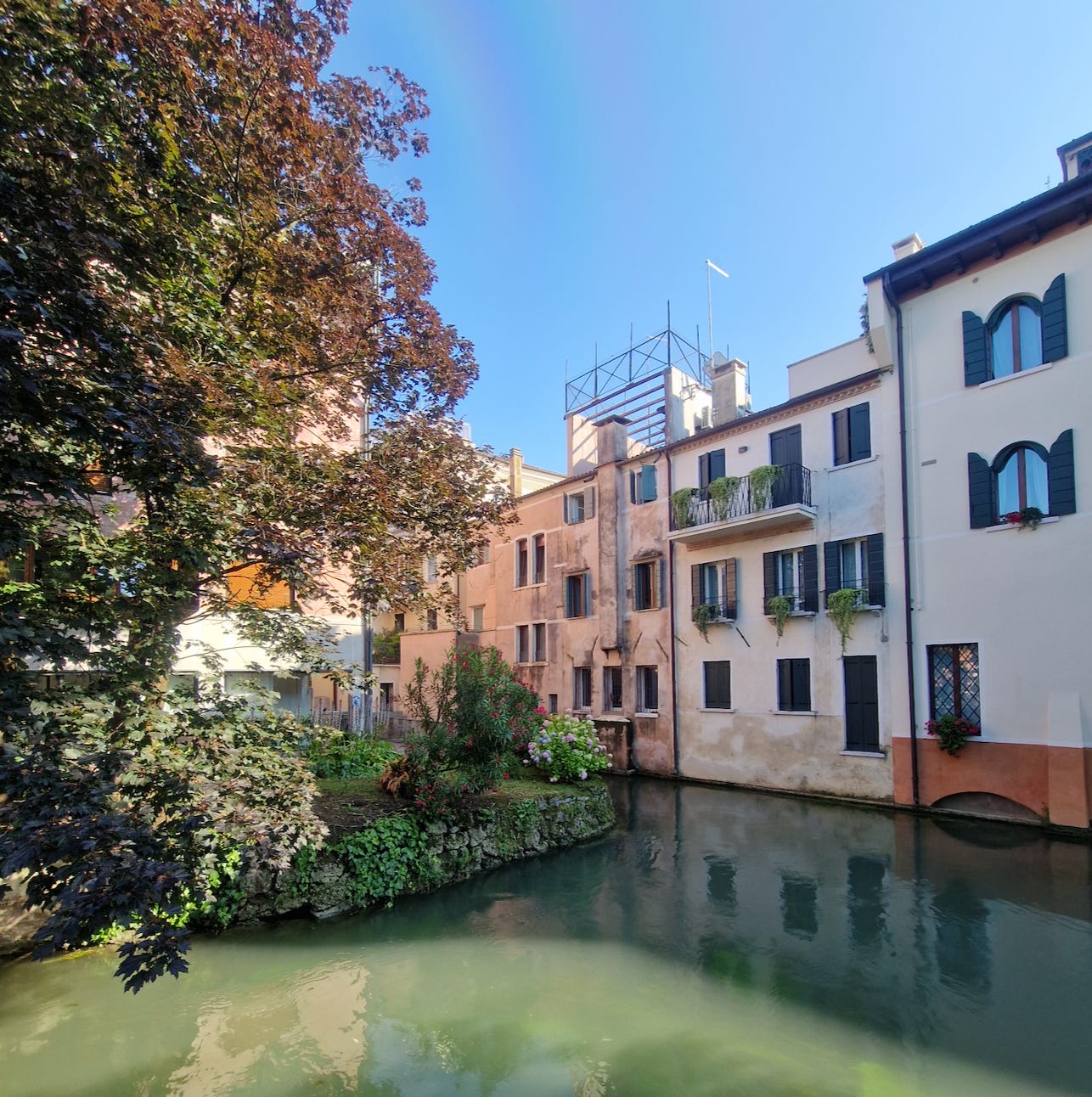
I know this was an extreme example, and people of Treviso and Pisa, please forgive me for this, I know it is not that simple. But it illustrates my point: do your research and trust the numbers. Because the richer a city is, the more likely it has better services. And that is why you pick a city and not a small town. And again, these are just two examples. I could have picked, let’s say, Isernia (Molise) vs Vicenza (Veneto) as well. Two cities, two fundamentally different experiences.
Third, sometimes a regional capital is a better answer. Not in all cases. This is where the line blurs between a city and a postcard. Trieste is a very good example, but also Perugia. But why the heck not, Turin can be a good example as well, where I live now. Turin might be a bit of an overkill, as it has around 1M souls, but it is one of the most overlooked cities in Italy, with next to no mass tourism. You get a city that caters to 2.2M people if you add in the province, with all of the services, options, events, and things to do, without the distraction of mass tourism. But for the sake of the argument, let’s use Perugia and Trieste.
Perugia (Umbria) and Trieste (Friuli-Venezia Giulia) are great examples. They are sort of equally sized. Totally different experiences: Trieste is a port town with Habsburg-Austrian heritage, basically Vienna by the sea, and it’s also the North, so things do work properly, while Perugia is an Umbrian fortress town, zero sea access, maxed-out elevation, kinda like a fortified castle on a hill, which is a technically correct framing.
They are regional capitals and almost totally unknown to mass tourism. Yes, they are both popular for their own events, and they both have their own fan clubs, but almost no one flies over an ocean to see Trieste. Which means these cities are still super local. In Friuli, the other provincial capitals are Gorizia, Udine, and Pordenone. In Umbria, the other one is Terni. If I had to pick within these regions, I would pick the regional capitals, without hesitation. Everything happens there. But in Tuscany, would I pick Florence? No, of course not, it is a postcard city, one of the most popular ones, and avoiding the tourists there is almost impossible.
Lastly, learn your history. I think history is a good way to connect to a city, and most of the cities have thousands of years of history. Also, never forget, you are in Italy. Technically it is a nation-state with Rome as its capital. But in reality, it is still a collection of city-states that pretend they are part of a nation. Ask a Florentine what they think of Rome. Or even better, a Genoese. Or even much better, someone from Sicily! LOL. That will be the best.
You are going to move to one of these cities, which has a longer history of being a local powerhouse than most countries on this planet. Learning this history helps you connect with the locals, with the architecture, and with the streets of the city. Most of the learnings can happen in advance. The Internet mostly a horrible place, but it can be super useful.
Also, these are cities, so a trial run is easy to do. I’ve mentioned this in the end of the road part, that if you can, before you make a move, try out the place. Live there for a few weeks. In a city, you have endless options. You can even do this living in a hotel if you want, and there’s no need to do it for a month. Visit the city, spend a week or two there. Feel it. If something clicks, you know you are in a good place. I did this in many cities. Some of them became candidates for a move, while I discarded others, because something was a bit off. That is totally fine.
On the main site of Anywhere Italy, I collected the 1,000 hidden towns of Italy. Small towns, but some of them are bigger ones, provincial capitals, cities like the ones we were discussing here. I track a multitude of data points for most of them, from schools, trains, landmarks, festivals, restaurants, hotels, and many more. All of it is free to browse.
On top of that, I filtered them into an all-time best-of-the-best list. The 100. Have a look. They are the best ones based on my absolutely personal selection.