

Hi, I’m Peter, and you’re reading Anywhere Italy. Our mission is to cover the 1,000 Italian towns most travelers skip, in person, one at a time. Come along for free, or pay to keep us on the road.
This article is part of a series that helps those who are considering moving to Italy for the longer term, but are not quite sure where. For more information about the series, my POV, and to read the overall intro (it is important!), start from the first part.

For tracking, here are the other parts (will be links once all of them are written):
Part 2 - The small town
Part 3 - The city
Part 4 - The postcard
Part 5 - The other half
Part 6 - The Best Towns
The small town
I lived in Pietrasanta for three years. I covered some of the experinces here:

There is a reason why I made this segmentation: end of the road, small town, city, postcard, the other half. It is because within these segments we can see fundamental differences in experiences.
I covered the end of the road before, and the main takeaway was that it is where the gap between dream and reality is the widest. Everyone wants to live in a Tuscan villa under the cypress trees. And everyone wants to live in a small medieval borgo in the Italian mountains. And I get it. You might even have had a vacation there, and it was the most magical thing you ever had, and you cried out once: OMG, I can imagine us living here! But… and I promise I won’t overuse this phrase this time: there are galaxies between visiting a place and living in a place. At the end of the road, this gap is the widest of all the options.
Now, in a small town, I think this is where the dream is closest to reality. In later parts of this series, you’ll see that a city can surprise you; you didn’t even imagine that you could love living there. A postcard, on the other hand, which is what I call the well-known places in Italy (Rome, Florence, Amalfi, etc.), can also be a disappointment, but in a very different way than the end of the road. But a small town… a small town can be the closest to the dream.
What is the dream? I can tell you, because we are not that different. I had the same dream. My dream was to live an extremely slow life in a small Italian town. Live in a modern or modernized apartment, close to the center. The town should have a longer history than most countries on this planet. A hint of Michelangelo wouldn’t hurt. The piazza should have a minimum of one old church, and a minimum of 3 bars, so I can rotate which part of the piazza I want to look at. The town also has to have a minimum of 10 restaurants, so I won’t get bored with the same food. This town should be either by the sea, because hello, this is Italy, or in a very Italian landscape (you know, the cypress trees and such). I also had a rule in the dream that life is not worth living if you can’t see at least one palm tree where you live.
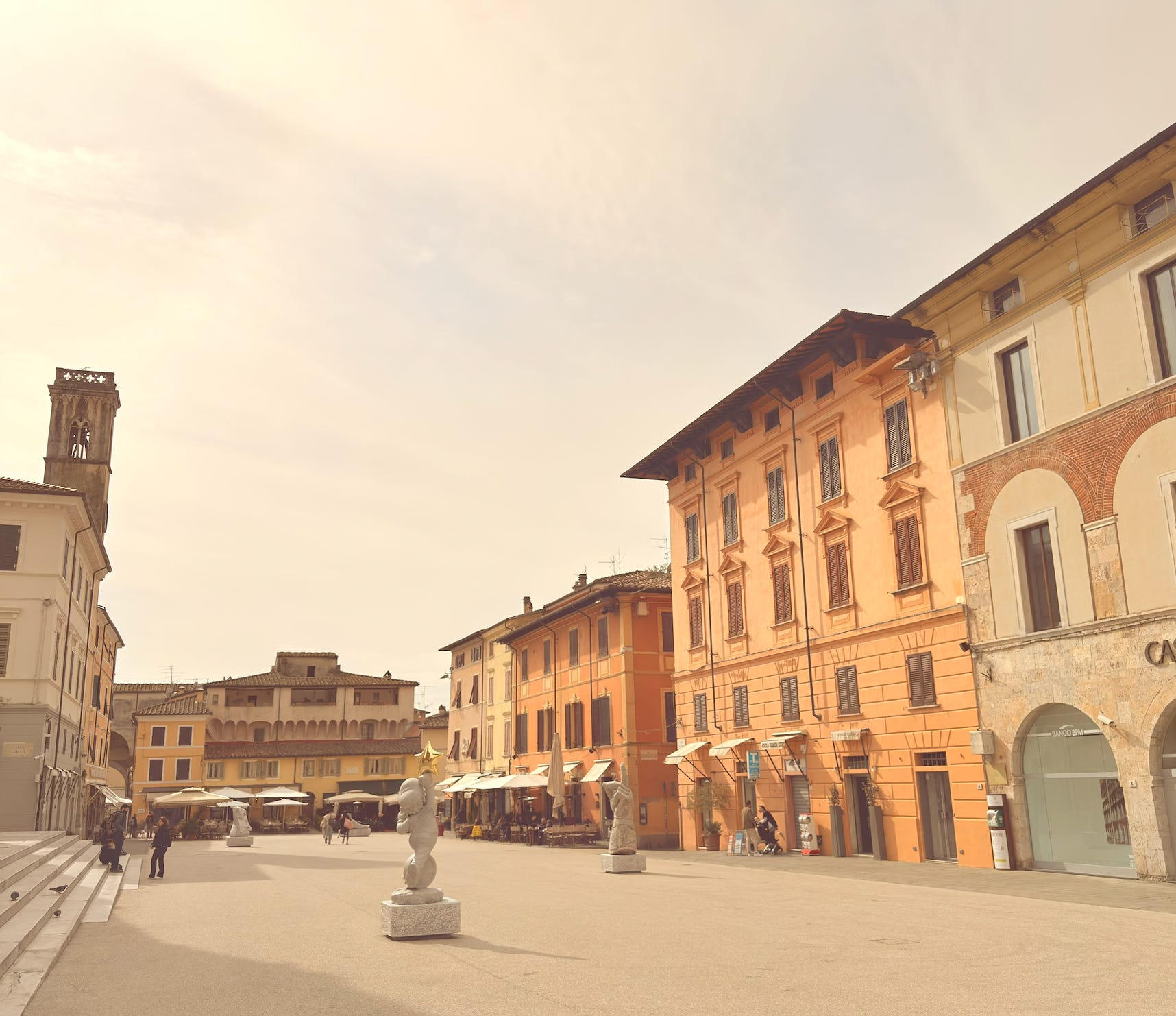
You think I am joking, but no, I am not. And to make things even worse, the years living in Pietrasanta were 100% like this. Our apartment was in a modern condominium, so we had none of the horrors I detailed in the previous chapter of this series. Our condo wasn’t inside the town of Pietrasanta, but on the Marina, which was a 5-minute drive from the town. In return, we lived on the main piazza of the local village, called Tonfano. The sea was literally a 5-minute walk from my door. We had 3 bars (Margherita, Cervetti, and Café Versilia), and around 10 restaurants, though most of them were closed during the off-season. The Marina was also kinda deserted during the off-season. But! The town of Pietrasanta was always open and had plenty going on. On its main piazza, it had more than just 3 bars (and 2 churches). There was a hint of Michelangelo (he spent time there because of the marble quarries of the Apuan Alps), and one of the bars was named after him. And we obviously had many palm trees.
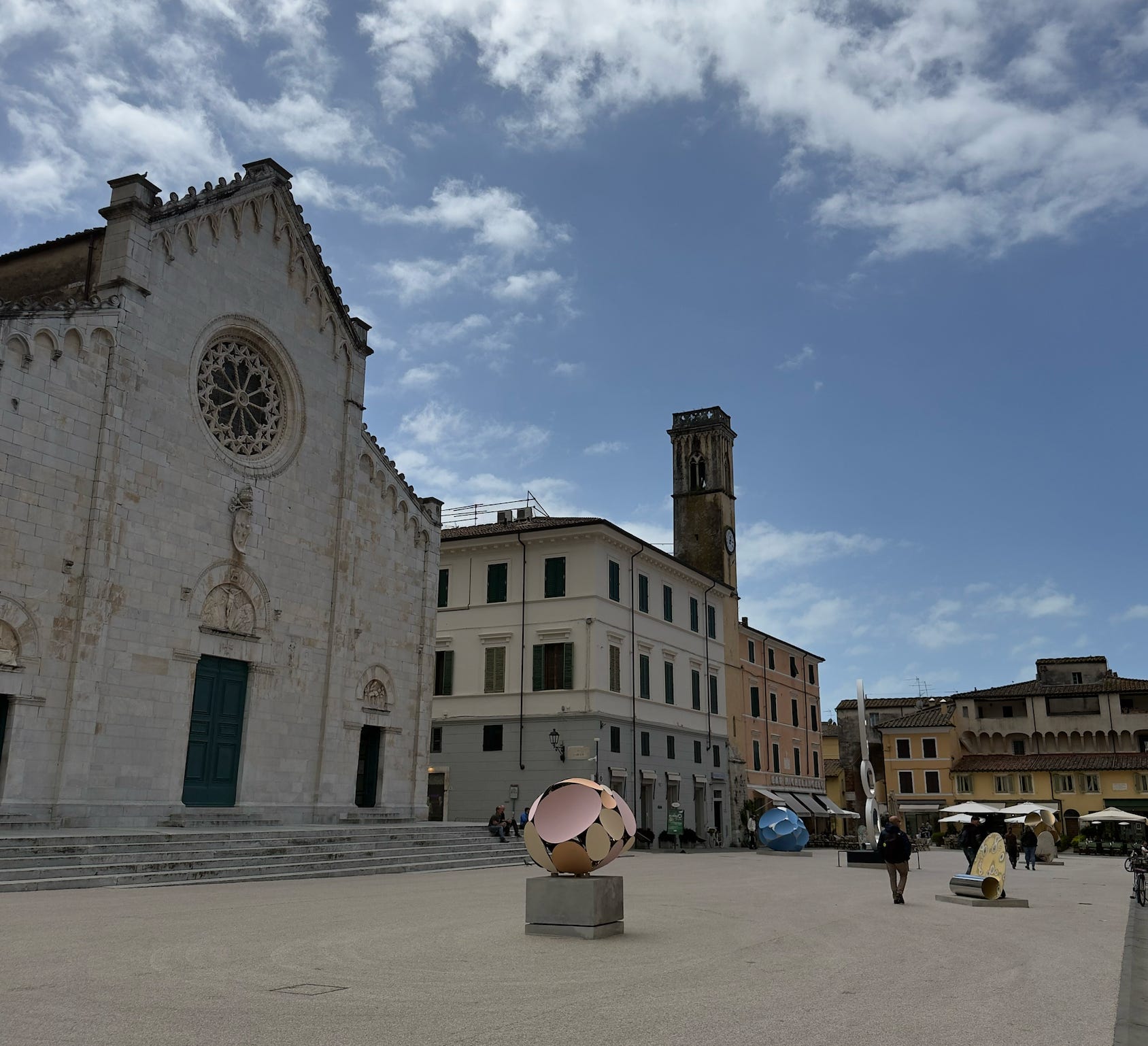
To make things even better, Pietrasanta was, and still is, in an ideal location: Pisa is just a 30-minute drive, and it is a proper city, with an international airport. Lucca is also 30 minutes, kinda like Pisa but without the floods of tourists. Cinque Terre and the beaches of Liguria were also an hour’s drive. Mainland Tuscany, with Florence and Siena, is 1.5 hours. The mountains of the Apuan Alps are 30 minutes. But if you don’t want to change the scenery much, Pietrasanta and the nearby towns of Versilia are amazing and can serve you decades of experiences.
When we explained where we lived and showed pictures, people went crazy. We had friends coming over and visiting us many times. And I mean, I get why. We always said this with my wife: we live a dreamy life. A town by the sea, in Tuscany. If we combined all the dreams of all the people on this planet, I’m sure this location would come up in the top 10. So, if you pick well, a small town can be the best option, with the shortest gap between dream and reality. I don’t want to push this too far with more examples that make you envious. But yes, it is that magical. The only reason we moved is that we could own our home in the new place. And some other things, but let’s not run ahead in this article.
Aside from our own experience of living in a small town in Italy, this entire publication is dedicated to these small towns. Our goal is to visit all the 1,000 hidden towns in Italy. We covering them one by one, but we have already collected the best ones here. So, aside from living in one, we also visited many of them. And here are the universally true characteristics:
They are the closest representation of Italian culture. I’m not talking just about the exported image of Italy. If you want to experience how locals live, a small town is the best place to start. Also, Italy, for better or worse, is a very old culture (even though the country itself is very young), with even older habits, customs, and regional traditions. All of them are visible today and can be experienced mostly in small towns. Cities dilute this experience and postcard places have ruined it with tourism, but in genuinely Italian, hidden small towns, outside of the main tourist routes, these experiences are still present.
What do I mean by that? Do you want to experience how a harbor town works, with its fishermen, and eat at the port restaurants, where you can have the freshest seafood possible? Live in a small fishing town. Want to be as close as possible to any kind of agricultural tradition, be it wine, truffles, cattle, or oil, and enjoy not just the products but the local customs around them, festivals, traditions, events? Live in a small hilltop town. Want to experience what mountain life means, with a close-knit community, super-local food, only-there events and experiences, and dramatic nature? Live in a mountain town. They will be different based on regionality and geography, but all of them will be uniquely Italian and local.
Want to slow down but don’t want to isolate yourself? Move to a small Italian town. Unlike the experience described in the previous part, the end of the road, you are not isolated here. The town is alive with or without you. It has its vibe, its local life, and you can slow into it. Whatever hurry you had before, it will pass within weeks. Nothing is urgent.
The dolce vita and the dolce far niente, all those exported lifestyle trends that people frame and put on their home office walls, they never happen at pesto cooking classes for tourists in Cinque Terre. You can find them in unnamed towns, a 1-hour drive from the nearest landmark.
After year one, you will be local, even if the locals don’t think of you the same way. We don’t speak really good Italian, so that kept us from truly integrating and having a closer circle of friends here. Most of our friends were either expats or the rare locals who spoke English. But frankly, we never considered truly staying there. We knew that sometime we would move away. And why invest in something that’s gonna pass someday? But you might be different, and you might speak amazing Italian. If that is the case, integration will be easy, because in a small town everyone knows everyone.
Since you are the expat, you are the interesting topic, so everyone will know you. I was the tall guy in our village. I’m 190 cm, two heads above the locals, skinny, tall like a Dutchman. I also often wear a panama hat. Everyone, and I mean everyone, nodded and said ciao Peter on the streets. Even though we never integrated well locally, we started thinking about our local community as ours. I preferred our local food above everything else. We knew our local service providers. We went into our town like we were visiting family. Long story short: it is easy to love a small community.
But not everything is shine and diamonds, so let’s jump into the classic GOOD vs BAD duality. This time, I’m going with the bad first, because this article just needs some balance now.
The bad
It’s not really a bad thing, more like a wonderful thing and a necessity, but… you have to speak Italian. In the previous part, where we talked about tiny places like end-of-the-road countryside homes, you picked isolation on purpose. Solving most of your problems, grocery runs, health, services, you could approach it like any expat in a foreign country: ignore the locals, somehow solve translation, and get out. You live alone at the end of the road, so why bother. In a small town, this is different.
Technically, you can get by without speaking Italian. We didn’t speak it either. But since you live among people who are, 99.99% of the time, almost unbearably friendly and nice to you, you simply have to pick up the language. Also, this is Italy, and in these small towns, the residents are Italians. Have you met an Italian, like, ever? They sit down at your table, take a deep breath, and talk for 2 hours without a pause. You don’t understand what they’re talking about? No one cares. It’s not a conversation. It’s a monologue. And it is endless. If you want to say something, you cut in, loudly. That is why you hear two Italians screaming at each other like it’s a life-and-death situation. Most likely they are just discussing their breakfast, which cornetto they had, the one with cream, the one with chocolate, or the empty one. You think I am joking again, but no, I literally listened to multiple conversations at my bar that sounded like a vendetta was imminent, but I understood them: they were talking about breakfast and what to eat for lunch. And get 2 Italian families together from different regions and put down the wine menu between them. And just watch World War 3 and 4 and 5 unfolding.
A friend of ours invited us to a dinner once, it was at the start so we barely spoke Italian. Suddenly, the table literally exploded, people started to shouting at each other, but it was odd, no one seemed really that mad, more like very committed to what they were saying. Once the dust settled, I asked our friend WTF, she said: oh we were just discussing which wine we are going to order…
Why bother? Because when you walk out of your home, your neighbor will stop you and start talking to you. For an hour. When you order at your bar, they will ask you how things are with you.
I am not joking again, but my wife had an accident once and nearly broke her ankle, so she had to walk on crutches for a week. When we arrived home from the doctor, she had to walk about 20 meters to the house. Half of the town dropped everything: the pizzeria closed its doors, the butcher put the “closed” sign up on his shop, the local aparthotel’s owner ran down 2 flights of stairs for us, and all of them ran to us and asking what happened and OMG and whaaat and how and noooooo and reaaaally and oh get better and all. It took us half an hour to conquer those 20 meters on foot.
Again, this is not bad, it is amazing. But good luck living in a small town if you don’t speak any Italian. Not to mention doing paperwork, getting things done, and enjoying any kind of services. The farther you are from any city or any landmark with tourists, the less likely anyone speaks any other language.
Speaking of getting things done… Everything works like it’s 1980. And I can confirm this now that I live in a city. In the small town, everything is like the internet never happened and everyone has endless time for anything. What do I mean by this?
First, all your modern gadgets and thingies? Booking stuff online, getting stuff done online, using email, chat, and other stuff? Yeah, so… forget them. Sometimes they do work. Some restaurants understand what “I booked it online” means. Two things will work all the time: calling on the phone and print-it-out-mail-it. Italians in general have a passionate love affair with their post offices, and they also love to just call you up. So let’s break this down.
The post office. The smallest town, with the absolute minimum of people, has a post office. Maybe borgos under 100 people don’t have one. Everything, and I mean everything, works if it is mailed on paper. Doing any kind of red tape? Post office. Print that bad boy out, mail it. You need a response? Email? What is that? You will get a personal letter, delivered to you by the postman; you have to be at home and sign it, otherwise it did not happen. You have time to sit at home, right? Why not? Are you busy? With what? Work? What is that?
If they don’t speak to someone personally in front of them, they speak to someone over the phone. Text me please, email me please. They simply never do it, even though you explicitly ask them to. Again, everything works like it is still 1980, when no one knew how to use a mobile phone and no one had heard of chat or email.
And there is the time. I don’t know how, maybe because I was a small kid in the 80s and when you are young, time passes slower, but we had a lot of time during the 80s. Even in the 90s. Since the internet, everything is on an endless cocaine ride and nobody has time for anything. Not in Italy. It’s still the 80s here. Not only does everyone have endless time for anything, but it is assumed that you have endless time for anything too.
Need to take care of something? Nah, you can’t do it online, no internet, remember? Walk into the random office. Wait for 2 hours. Get served. The service itself is slower than anything you can imagine, because everyone talks about random stuff that is beside the point. Then you learn that you have to come back, because you need to get a letter which you need to sign, which you come back with, and repeat the process. Or you need to visit another office.
I’m not riffing here; this was the process for getting the Italian plates for my car, and it was 1/10 of the full process for getting my ID card. I thought Eastern European & Hungarian red tape was slow and complex. Looking at it from Italy, Hungarian paperwork seems like space science from the 23rd century.
That said, in the city (Turin, in my case), you do all the stuff online and people understand the concept of an email and a text. But in a small town? Yeah, expect the 1980s.
The good
The good points are direct consequences of the bad points. I know I might have been too cruel to small towns in terms of how they operate and how you can integrate there, but everything that is good about these places is great only because of the same things: small towns are closed communities where you can get by only in Italian, and everything is inefficiently slow.
Both of these are amazing things, and you have to understand that you are making a deal here. Let me explain how I approached this.
The first 3-4 months are the honeymoon period, so whatever experiences you have, they are all part of your dream. They don’t matter. Once you need to get anything done, you will face reality. And the reality is that everything works like it is still 1980, and you simply can’t move forward without speaking the language. At first, I was furious. I wasn’t expecting American or British levels of efficiency, and I also didn’t expect anyone to speak to me in perfect English. I’m the guest here. I decided to be here; Italy is just being Italy.
So I calmed down within weeks and treated getting things done as a war. I got into my car, pulled myself together, put on my nicest smile, prepped my Italian for the basic things, and went on a crusade. If I got anything done, I was happy, I conquered! If something wasn’t done, well, fine, next time. Any time I went out to get things done, I expected that Italy would stay Italy in the worst possible way. The local clerk would speak to me for an hour about her kids and her latest meal. They would put me through 5 other appointments before I got my stuff. I would need to make 10 visits to the post office for whatever paper they love. My phone, my card, my money, my papers, my whatever wouldn’t work there, so I’d need to get new ones. Sometimes the worst things happened. Sometimes not. It’s like a Kinder Surprise, you never know what’s inside the egg. Also, with time, I learned to speak Italian better. That’s a good thing; knowing one more language is always amazing.
What I am trying to say here is this: you need to relax into this experience. Do you see anyone rushing in your small town? Probably not. So why should you? Look around on the internet. People literally make a living selling courses and coaching on how to slow down, retain your focus, and let things go. The solution is not the courses and the coaching; they never are the solution. The solution, ironically or not, is simple: move to a small Italian town. You will slow down, even if you don’t want to. It might be similar to rehab or coming off an addiction, but you will slow down.
Pick a town by the sea and this slowing-down journey will be even slower. You just walk outside, spend half an hour looking at the sea, and every problem you have, I mean every worry, any stress, any angst, all of it, will just vanish. Add Italians who seem to have endless time for doing the most meaningless things, living in a forever 1980, and you will not just relax but cheer up. Where I lived, we had a pier; it went 100 meters into the sea. It looked amazing.
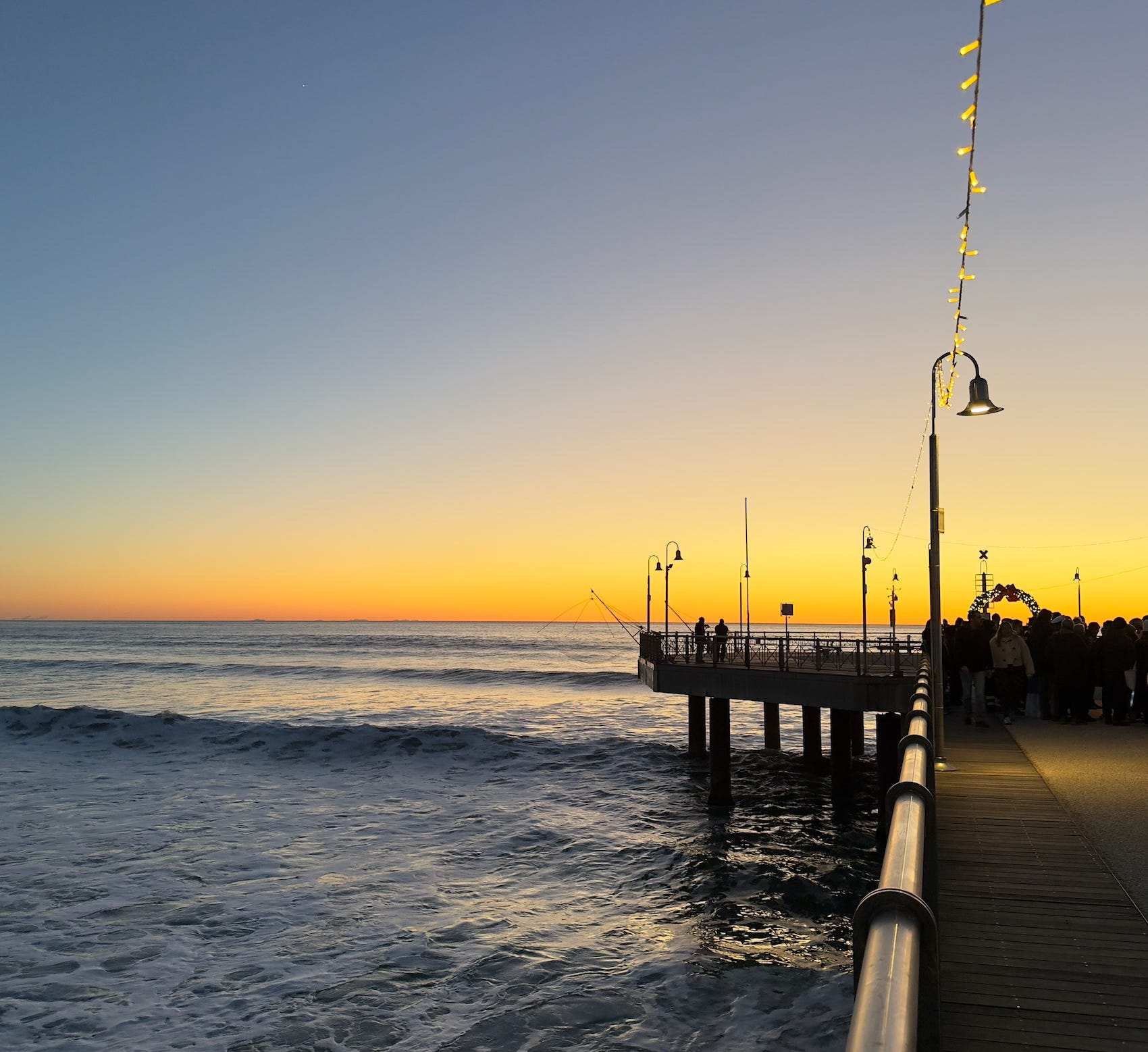
There were always some fishermen on the pier. Sometimes with nets. Almost always grandpas above 70. One time, one of the grandpas cast his net right next to another one but left very little space. Obviously, the two nets crossed each other. The two old men argued about how to separate the two nets. Then about 5-10 other old grandpas, who were just passing by on the pier, stopped and watched the scene. Some of them were just watching the show, as was I. Others were participating by talking to the two fishermen, playing expert on the whole thing. In under 10 minutes, the happening became a theater. Meanwhile, the sea was there with its waves and fresh wind, and there was a dude playing guitar at the end of the pier. I mean, that was the best stuff of that day. I stayed for almost an hour to watch this. Obviously, Italians, so after an hour the two nets were still hooked together, but no one really cared anyway, and one of the grandpas started offering some grappa to the crew…
For a local Italian in these places, this is a Tuesday. For us expats, this is slow paradise. This is why you move to a small town.
My tips
So there are some tips I wanted to share so you can max out this experience. It doesn’t matter what type of small town you prefer, seaside, hills, mountains, or something else; these are universal tips:
Pick a town that has between 5,000 and 20,000 people. I think that is the sweet spot. Of course, there are exceptions; some towns are super alive even with a few thousand people, and some are dead silent even with 50K people. But generally, 5,000 people means you have a town and not a village, and 20,000 people max means that you still have one local community, without the city fragmenting into areas and hoods.
Pick a town that has a big city close by. By big, I mean around 50K people or more. But not too big. Any regional capital turns a small town into a residential sleeper town. You don’t want to live near Florence. You want to live near Siena, near Pisa, near Lucca. The nearby city gives you access to all the services that are either missing in your local town, or where you just want more variety.
When picking the town, check driving times. You will still need a car. You want to live a maximum of 1 hour but a minimum of 30 minutes from the nearest city. Italians not only eat and live but also work locally. It’s rare that someone lives in Pietrasanta but works in Pisa. They move to Pisa instead (it’s only a 30-40 minute drive; I wouldn’t move, but Italians would). So, a 30-minute drive ensures that your town is not a sleeper town or a suburb, but an actual town that is alive with local life.
Skip the postcard towns. I will talk more about this type in later parts, but you don’t want to live in small towns that are overrun by tourism. San Gimignano, Montepulciano, Riomaggiore, Sorrento, I can go on and on. When you live in Italy, the goal above all else is finding places that are hidden from tourists. As a local, you don’t want to live in a town that sells fridge magnets and lemon pasta.
There is a tax on the sea in Italy. Nah, it’s not a tax per se, but it works like this: the closer you are to the sea, the more you will pay for your property. Doesn’t matter if you own or rent it. You will pay more. The rent of our home in Pietrasanta (a huge, fully renovated 4-bedroom apartment) was more expensive than our home in Rome. And in Rome, we lived in a walled condominium that normally served not as a long-term rental but as an aparthotel. It was even more expensive than our rent in Florence, where we rented an entire floor of a palazzo in the center. Obviously, prices vary by region and seaside community, but generally, you will pay more per square meter the closer you are to the sea. Plan your budget accordingly.
If you want maxed-out convenience, pick a town that has good rail connections. Trains are an overlooked way of getting around in Italy. They are amazing. Yeah, sometimes they are late, and strikes happen, but when they operate, trains are awesome. The trains on the main lines usually run predictably, so look for a town that has many connections to other cities. It is just simply more convenient to use the trains. Parking in Italy, especially in bigger cities like Florence or Pisa or Lucca, is and always will be beyond insanity. Old medieval towns just aren’t built for cars. But trains! All main stations are central. You just sit on the train, arrive in the center, no need to look for parking, and in the evening you go home by train, done.
Lastly, everyone’s money situation is different, but if you can afford it, look for a property in a small town that has both of these qualities:
It is close to the center. Since you are living in a small town, you want to live in the center. If you did all the things right, you are probably living in an amazing town, untouched by tourists, fully local, so you want to claim your place at the bar on the piazza. And it is not just Florence or Pisa that are not built for cars and parking. Small towns are also hilariously bad with this (though Pietrasanta was quite OK with it, surprisingly). You want to live close to the main piazza (the town probably has only one piazza anyway), and you want to be able to walk to it. Trust me, walking down for a coffee and spending half the day doing nothing, just watching life unfold… it is the why.
It has guest room(s). Nothing else in this series will have this short a gap between dream and reality. Your friends will want to come and spend time with you there. People fly across oceans to experience this, and you live there. Trust me, you will need that guest room. We had two.
I’ve lived in many cities, towns, and villages, and visited many, many countries. There were some places where I said, oh, I could get old here, or I could spend some years here. Sometimes I returned to a place and it was different on a second visit. Sometimes I fell out of love with them. Sometimes, when I came home, I rationalized the why-not.
When we first came to Pietrasanta, we hadn’t planned to stay. Our home in Budapest was rented out until January. It was the end of November. I remember it very clearly. After a month, I said to my wife: I don’t care how much it costs, or how we will make this work, but we will stay here. I’m not going back, like, ever. Within 3 months, we had a rental for a year. Within half a year, we signed for multiple years on the same rental. We started learning Italian seriously. We took care of the red tape, ID cards, taxes, everything. We moved, officially.
The reason is childish and utterly cheesy. Living there, just for a month, it was like a dream. For us, this is life maxed out. A small seaside town in Tuscany. If I could pick any location on the planet, no limits, no holding back, I would pick this place, without hesitation.