

Hi, I’m Peter, and you’re reading Anywhere Italy. Our mission is to cover the 1,000 Italian towns most travelers skip, in person, one at a time. Come along for free, or pay to keep us on the road.
This article is part of a series that helps those who are considering moving to Italy for the longer term, but are not quite sure where. Most people start with the name of a town, which I believe is only the second step in figuring out the location. The first step is figuring out the type of location, or the type of commune you want to live in. I’ve lived for months and years in many different places in Italy, from absolutely tiny hilltop towns to cities like Rome. So, this series will be mostly based on my personal experiences and my personal point of view.
Because of this, I want to clarify my point of view. I think it is important, since our personal life very much dictates where we feel at home. I’ll be brief so you can orient your needs to my setup, and therefore to my advice later on in this series:
I’m married to my wife, she’s 35, I’m 45. We don’t have kids.
We are between an introvert and an extrovert, so we are totally fine with no one around us for a time, but we also thrive in a large community.
I grew up in a small village but spent most of my adult life in capitals. My wife is the same, but she grew up in a small town.
We are what you would call creative professionals. We work online, so we are not tied to any local market. Our home is our office.
We have traveled around the world already. I haven’t counted, but together we’ve probably checked out around 100 countries.
We are both Hungarian. We didn’t speak Italian when we moved here. Since we work online and neither of us is Italian, learning Italian is hard for us. We picked it up, but I wouldn’t say we speak it well.
We own a car. We also own our home now, but we rented for years. We live in Turin; we moved here in Q3 2026.
So, nothing fundamentally interesting here, just a young professional expat couple. But some of my readers are pensioners, others have kids, and some move to Italy to explore Europe as well. We don’t have these needs, limitations, or setups. So whenever you read my guide on where to live, unless I mark it explicitly, always keep in mind that we are somewhat free to move anywhere.
Now that this is out of the way, let’s focus on the biggie: where to live in Italy?
As I said, most people start with town names. But that is just plain wrong. You have to decide the type of town where you want to live first. Now, in all countries, you have smaller towns and bigger towns, and they resemble roughly the same scenarios, regardless of where you are from. But every country is slightly different, and I am here to tell you how Italy is different within the types of its towns.
So, what types am I going to cover in this series? I had to split this into a series, because covering them all in one article would be way too long, so there will be parts:
Part 1 - The end of the road
Part 2 - The small town
Part 3 - The city
Part 4 - The postcard
Part 5 - The other half
So we go from the smallest to the largest, and at the end, we need to talk about the North vs South of Italy. The parts will be links as we go, and I will link back to my POV here, all the time, just FYI.
In terms of town names, don’t panic. I will give you my tips for names. But you will see, the names are less important than deciding on the type of place you want to call your home in Italy.
The end of the road
I’ve covered this experience from our journeys here:

For a couple of months, we lived in a small borgo in Lunigiana, called Marciaso. A borgo is a medieval town, and though some of them are famous, like San Gimignano, most of them are just old, with an aging and emptying population. Where we lived wasn’t famous, as it was in the most hidden part of Tuscany, away from busy tourism, or any kind of travel frankly, in the mountains of Lunigiana, between the Apuan Alps and the Apennines. If you know where Carrara or Pisa are, Lunigiana is north of them, up in the mountains.
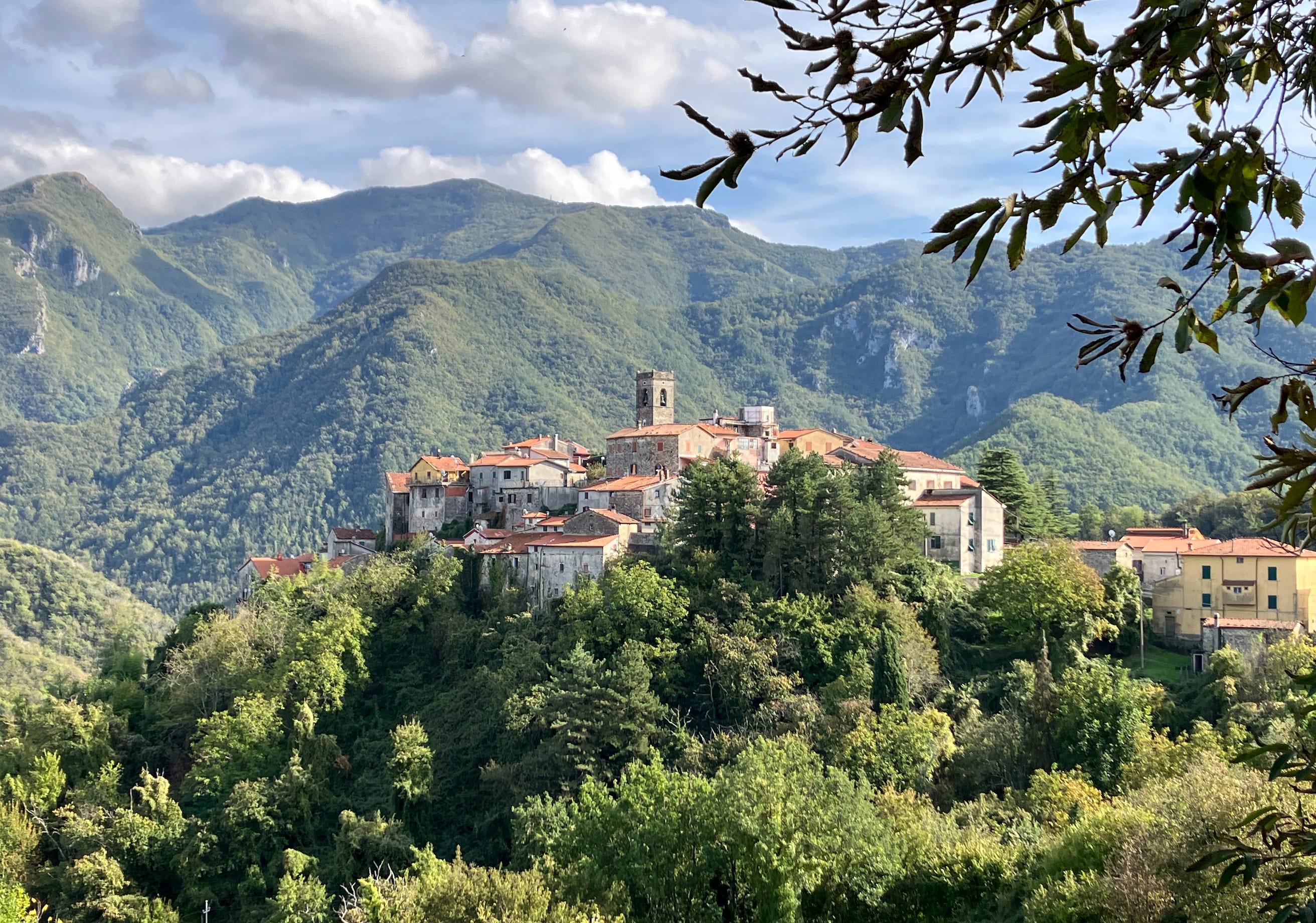
Marciaso had around 80 people total, most of them closer to 80. There was one circular stone road in the borgo that went around an old tower. Hundreds-of-years-old stone houses, walls, stone courtyards, and very, and I mean very, old architecture. Half of the houses, maybe more, were empty, deserted, rotting, decaying. Most of the borgo had already been taken over by nature. Giant spiders, stray cats, and geckos were everywhere, and we once saw wild boars wandering around casually.
The borgo had nothing to offer in terms of services, except a bar that was open only on weekends for hikers, and sometimes trucks came up to sell cheese and salami. No grocery shop or any kind of shop really. We haven’t tried home delivery; maybe Amazon delivers, I wouldn’t be surprised if not. We had internet, but it was on and off during rain, and it did not matter that we brought our Starlink dish with us. When it rains in the mountains, it rains, you can’t see the sky.
The road up to the borgo was a winding, curvy mountain road, which was almost completely undrivable when we had rain or storms. We were there during October-November, so we had plenty of rain. The closest town was a 10-minute drive and had a grocery shop. The nearest restaurant was 20 minutes away. The first hallmark of civilization, with a mall or any kind of services, was about a 40-minute drive (Carrara). We learned what the words “grocery run” mean.
On a personal note, I’m sure you’ve asked yourself this by now: how the heck does a young couple end up in a place like this? The answer is very obvious. There are only two kinds of people who live in places like this:
Those who were born there, or have some personal connection there, like our host, who inherited 3 stone houses from his family in the borgo and turned them into Airbnbs. He was a construction worker and his other option was to chop stones in the mines, so obviously managing the houses was a better deal.
Those who run away from something. That’s us. We had some personal tragedy in our family, plus we simply had enough of Hungary anyway, and a small town in the Tuscan mountains seemed like a good idea to relax and chill for a while. We could work from there and always wanted to live in a hilltop town, so why not.
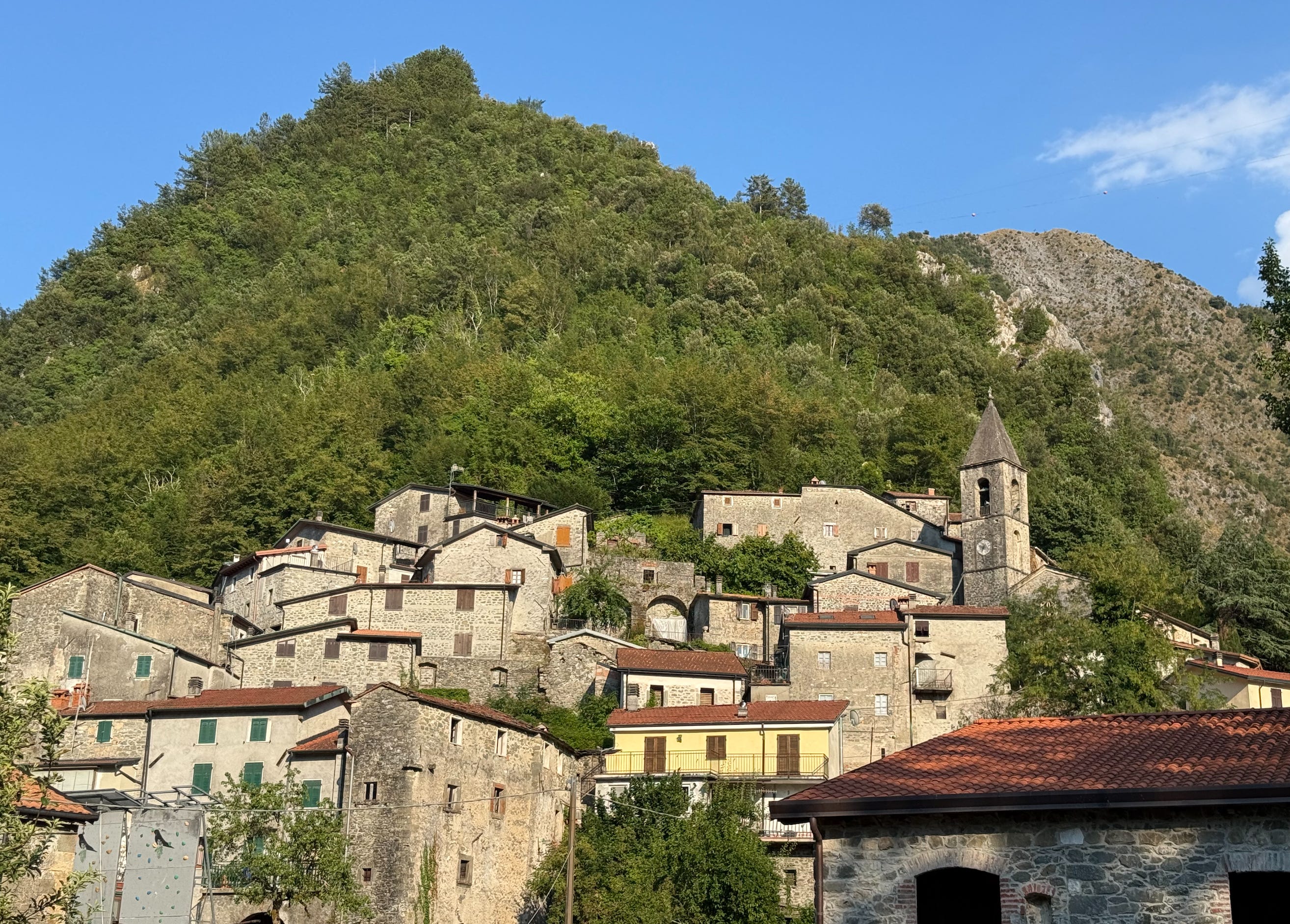
Marciaso wasn’t popular. We had some hikers visiting the town from time to time, but I promise I saw more geckos in total than hikers. But we have lived in a similar place by the sea as well. Immediately after Marciaso, we moved to Marina di Pietrasanta. Our experiences were covered in this article:

Marina di Pietrasanta will be covered in the small town part of this series, but our first home there was on a small backroad. For most of the years, we lived in the center of the town, but our first rental was a house on a street full of villas and family homes, also during winter. Aside from the old couple in the house in front of us, we had zero people around us.
Plus, for weeks at a time, we also lived in vacation homes which were easily at the end of the road. In Umbria, most of the places where we lived were family houses in the middle of nowhere. In Calabria, we lived in a small town (Scilla), sure, but the house was on the very edge of a cliff, outside of the town itself on a backroad. In almost all of these places, we were the only people within miles.
And I also know that this end-of-the-road vibe is popular with expats. Why? Oh hello, this is exactly the dream for most of you: the countryside Tuscan villa under the cypress hills with a pool? All of them are so freaking end of the road that they usually have their very own private roads leading up to them. I lived in Versilia, which was mostly a marsh back then until it was drained and built up into the scene you see now. But you can still see some of the canals. We drove around the area a million times and saw these family homes there. All of them count as end of the road. Maybe the living conditions are different from an old borgo, but the lifestyle is the same.
So, let’s conclude with a nice and tidy GOOD vs BAD duality here.
The good
It is quiet. Like, really quiet. There have been around four or five places in my lifetime so far where I had this type of silence. On top of an Austrian mountain, in a wooden cabin. In a Japanese ryokan in the mountains of Nagano. In the house in Scilla, Calabria, where the sea was just below our window and we had our private stairs to go down. In the desert (in Bahariya, Egypt, in Wadi Rum, Jordan, and in the Negev, Israel). In Marciaso, only the sounds of the forest and the rain. We had a balcony overlooking the mountain ridges, so yes, we spent hours there.
It is very easy to do something with mama nature, since you are already living in it. If you are into hiking, the end of the road in a mountain borgo would be perfect. Our daily habit in our seaside houses was to walk to the sea and back. We had a dog, so walking was mandatory anyway, and in our first place in Marina di Pietrasanta, we had to walk about a mile to the sea. It was a bit far, but it was also perfect for a daily walk with the dog. We have spent time in houses by lakes and inside forests. Again, if you are into nature, this could be a perfect spot for you.
I am putting this into the good ones, but that is debatable. Remember our POV, plus the fact that we were looking for this experience purposefully because of personal reasons. So, at the end of the road, life becomes super simple. There are no distractions, because the only things to do are either something in nature or around the house. For anything else, you have to travel. In Italy, even in a small town, you can simply pop into a bar or a restaurant, and suddenly you have life around you. At the end of the road, life is usually your immediate family circle and a couple of geckos.
The bad
The tranquility is amazing, as said above, but we moved on after the 2nd month or so. It was an experience and it was well-needed for us, but OMG, I was so happy that we finally had a bar or a restaurant within walking distance and could also just walk to the grocery shop.
I grew up in a family house in a small village. Maybe because of this, or other things, but this whole renovation game is very far away from me. When I see a video on YouTube where a nice, mostly British, Australian, or American couple renovates an absolute trash ruin in Tuscany into a somewhat modern family villa, they see fun work. I see giant spiders, dust, geckos, rotten moldy woodwork, a dead stray cat, and a mummified rat under the chimney.
So no, I’m not the one who will renovate your dreamy countryside house. And if you are into this at all, my advice is to buy something that is already renovated. Yes, bite the bullet, it costs more, a lot more, but you will spare yourself the insanity of renovation in Italy. Especially countryside renovation. With Italians. Which means everyone is mega-super-nice, you will have the best time of your life in terms of renovation process, but everything will move 10X slower than it supposed to be moving… I would argue, if you know a team in Ohio, pay them, put them on a plane, let them live on-site, do the work, fly off. It’s just a saner option. Or do everything yourself. But prepare for the worst. These countryside houses are hundreds of years old. And I am not even mentioning the Italian paperwork, rules, and regulations on how you should, or can, or will be able to renovate your own property on your own land. Let’s just say, this is not Texas.
Why am I saying this? Because if you rent a house at the end of the road, most likely it will be low quality. On paper, everything is amazing. Our home in Marciaso was perfect on paper. But then, the mosquito net on the kitchen window was off, so spiders the size of my hand could get in. The pellet stove was supposed to provide heating, but it didn’t work, so we had to rely either on the air conditioning unit or on the giant fireplace. The house didn’t have a carbon monoxide detector, and I obviously wouldn’t trust the fireplace’s building quality, so we were left with the air con unit. Which didn’t work during rain, no idea why. But as our host said, just dress up and use the warm blankets. Thanks.
Oh, you are wondering why don’t just use gas and radiators? In Italy, it’s pretty common that you have no gas at all, because only 1-2 months in the year you need to heat your place anyway. If temperature is below 20 Celsius or even 15 or 10, the Italian answer usually is to dress up and use a warm blanket. It makes sense if you grew up here, I guess. But we didn’t. We look for the thermostat in a house, turn it on in October, leave it on at 22 Celsius, and turn it off in May. Yeah, gas bills are a thing, but our homes also have 100X better insulation than almost any Italian home.
So if you want proper living conditions, you have to do it yourself. And even if you do it yourself, it will be a lot of headache, so prepare for a lot of surprises. On paper, most of the homes, even with renovation counted in, are much, much cheaper than homes in the US or the UK. But add the surprises into that, plus if you want anything above basic conditions, you will end up with a similar or comparable chunk of money. Of course, your home will be in Italy, let’s say the Tuscan countryside, everyone’s dream, and not in, I don’t know, the middle of Tennessee.
Speaking of living conditions, there are some universal things which are very Italian, and you are affected by them mostly in remote locations.
I mentioned insulation, for example. Personally, I can’t imagine a house without double-glazed windows, proper radiator piping in every room, and air conditioning in every room. But I am coming from Hungary. We have deep minuses in winter and almost Sicilian hot summers, so our homes by default have to be prepped for both extremes.
In Italy, you don’t have those chilling winters (except up high in the mountains and on the northern plains), and hot summers aren’t new here either, so even the Romans had natural air conditioning: pines for shade, narrow streets with small windows, thick stone buildings, etc. Because of this, most countryside homes have single-glazed windows, and some even have aluminium window frames. TLDR: insulation is not really a thing here…
Also, I don’t know why, but even in condominiums, and I honestly don’t want to offend anyone with this, a properly straight wall seems to be a rare thing here. I am not joking, even our current home, which is a new condo, has some curved walls… In almost all the countryside homes where we’ve lived, the window frames were fixed in the funniest ways. The best one was in Marciaso, for sure: I could literally push my finger through the gap between the wall and the window frame while it was closed. The first place where all the walls were kinda straight and all the windows were kinda all right was our Pietrasanta home, so we signed to rent it for years. But even that home was nowhere near as mint as my original home in Budapest. I don’t know, maybe German engineering is truly above all?
But the lack of insulation has another reason beyond simple dolce vita carelessness: mold. A house that breathes through its gaps dries out. Seal it tight, and the moisture stays inside. And mold is everywhere. The more remote your location is, the more likely you’ll encounter it. In corners. Under the bed. Behind the bed. Behind the cupboard. In the attic. In the frames.
By the sea, it is obvious, the humidity is almost always above 70-80%. But it is also in the mountains. Anything below 1,000 meters means a lot of rain. Forests, fields, marshes. It almost never gets below 70%. You would say: oh, but why not paint the walls with anti-mold paint that doesn’t let it build up? If you are doing your own house, do it. You’ll need to explain it to most craftsmen here, because they either never heard of it or think you are wasting money: why not just open the window, air out the house, and in extreme cases, there is that anti-mold spray. If you are renting, there’s a 99.99% chance that mold will build up. And the better your insulation is, the more likely it is to build up, ironically.
Some issues that you might want to double-check in some areas, depending on which end of the road you are picking:
The smaller your place in a seaside town, the more likely the sanitation is off. Yeah, the sea is close, it shouldn’t be a problem, but no. Toilets can clog, water is salty, and trash collection is hardcore because of the unpredictability of local services, and the birds. Yes, the birds. Seagulls freakin’ tear apart your bags, which you most likely just throw out onto the street to wait to be collected. The trashmen come the next day, but Mr. Seagull, the local capo there, comes an hour after you threw out your stuff.
The smaller your mountain borgo, the more dangerous it is. No joke, half of those places are empty, and they have been empty not for ten years but since 1910 or so. Arches, towers, walls can crumble. Landslides, floods, earthquakes can happen.
Think twice if you have any kind of health issue. If you slip? If you have a heart attack? If you have a stroke? If you just eat a bad mushroom? Seaside places and places on the plains are easier to get to, but mountain borgos take time. Can you afford that?
Buy a rat repellent and spray your car with it. Squirrels, rats, bunnies, they all love spending nights in your warm engine bay and chewing up your wires. I spent a January 2nd at a mechanic shop and paid 300 EUR for a tow truck, because my Honda said no, I won’t start with 3 cylinders, and my 4th was eaten up by a rat or something. This never happens in a small city or town, only at the end of the road.
And there are the obvious ones, which you’d have regardless of Italy. If you live at the end of the road:
You have to be in a very intimate relationship with your partner and with your car. Yeah. You can’t hide from your partner, and you will do most activities with your partner, since there is no one else and nothing else to do anyway. And you have to marry your car, because even for the smallest grocery run, you have to drive. For Americans, this is not a biggie. For us Europeans, it is. I got my driving license at the age of 35, simply because I was fine without it.
Forget about social life. You will talk to your trees, your grass, and your river. I had deep and long conversations with my dog. When we visited friends in Verona and went to a social event, at first we felt like some sort of weird couple who don’t know how to connect with others.
Best of luck finding ANY kind of services. Want a dry cleaner? 1 hr drive. Need something fixed in your house that you can’t DIY? Maybe, just maybe, Marco, whom you called from the nearest town (30 mins drive), maybe Marco comes and fixes it. But it’s Italy, and it is a service, and it is Marco, you never know. He might stop halfway to visit his uncle, spend the week there, and forget about you. Cinema? Forget it, it’s more than an hour’s drive and it’s dubbed in Italian anyway.
A special end of the road is an island. We have never lived on an island, though we’ve visited many. And coming out: I would never ever live on an island, not even for a fixed longer period of time, not to mention forever. To me, the end of all roads is a mountain town on an island. Even if you manage to get down from the mountain, you still have the enemy of all travel: the ferry. A very close friend of ours lives in Corsica. The ferry there goes from Livorno, which was a 1-hour drive for us from where we lived in Tuscany. We have visited them only once in 3 years. We love them. But getting to the island is an unspeakable commitment. So think twice, if not three times, before you pick an island. It sounds and looks the most romantic, yes, and visiting is surely an experience. But I don’t want to make this into a mantra: there is an astronomical difference between visiting a place and living there for life.
My tips
So, what would I suggest here? There won’t be town names here, because this is the end of the road. Even if you live in a town on paper, technically you will be living at the end of the road. So instead of towns, I will give you my tips on what to look for.
Pick something interesting. Since you are at the end of the road, you want to make sure that this end of the road is at least the most exciting of all the ends of the roads. I think there are two options to max out excitement:
Option 1 is where you go full hardcore on nature. Pick a tiny town’s house in the Dolomites or in the Apennines. Get a house on the edge of a cliff above the sea. Look for national parks, there are plenty in Italy. Look for pilgrimage routes, hiking trails, or some dramatic landscapes. Max out mama nature. You can’t do that in a town or a city.
Option 2 is where you pick a road that is close to a city. Google Maps can help you, and I do have actual numbers here. You want a small town within a 15-minute drive. Why? Because that’s enough to do a grocery run or get a nice meal at the local restaurant. It’s convenient. You want a city, a provincial capital of 50-100K people, within a 30-60 minute drive. Why? Because to get any kind of extra services, that is a convenient distance. Most small towns have basic services, but the city has a multitude of them.
We went with option 2 later. We lived in a village that was more like a small town, The Town was 10 minutes away (Pietrasanta), and The City (Pisa, Lucca) was 30 minutes away. A small place with chill, but not the true end of the road.
Double-check the nearest town for services. Regardless of whether you pick option 1 or 2, you still need to check the nearest town for its services.
There are some obvious ones. If you have kids, you need a school. You are an expat, so you most likely need an international school. No matter how old you are, you still need a hospital or at least an emergency room close by. Accidents can happen. If you are older, they are more likely to happen.
Then there are the non-obvious ones. A proper grocery shop where you can buy everything you need. I wrote endless pages about this, so I won’t repeat myself: Italian food is astonishingly local. Locality means freshness and 0 km logistics. It is truly amazing, one of the best things about Italy. But it also means a lack of diversity in a small town. This is an extreme example, but in a mountain town, the meat selection is mostly rabbit and pork and the veggies are greens only; in a seaside town, good luck buying anything that isn’t crawling or doesn’t have a shell; and in the countryside, the opposite, good luck buying proper fish.
Other non-obvious ones are the small things. Hairdresser. Dry cleaner. The basic supplies shop. A mechanic. Dentist. I know these are basics, but you would be surprised how many small towns either don’t have these services, or if they do, the service is OMG. I mean, I believe you have to put your faith in the hands of God when you walk into a small Italian mountain town’s dentist. And I know that you can drive an hour to the nearest city. But sometimes you either aren’t in the mood for it, or you need something urgent, or the weather is just unrealistic for a longer drive.
Get a really good car. By good, I mean three things:
Reliable. The last thing you want is Marco fixing your engine or calling a tow truck to the end of the road. Again, it is Italy, everything is 100X slower than you might got used to. I explained above that car is mandatory. Do you think you can afford not having a car for a week, while Marco fixes yours? You want 24hrs brand service, right? Muhahaha. When my Honda’s wire got chewed up by a rat, the car spent a week in Marco’s hands. He forgot to work on it for two days, then ordered some parts (he only had stuff for Fiat I guess, almost no one drives a Honda here), then fixed it. And I called him every day, literally sat on his neck to do it. He called me di ungherese capo when I paid. Not sure if it was a compliment… Buy Japanese cars and they help you to avoid local mechanics (except when accidents happen).
All-terrain. You don’t need to go full 4x4, but you need ground clearance. I would recommend a small SUV. End of the roads are bumpy, sometimes they are dirt roads. Roads leading to the end of the road are also full of craters, holes, and fallen trees. It is also raining, flooding, and roads are windy and curvy. Oh, and locals drive these roads like if they are racing on Imola. You need a car that goes through anything and if it crashes, you walk out of it on your own. Buy a Japanese truck or SUV.
You need a trunk, because you will haul stuff. Groceries, dead animals, supplies, water tanks, gas, whatever. I’m not saying you need to go full American and get a pickup, because you also need to fit on the narrow streets in Italy. But a SUV is a solid solution. Obviously, a Japanese one.
Basically, you need a Toyota RAV4. It gets you from A to B with all your crap in the back, even during floods and storms. It also fits into narrow streets, if needed. If you need to go through nuclear wastelands, or you carry dead elks to butcher at home, or your end of the road is not even a road, your answer is a Toyota Hilux. They almost never stop, and you need to change the oil every century. Thank me later. I own a Honda, by the way, and though I aced the reliable and trunk parts, I wasn’t prepped for this end-of-the-road experience with my ground clearance issues (Civic).
Spend time there before you move. It should be a tip for any location, but here it is paramount. Because, I feel, this is where we have the largest gap between dreams and reality. Expats have these dreams of Tuscan landscapes with their villas, hilltop borgos with medieval grounds, and living on a cliff above the sea. Seems, sounds, and looks amazing.
But… trust me, just book an Airbnb that has this dreamy setting and stay there for a month. No need for more. You either fall in love and say “this was my dream, and it is still my dream,” or you will run away screaming.
In a small town, in a city? No matter how big the disappointment is, it is a town and a city. You will get used to it, and I’m almost sure that you will love it. It is in Italy after all, and places are not that different here, no matter what people tell you. But a place on its own, at the end of the road, well, you have to really love that place to stay.
Aside from some time in Palermo, we had the most challenging living conditions and lifestyle changes in Marciaso, at the end of the road. By now, you might have spotted it, but we are very comfort-loving people. We love our everyday pleasures, and as the British say, we love to get comfy. It is a bit hard to get comfy when you need to fight for your bed with giant spiders and geckos, and you need to drive 30 minutes just to get milk.
That said, when we’ve spent only days in places like this (a villa in Umbria, or a seaside cliff-house in Liguria), it was always magical. So much so that we had places we returned to multiple times just to relive the experience. But, I know it is a mantra by now, visiting a place as a traveler is fundamentally different from living in a place as a local. And I think the widest possible gap between these two experiences is here, at the end of the road.
So, all I am suggesting here is the very unpopular opinion: double- or even triple-check your dreams before you make the move.
We had many online calls during our stay in Marciaso and also during our stays in Calabria. When we explained where we were living and sent pictures of the borgo, people got super excited. Frankly, everyone told us that it is their dream to live in a place like this. We told them our struggles and the challenges that everyone faces in places like these. Didn’t matter. It is still a dream for most.