

Hi, I’m Peter, and you’re reading Anywhere Italy. Our mission is to cover the 1,000 Italian towns most travelers skip, in person, one at a time. Come along for free, or pay to keep us on the road.
When you think about an Italian town, most images revolve around the hilltop towns. A medieval town, ideally with walls, sitting on a ridge or a hill, while panoramic countryside lies beneath it. I wrote about the background of this image before and why it is mostly a product of survival.

There are other cities in Italy, of course: the classic seaside towns, the industrial capitals, the lagoon-island towns, and many-many more. And there are the extremes, the ones that push one of these categories to the maximum level. Perugia is when a hilltop town pushes so hard above the clouds that it essentially becomes a vertical two-town scene. This story is about the City upon a Hill, Perugia, Umbria’s regional capital.
Frankly, I tried to avoid visiting Perugia as much as I could as I have heard the stories from others on parking, climbing, and the entire ‘stuck-on-the-citadel’ situations. But, since I have spent some weeks at the Lake Trasimeno (detailed my experiences here) and also visited Assisi, Perugia was kinda like a can’t-skip-it option.
There was also an international journalism festival in the town, and I have some friends in this field, so it was convenient to meet with them and spend some time in the upper town.
So, let’s start with the basics.
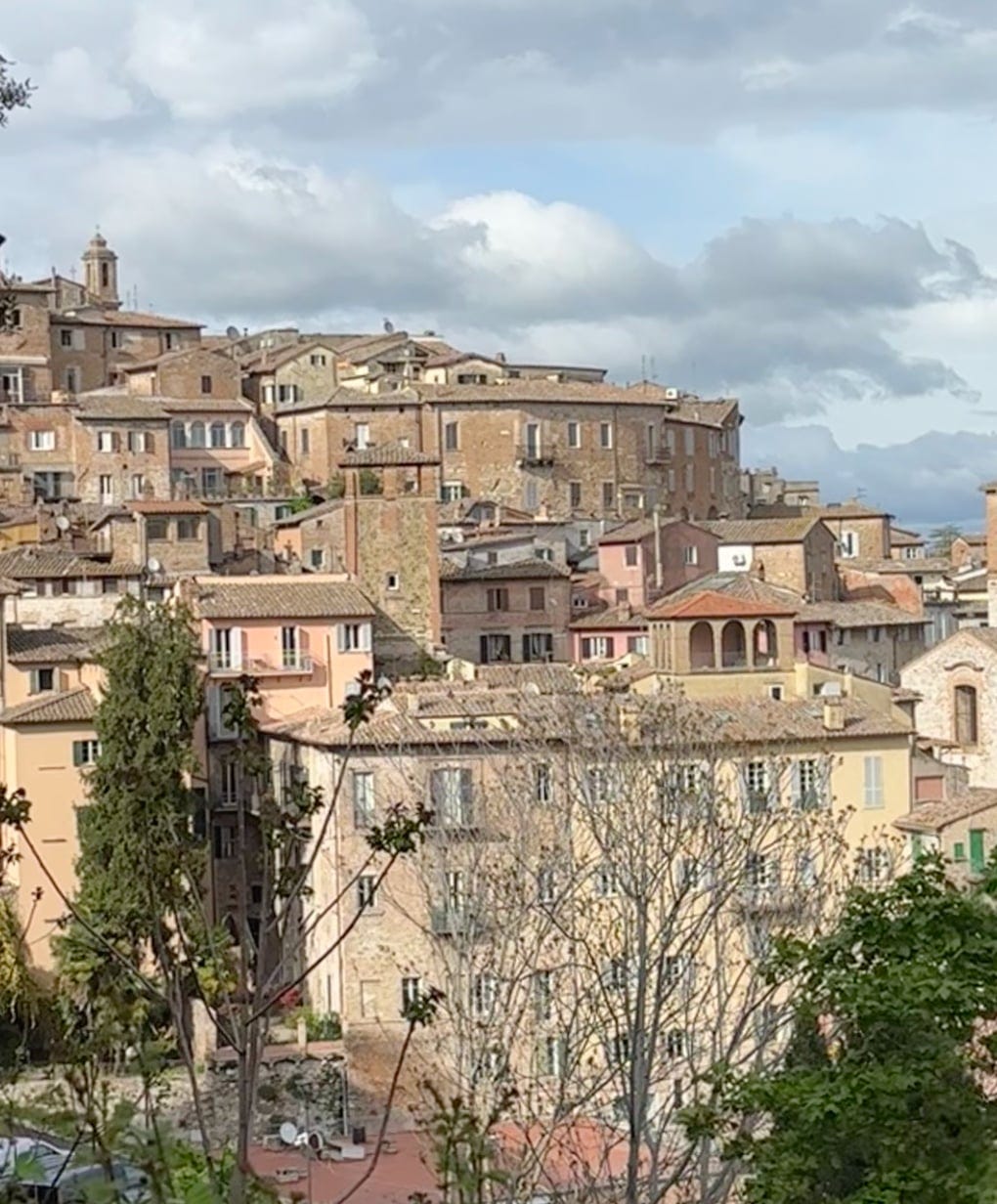
Perugia is essentially two towns. The upper and the lower town. The closer you are to the upper town, the steeper the roads. Circles. Turns. Rounds. It’s like you are driving up to a mountain. Which is kinda true, the peak of the town is just shy below 500 meters.
If you are coming by car, don’t even try to find a parking space. I tried and I gave up, so I ended up with the same solution everyone went with: park the car in a nearby closed parking garage, walk towards the nearest escalator or elevator or Minimetro station.
Yeah, I forgot to tell you: you can’t just walk up to the upper town. I mean, you can, but you have to be at peak cardio and be a regular hiker in your spare time.
Because the upper town (I’m calling it citadel from now on) is such an unbelievably steep climb, modern-day Perugia has escalators, elevators, and an autonomous metro/tram/subway/cablecar hybrid, the Minimetro. Before these, people used Piaggios and small cars to go up, even before that, donkeys and horses.
You may ask, why bother the climb? Because everything that makes Perugia the city it is, lies on the citadel:
Two universities: one of the oldest in Italy, from 1308, and the University for Foreigners, Italy’s most international one
The region’s government, councils, everything is there
All festivals, events, the famous Umbria Jazz and the Eurochocolate festivals, all happen up there
The nightlife, tourism, best places, all up there
And the historic center with all the old palazzos and castles and papal residences, obviously, all up there
Not going up to the hill is like skipping Perugia entirely.
I’m Hungarian and I grew up in Budapest. Like other cities in Europe, we also have a castle hill, we call it literally Castle Hill. That is where the Buda Castle, a give-or-take 800 years old castle complex lies. It is home to some museums, libraries, some government buildings, and even some people live there. It overlooks the flat part of the city (Pest) and the Danube river. But, unlike Perugia, almost no Hungarians go up to the castle. Yes, it’s pretty, you can take a walk, if you don’t mind criss-crossing tourists, and some festivals are held inside the castle grounds, but the castle is mostly for tourists. Perugia’s citadel is part of the daily life of locals, despite the fact that almost no one lives up there. The lower town is for residents, that is where you live.
Because of this setup, everything is all about getting up and coming down from the citadel. Most people forget about the coming down part.
I went up to meet my friends after lunch and I did what everyone does: I parked my car down, used the escalators. There are multiple gates to the citadel with multiple escalator stations. These gates sit on the ridges of the hill where the citadel spread out during the centuries. They are also quarters, named after the gates. I spent my day up, then, after having a long dinner with folks, we tried to come down the same way we came up, using the escalators.
Nah, it’s Italy, this isn’t this simple. Some escalators and elevators stop around 9 or 10 pm, some run later. I don’t know the exact rule, but ours (the Minimetro at Pincetto) got closed after 9. And when I say escalator, don’t think about your usual escalators in your malls or offices. You are up for a long ride there, switching escalators 2-3-4 times, then walk, then maybe an elevator, and then you are at street-level. The ridges are like deeps, falling onto the lower city, you can’t just walk your way down. And no, GPS won’t help you, it marks roads open which are in reality closed after hours. So after 10, we simply asked around the locals, which street is open so we can walk down like donkeys. Calling a cab would have been admitting we are losers, also, the parking lot was 5 minutes only in distance, but, yep, you can’t just walk down. A super narrow, dark, windy pedestrian street with cobblestones older than most countries, that was our solution. Cheers to Sophia who survived this adventure wearing high heels and a cocktail dress — my deepest admiration.
Anyway, once you are up, you are in for a treat.
The citadel is based on the old Etruscan town (Perusia), and it was one of the strongest in terms of military power. I wrote about Etruscans here. To understand why Perugia was always strong in arms, we need to talk about Umbria for a bit.
Umbria has no sea access and the entire region is hilly. Not heavily mountainous, but more like moderately. Almost half of it is covered in forests, way more than the rest of Italy. So, Umbria had very few things to offer to Italy in terms of merchandise, except arms. Umbria provided large numbers of mercenaries to city states like Florence, Arezzo, Bologna, and the Papal States. Some of the mercenaries became high ranking officials. Some of them came back and ruled cities in Umbria with military might.
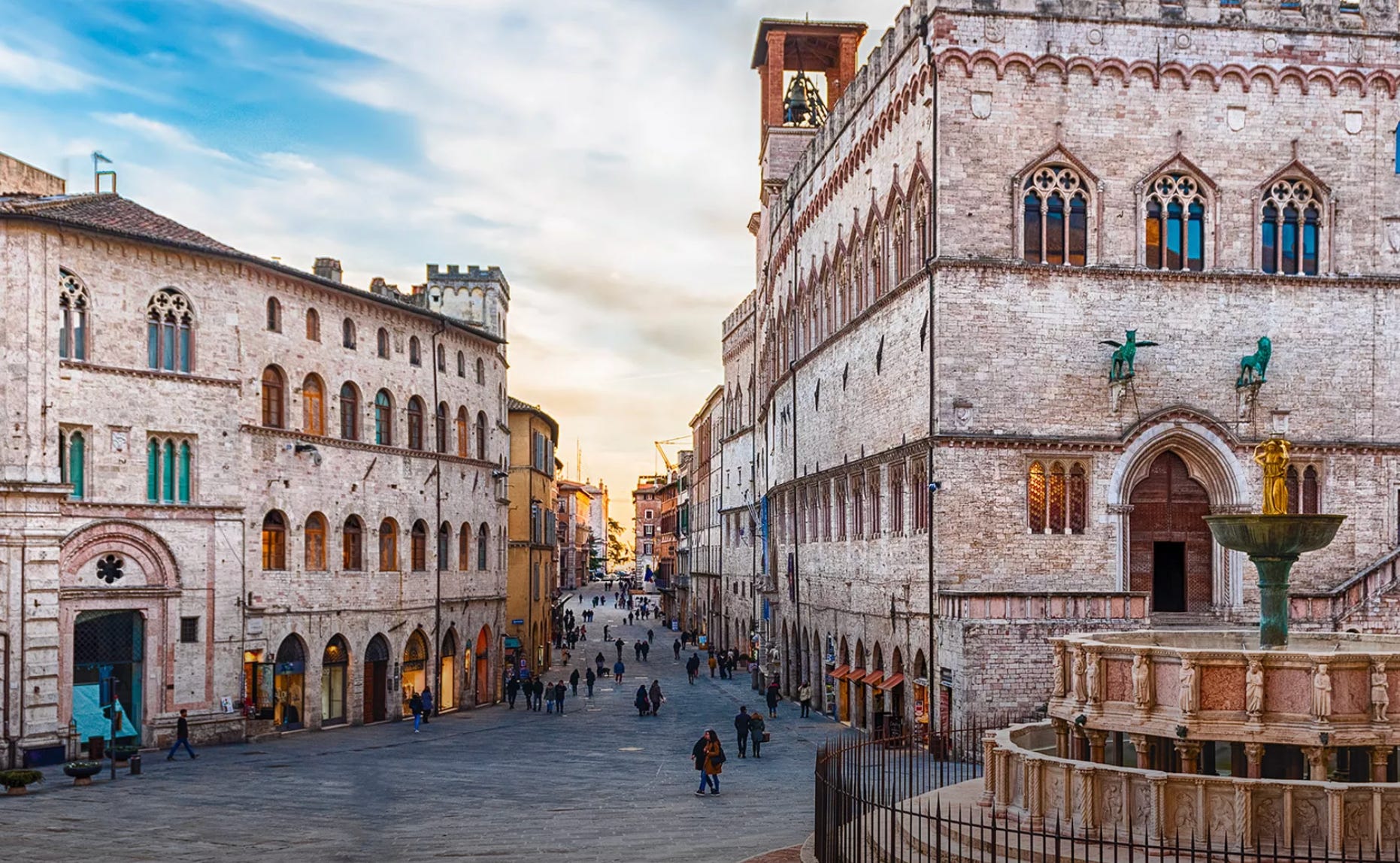
Perugia was ruled for a while by the Baglioni family, a family of mercenaries. They didn’t even have official titles like the Duke or Prince or something, they just ruled the city with arms. And it is easy to understand how this was possible: the city is a citadel where everything and everyone is circling around the high castle. A defensible unit which hosts all the structures of power, ruling over the land. Even Perugia’s symbol, the griffin, which you can see everywhere in the city, is half-bird, flying around the castle.
The town of chocolate, jazz, and party
I have to be honest here, Umbria is very conservative in a sense that anywhere you go in the region, you probably have a similar experience in terms of food, stays, landscapes, and people. It’s the land of the forests and steep hills. Anything that lives and grows in the forest, Umbria has it. Wild boar ragú, chestnuts, big hearty stews, mushrooms, you name it. Aside from some off-shoots like the Trasimeno Lake, the region is quite monocultural.
Not Perugia. And once you have managed to get up to the citadel, you will see it immediately. It’s a town of chocolate, jazz, and amazing nightlife.
I lived next to Pisa for years, and you can always tell a university town. The university itself creates a vibe, an economy, and a collection of services that simply just don’t exist in towns that have no unis. Pisa’s university is one of the oldest in the world, like Perugia’s. But Perugia has a second university that excels in something else: international students. It is one of the main points, where people from all over the world come and learn the language of Italian and anything related to language, history, literature, and culture.
The city is flooded not just with students, but with international students. And students demand two things all the time: cheap food and endless drinks. Add in the international spice and you end up with amazing cocktail bars, world cuisine, and a nightlife that’s famous in Italy. Umbrian beer is a thing and Perugian beer is another level. Umbrian sandwiches (torta al testo, porchetta) are also a thing, but Perugian street food is just insane. Seriously, if you are young or you enjoy the buzz of the city, Perugia is the perfect place.
No wonder the city became a jazz-hub as well. Perugia has one of the best jazz festivals in Italy. It is an international event with famous past headliners like B.B. King, Santana, Chet Baker etc. The citadel is full of piazzas which are surrounded by palazzos, up in the hill, so they end up like natural amphitheatres with a built-in audience of students. Every summer in July, Perugia is the jazz capital of Italy.
And there’s the chocolate, which has almost no local ties aside from a woman, Luisa Spagnoli, who in 1922 made the first Baci from leftover hazelnuts and cacao. But since then, the blue-and-silver packaging is world famous (not even Italian anymore, owned by Nestlé). So much so that Perugia hosts the Eurochocolate festival every year, which is one of the greatest celebrations of chocolate internationally.
The crawl
It’s the best way to enjoy the town, honestly. Since you have crawled yourself up here, the only sane choice is to do a tour around the citadel and visit as many small vendors, bars, restaurants, and cafés as you can. Sort-of-like a pub crawl. You are inside a closed environment because it takes an effort to come up and go down. It almost feels like you are on an island. And, as you are, everyone else is also not just aware of this, but all of them are pointing to the same direction. Students do this. Locals do this.
So start on a piazza, have an espresso, then walk. Grab a panino, eat along, then sit down to have a beer or wine somewhere. From the squares walk inside the narrow streets until you reach one of the edges of the citadel. Look down, then walk more. Back to a new piazza, new places to discover. Repeat this until everything closes so you can walk down in a narrow, steep street to your car or hotel.
Or even better: book your hotel inside the citadel. That is what I would do.
