


Hi, I’m Peter, and you’re reading Anywhere Italy. Our mission is to cover the 1,000 Italian towns most travelers skip, in person, one at a time. Come along for free, or pay to keep us on the road.
This article is part of a series that helps those who are considering moving to Italy for the longer term, but are not quite sure where. For more information about the series, my POV, and to read the overall intro (it is important!), start from the first part.

For tracking, here are the other parts (will be links once all of them are written):
Part 3 - The city
Part 4 - The postcard
Part 5 - The other half
Part 6 - The Best Towns
The other half
In the previous part, we gave mass tourism what it deserves. Job well done. This time, we are going to discuss one thing: the difference between the North of Italy and the Central/South of Italy. I will probably get hate mail after this part, so let’s just cut into it.
First of all, why do we need to discuss this at all?
Because this series is about moving to Italy, not about visiting or vacationing here. And there is the age-old mantra I keep repeating: there are galaxies between living somewhere and visiting it. Especially in Italy.
The way I described most parts of this series is dream vs reality. When I say living in a small Italian town, or a countryside Tuscan villa, or Rome, you think of something. A picture appears. Some feelings rush in. In almost all cases, they have no connection to reality. If you pull off a move, you might be disappointed. So I’m here to tell you what these places are really about.
In this part, I am going to address something that even Italians don’t really want to talk about, because it is such a big, heavy, sensitive, and overinflated topic that you need to be brave just to bring it up.
Since I am not Italian, I bring two things to this game: some level of ignorance, because I probably don’t know the centuries, what centuries, millennia of differences between North and South (actually, I do, but that’s irrelevant here), plus an absolute amount of freedom. I can talk about this, I don’t care, I’m an expat. I hope I won’t find a horse head in my bed, though. Please don’t kill the horses!
Oh, before I forget: why me? What do I know about the South? I drove down from Trieste to Palermo once. I lived in Sicily for a few days, then a few weeks in Calabria, and we (my wife & me) visited Puglia & Naples & Amalfi countless times. I’ve also lived in Rome for almost a year, and if you ask me, sorry, people from Lazio, I would totally consider anything below Siena a different country entirely.
Long story short: I tried the South. I haven’t lived there properly and I nowhere near traveled that much there as I did in the North/Central, but I’m confident enough to say this: I know the South.
OK, so, I’m a big fan of in medias res, so let’s start with the most important thing here: money.
If you look at any number, the South is much poorer than the North. The people, the infrastructure, the services, the opportunities, the variety of things, everything. Whatever you look at in the North, half of it is missing in the South. That is a fact.
Short history detour, mainly because I enjoy it, but also because I want to save some face in front of Italians who think I am an ignorant expat who knows nothing about their country.
So, there are two fairy tales Italians tell each other. Southerners say the North robbed the South of its former glory. Northerners say Southerners are simply lazy, don’t want to work, and are not to be trusted. Both fairy tales have some true roots.
Before unification (1861), North and South were kinda equal on paper, but the North was always better equipped in everything. Big flatlands, great rivers, better market access, hydropower from the Alps, fewer natural disasters from earthquakes and volcanoes, and overall stronger, more independent small states interacting with each other.
The South mostly had one kingdom all the time, ruling either with an iron fist or “whatever goes,” Texas style. It was far from every European market (North Africa doesn’t count), had a constant natural threat from malaria, volcanoes, and earthquakes, no coal, no glacier-fed rivers, hardly any flatland, and almost no infrastructure.
The latter, why? Oh, because when you run a low-tax, low-spend, low-debt state (Texas, I mean, the Bourbon state in Southern Italy, the last kingdom), you might have nice, juicy, big estates owned by very few people, but there is no money spent on infrastructure, education, and healthcare.
A cheap state is awesome, until you look at how the median person lives. At unification, the entire South had about 100 km of railroads. Piedmont alone had over 800. Close to 90% of the Southern population couldn’t even read.
Then industrialization happened, and guess who got better growth? The regions with flatland, existing infrastructure, rivers, an educated population, and shorter/better market access. Yes, there was some reform after WW2: the South got a big cash bag, land reform, government-built factories, massive infrastructure development, and for twenty years it actually worked. But a) Italy had an economic miracle anyway, so everyone was growing, and b) then came the 70s.
The oil shocks killed the shiny new steel and chemical plants, and the money switched from building things to buying votes. Italians call it clientelismo. Everyone else calls it handing out public jobs for votes. Oh, and the mafia? Most of it comes from the South, where the state was weak anyway, so someone had to step in. And guess who ended up winning a lot of those public contracts. Thank God the Maxi Trials put an end to that, right? Right?
Now look at today: the basic numbers are around the same as they were in post-war Italy. TLDR: f*cked up.
Oh, and the Southerners who are simply lazy and can’t work? Tell that to New York, most was built by Italian construction workers, as did Buenos Aires. And I’m sure the Agnelli family at FIAT would be curious to learn about Southern work ethic, since the northern factories of the boom ran on workers from the South. Not to mention today, when a lot of the Northern jobs that require educated people are done by talented young Italians from Bari, Catania, Palermo, and Reggio Calabria. Why? Because the same talented young Northern Italians end up in London, Zurich, Frankfurt, or New York.
That all being said, this post is not about giving justice to either side. Also, I’m not even Italian, so frankly, I have no skin in this game. All that matters for you (and me) is pretty much this: the South has money issues.
I can give you a very literal example. As I said, I drove down from Trieste to Palermo. The highway from Trieste to Bologna? Wonderful. Smooth as butter. Clean as a Japanese toilet. Autogrill service stations so close together that it doesn’t even make economic sense. Then the first bumps and cracks appear around Arezzo. We are still OK, in the clear, but things are simply not that comfy. The moment you pass Rome on your right, something suddenly changes. Craters. Cracks. Some guardrails are missing. Some tunnels have fading lights. By the time you pass Naples, you clearly know: you are in the South. You see cars stopped on the side for absolutely no reason. In Calabria, the guardrails start disappearing. Which is a slight problem, since half of the highway runs by the sea, so on your right you have big-drama cliffs falling to the sea, and on your left, you have mountains. By Reggio Calabria, the lights in the tunnels disappear and the painted lines are off. In Sicily, guardrails are rare (almost zero), lights in the tunnels are unknown, and the lines, even on the highway, are more like suggestions (if there is any).
And at Palermo, the road stops, and you simply ask yourself: where the f*ck am I, OMG, what the heck is happening here, I’ve never seen anything like this, what is this, how can you fit 5 lines of cars on a 2-lane roundabout, where is the traffic light, oh, there, but it’s off, no, it’s red, and everyone is going, why, and why are there 20 broken washing machines on the street, is that a market or what, why Google Maps is not working at all, honey I don’t know why, it worked for me even in the f—cking Sahara, but no, not in Palermo, of course, and is it real that whoever still has a rearview mirror at all, since most of them have none, has literally duct-taped it to the car, why? And why do I see little kids bathing in inflatable pools on balconies that are barely holding on to the wall, on grand palazzos that seem to have been renovated last somewhere around 1721, and why are they selling lamb intestines rolled onto skewers and grilled over open flames, and what is that sandwich, they say it’s spleen, veal spleen, and lungs, in a bun, and people are queuing for it, insane, why, and what is that smell anyway, and for real, why do they put the electric boxes under broken water pipes and let everything spark like fireworks? Nobody here is afraid to die today. Its all YOLO. Honey, I’m not sure if we are going to make it, I’m gonna park the car here, it’s the church, next to the church, have faith, I have faith.
I hope you’ve got the picture. Oh, and I did this with a car that was fresh out of the salon, 2-months old, because I am an absolute moron. We got scratched on the first day in Palermo. Obviously.
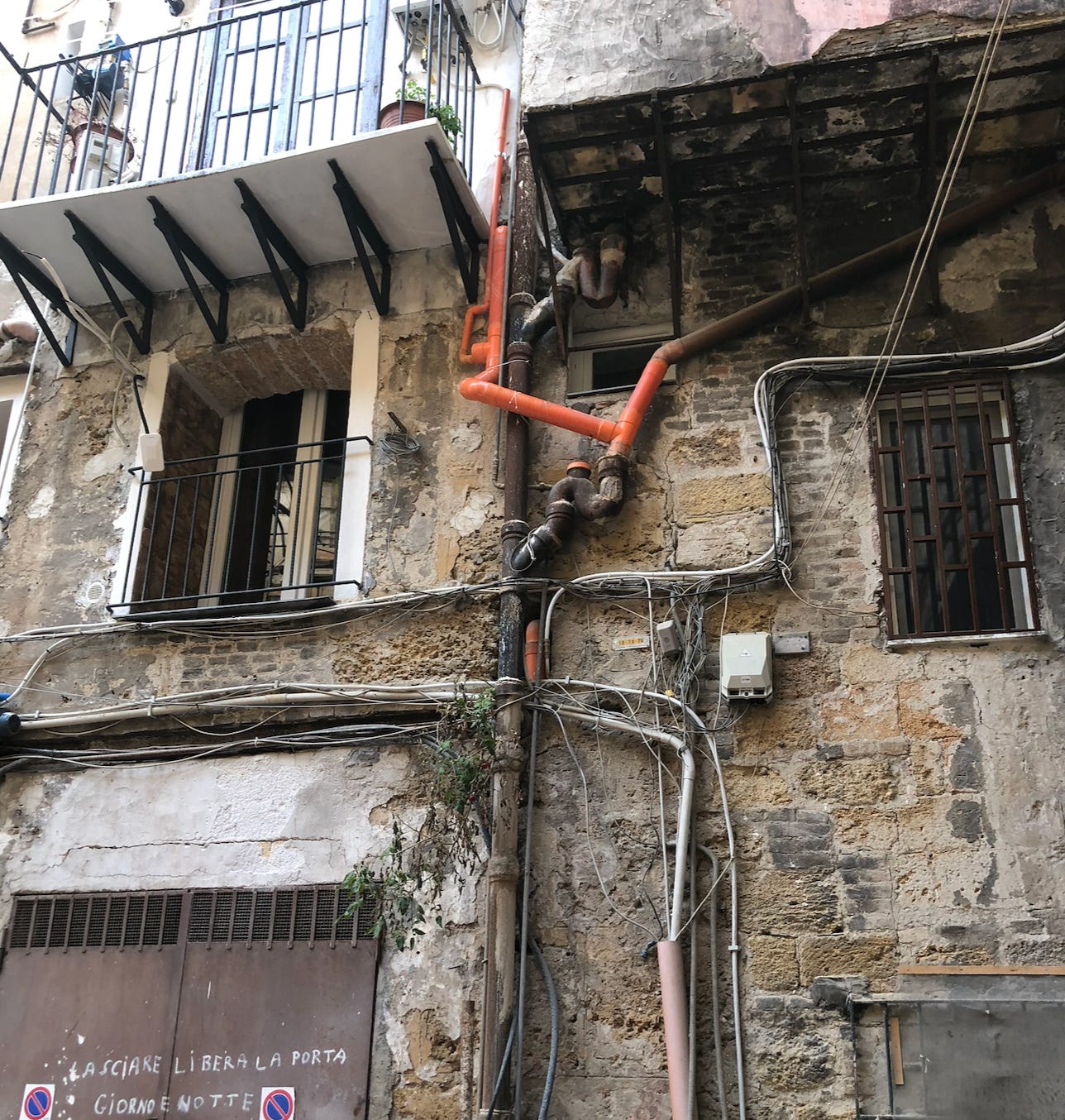
This is in the very center of Palermo, a random house. We lived next to it in an old palazzo, paid a lot of money, and still, we had fist-sized holes in the walls, barely working A/Cs, and the washing machine, which for reasons we simply couldn’t understand was on the balcony, open-air, fully rained upon, crackling in the connector, electrifying the entire water system. My wife literally got electrocuted during a shower, she asked, why the water is giving me bites? Then, I looked at the washing machine on the balcony and understood it. It was a 1.5K EUR/month place, a full wing of the old palazzo. Imagine what’s like if I pay less for a simple local flat. I’ve seen this level of insanity only in Asia or North Africa. Which we will get to shortly, don’t worry.
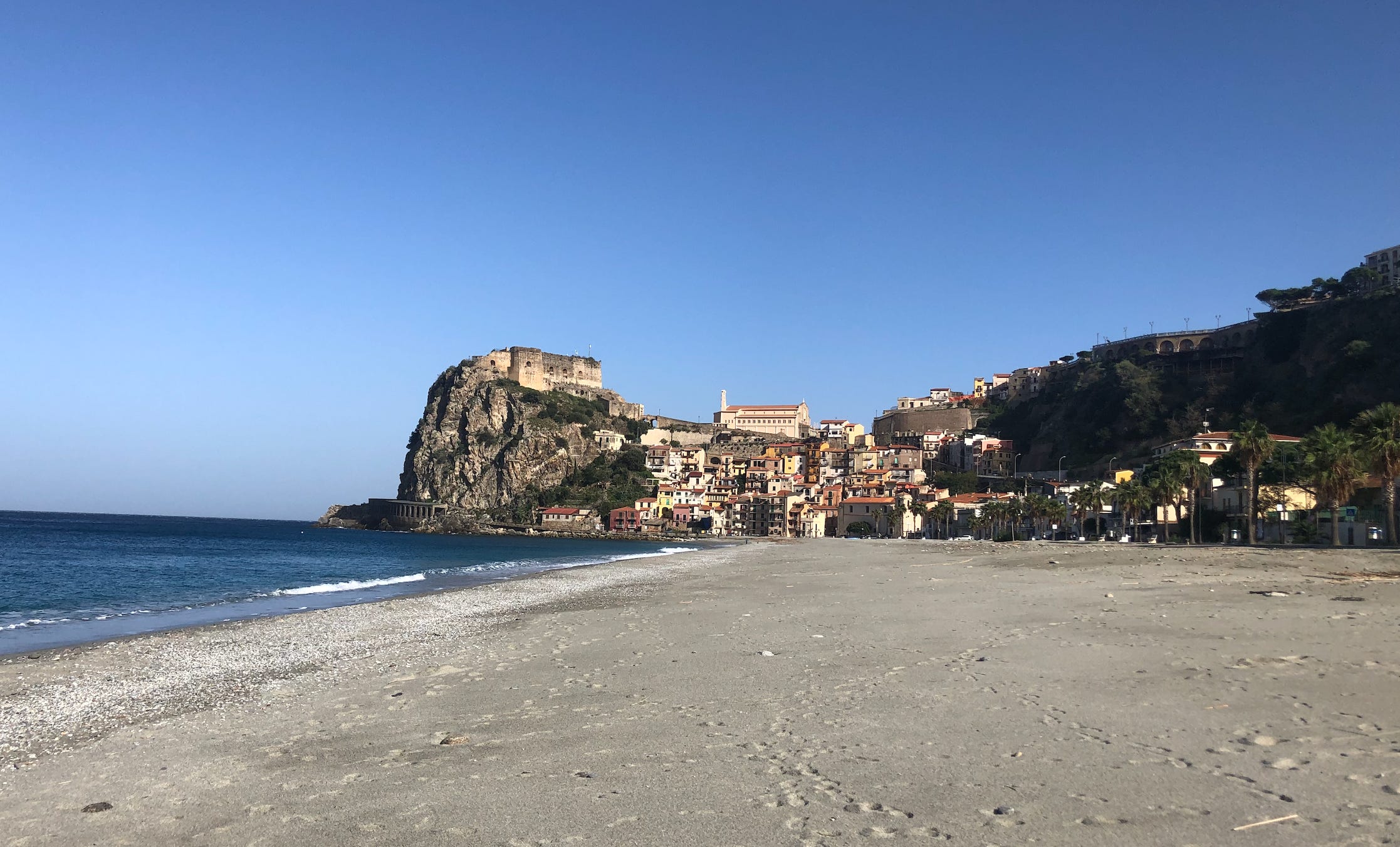
Puglia? Yeah, Polignano and some other places are amazing, in those pictures that show you that particular location from that particular vantage point. Go 3 streets further and you will see why most young people migrate from there to the North. Calabria? Sure, wonderful beaches, we lived in Scilla for weeks. But the amount of straightforward poverty in the towns up in the mountains is almost unbearable to look at.
Coming out: I have zero romantic feelings towards poverty. I’ve seen a lot of third-world poverty. I went through the Maghreb and some very deep Balkan states, I also grew up in East Hungary, and no, poverty tourism has never been my thing. I lived in a 5-star hotel in Marrakesh’s medina. It was priced the same as a low-budget German motel, I thought it was a good deal, and it served orange juice that didn’t send me running to the bathroom for three days, and I’m not sure I could say the same about the orange juice on the main market square. I also have a standing rule not to eat meat in Asia (except Japan), and I don’t drink anything that is not bottled south of Malta and east of Bucharest. Judge me.
Anyway, I think we’ve all got the picture on the money question. But the most important question about money is this: do you need to care?
After endless lines explaining the money issue, I can safely say to you: no. I know this will fundamentally piss off many people, especially Italians: the problems locals face are not the problems that an expat, or anyone with any kind of money, would face.
Let’s not stop there, let’s piss off even more people, and say this out loud: if you, dear European, loved or ever wanted to live in Bali, or anywhere in Southeast Asia, and you are not bothered living in a gated community, eating food cooked only for you, Big White Man, and you are happy to find good deals, paying 1,000 EUR for a villa with some servants, may I suggest Southern Italy as an option? It’s the same deal there. If you, dear American, did your first Tijuana cha-cha run to Mexico, and you think living in Baja is anything close to authentic, or just simply a good bang for your buck, may I offer up Southern Italy as an alternative?
And why Southern Italy instead of Central or even South America? Well, for starters, in Italy, you are less likely to end up getting shot or robbed. You might get pickpocketed, at worst. The beaches are the same or even better. The real estate is just slightly more expensive, but hey, you are in Europe. If you’re a pensioner, you get insane tax advantages: a flat 7% on your foreign income for up to 10 years, if you settle in a southern town of up to 30,000 people. For pensioners, this is like dreamland. The food is debatable, because you are coming from Mexico, which has amazing food, but sorry, I am biased: it’s Italy, so you don’t need to panic, you are in good hands. Or plates. Oh, and lastly, no one will call you gringo here, and waving an American passport opens more doors than it closes.
Why Southern Italy instead of Southeast Asia? It has a culture that you can actually understand, relate to, and be part of. You might be the expat, but you will never be the Big White Man. Also, people in Southern Italy are actually nice to you, some of the most straightforward, happiest, and warmest people I know, and they are like this with you regardless of whether you pay them. The food is obviously better, and I’m saying this as someone with a standing rule about meat in Asia. Taxes are amazing, if you ever wanted to pay them (I know, I know, in Bali it is optional…). And it costs more or less the same. Yes, I know, you can still live like a king under $1,000 in, I don’t know, freakin’ Da Nang, or some random Indian/Philippine/Malaysian fishing town, but let’s be real here: is it really #richlife if your only friends are the other expats in your gated community and your villa staff? I don’t think so.
So for you, dear cash-heavy expat, Southern Italy can be something that Brad Pitt would call a “damn good deal.”
It is no wonder that Catania has a growing digital nomad scene, and it is no wonder that some Calabrian towns are “best kept secrets” for those who just want to enjoy life, lock in and work, and spend their time by the sea while paying the absolute minimum for it. If you work online, or your income/revenue/pension is independent of your location in any way, Southern Italy is a damn good deal. You also do the local Italians a big favor: spending your money there.
But even with an endless runway or an infinite credit line, there are some limitations, mostly because of the same thing: money. So, to whom would I not recommend Southern Italy?
Anyone with a chronic illness or ongoing health problems. Yes, there are some private hospitals where you can solve your immediate needs without setting foot in any public establishment. Same deal as in Asia or South America. I mean, Asia is wonderful and all, until you need actual local infrastructure. Then, you realize, you are in the jungle with a beach. For any health issue that is chronic or needs any kind of special care, even locals mostly travel to the North. It’s the same infrastructure problem, but this time it applies to you as well. You can’t escape it with a bankroll.
Anyone who values predictability or expects things to work at all. It’s the little things you can’t really plan for. Basic services are sometimes open, sometimes closed. Public services in general? Forget them. Ferries? Sure, they might run, but not on schedule. Nothing happens when it is written down, if it is written down at all. You expect something to be done in X. Reality: it will be 100X, if it gets done at all. And I know, you will drive a big black SUV with 4x4 tires. Hope it won’t need a mechanic. And I know you will treat the most basic things at a private health center. Hope you don’t need an emergency room. And I know your kids will go to the international school or do some school-anywhere program for global citizens. Hope they are OK to play around your villa only. I know all of this. But what if you need someone to eradicate the tarantula infestation in the toolshed next to your villa? What if Salvatore, who runs the local pest control business, is simply not in the mood to do anything this week?
Before you ask: yes, there are big spiders in the South. The town of Taranto gave its name both to the tarantula and to the tarantella, a rhythmic folk dance meant to cure the lethargy and pain of spider bites, which happened mostly during the harvest, in the fields where these big wolf spiders lived, and still live.
Anyone who won’t learn Italian. The South is not really frequented by expats or global tourism (except some spots, which you will most likely avoid anyway), plus the locals are mostly older, so almost no one speaks English. Yes, you can live like a king, but if you don’t learn Italian, it will be a lonely kingship.
Anyone who can’t tolerate heat. And I’m one of these people. August is insane in all of Italy. But in the South, it’s really like being in the Sahara. It is just unimaginable, intolerable, and never, ever forget the infrastructure problem. Can you live a week without your A/C in Sicily during peak August? Grids go down during heatwaves. Mechanics won’t arrive promptly. You end up without your precious A/C. Can you afford that? For me, Southern Italy is off the list during summer, full stop.
Lastly, some positive notes. Whatever frankness you’ve read from me, you should know: the people in the South are absolutely amazing. I think, aside from this damn good deal, the real reason you move to the South is the community of its people.
And there’s no need to romanticize this, really. The long tables where everyone eats on the main square of the town, and no matter who you are, you get invited? Those are real. They happen out of necessity: there is not much else to do there. There’s no real high culture, theatre, cinema, whatever you think of as culture up in the North, at least not in the small towns. In Tuscany, even the smallest towns have some cultural infrastructure. In a small southern town? There is the church, the local bar, and the main piazza. That’s it. People belong and connect to each other because that was the only thing that worked for the last few hundred years. The food is quintessentially cucina povera, poverty food. Funny how nowadays it’s considered blue zone food.
And let’s not forget the Southern cities, because most of the missing infrastructure is in the smaller towns. Spend some time in Naples. Even though it has huge challenges, spend some time in Palermo. Naples has the oldest working opera house in Europe, Palermo the biggest one in Italy. I simply can’t describe these cities in words, but compared to cities in the North, they hit all your senses, all at once. There is nothing sanitized in these cities, if you get what I mean. Nothing is pulled back. They are extremes. Would I want to live there? Absolutely not. But I visit them with religious awe and total respect. One of a kind. And again, the people…
You might spend months or years trying to connect deeply with a Northern Italian, especially if they are from Veneto, Piedmont, or Lombardy. In the South, this connection is sometimes made within days.
The world is lonely, fundamentally lonely nowadays. We are fragmented by social media channels, shopping malls, highways, and data centers. So don’t be surprised if, in your first weeks in a random town in Southern Italy, you somehow feel that you belong there, just because the local waitress or butcher or just a random dude smiled at you for no reason. It just happens. And it is more likely to happen in the South than in the North. I know that for some, this is the only information they need to make the decision. Oh, and the best thing about a smile? It costs nothing.