
Hi, I’m Peter, and you’re reading Anywhere Italy. Our mission is to cover the 1,000 Italian towns most travelers skip, in person, one at a time. Come along for free, or pay to keep us on the road.
I wouldn’t know about Todi, or at least not as intimately as I know it now, if it weren’t for two Hungarian writers: Gergely Péterfy and Antal Szerb. And a third, surprising reason: the many American friends who remarked, “Oh, I know Todi, a friend of mine lives there.”
There are these places you know, small towns which deliver you odd surprises. For example, Barga in the Apuan Alps: I wouldn’t have guessed that it has very deep Scottish roots.
And then comes Todi, which got nicknamed the Beverly Hills of Umbria. The nickname started with Beverly Pepper, an American sculptor from Brooklyn who moved to Todi in the seventies, when that was still an eccentric thing to do. Artists followed her, then many Americans. From what I’ve seen, mainly Californians. Unusual, odd, and also WTF. But it explains why I’ve sometimes heard that classic Californian accent in the bars on the main piazza…
Anyway. Italy became the UEFA Euro 2020 champion in football (or soccer, if you are an American), which is a pretty big deal in Europe. The tournament was in 2021, a year later than planned, because of, you guessed it, the pandemic. At that time, I was still a slow traveler in Italy, spending weeks here and there, slowly working my way down to Rome (just got redpilled on travel in Ronciglione), one Airbnb at a time.
I met my friend, Gergely Péterfy, the writer who had kinda emigrated to Todi in 2020, I knew him from Budapest as we are both Hungarians, and Budapest is a small village if you are a liberal... He is a well-known writer in Hungary (and Germany), with a long line of artists in his family tree.
We watched the Euro 2020 final on Todi’s main piazza, with our families and a bottle (or 2?) of Sambuca. The small town literally exploded after an insane penalty shootout (and Gianluigi Donnarumma went to heaven). This video is post-explosion:
Aside from this great memory, Todi would be in line with most Umbrian towns. It has everything that you think an Italian hilltop town should have: a great piazza, narrow curvy roads, a medieval center, a church on the piazza, and, as with classic Umbrian heritage for towns, an upper and a lower town. I am not saying it is unremarkable, because that would be unfair. The word that comes to my mind is… neat. It is a neat town. Let me explain why. Sounds cheesy, but I promise it lives up for it.
The entire area of Umbria is full of hilltop towns that are totally unknown to most people. And while some other regions also have these unknown hilltop towns (Abruzzo, Marche, and the South), Umbrian hilltop towns are still full of life. The piazza is crowded with young people, there are shops and services operating for locals, and because these towns are unknown to the crowds in Tuscany, the center of the town itself is totally livable.
You can enjoy your time without a loud group of tourists coming like vultures and shouting “I want a coke, but with lots of ice!” around you. You don’t need to retreat to the lower town with its residential areas to have a quiet life. You don’t need to scooter-your-way-up to the upper town to enjoy something. My friends live inside the historic center.
But it is also not like the small medieval borghi in Lazio, where after 7 or 8 PM the town transforms into a haunted village. A cat sneaking around. A close-to-100-year-old nonna walking her dog. And that’s about it for life after dark. In Todi, there are people taking a walk, young boys flirting with their teen crushes on the medieval walls like pigeons.
Speaking of pigeons, wood pigeon is a local tradition there, and you can get it almost everywhere. Roasted on a spit and served in a sauce made from its own drippings, red wine, the bird’s innards and olives. Gamey, very local. Try it, especially with a heavy red Umbrian wine.
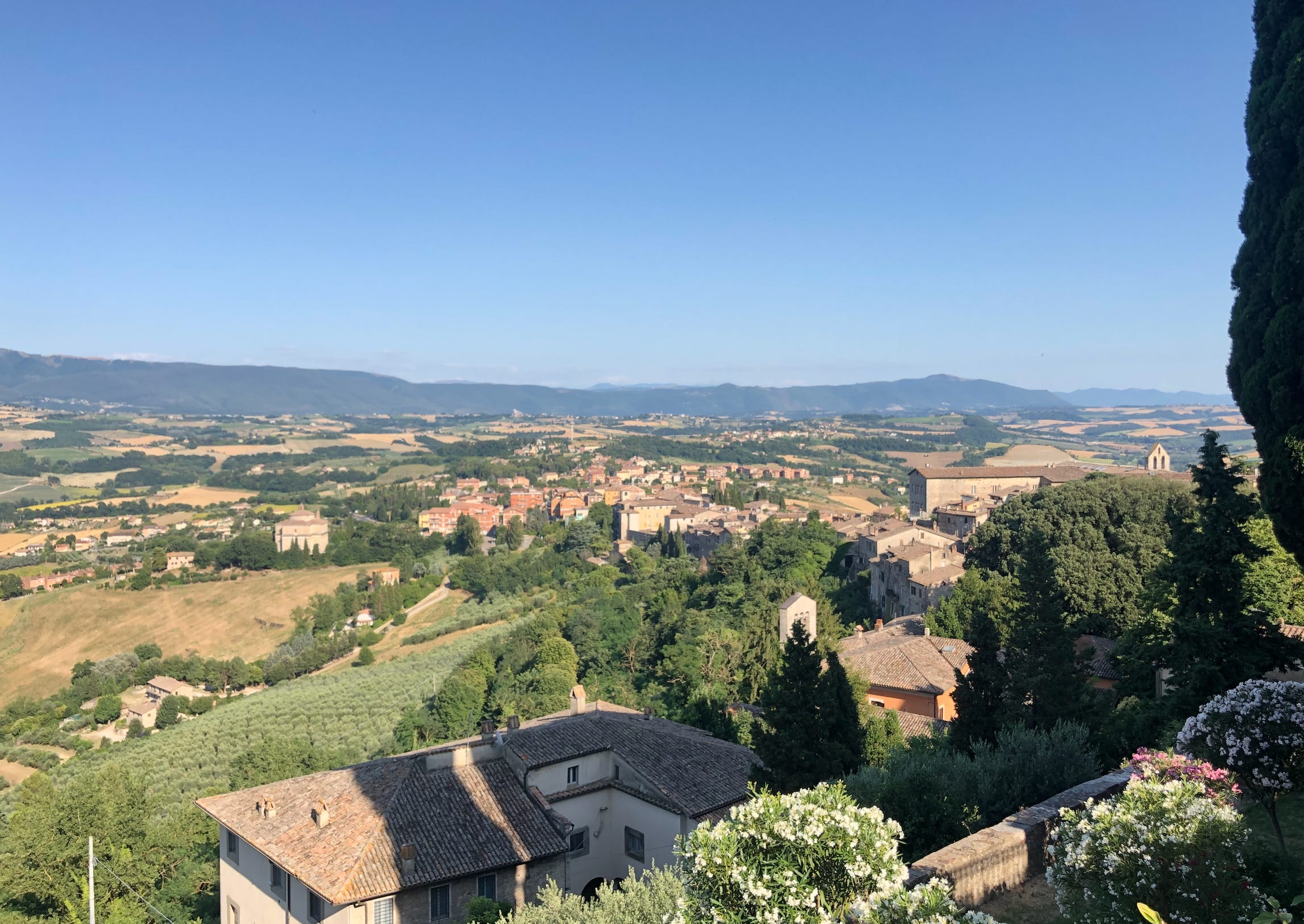
One of the most popular Hungarian novels is Journey by Moonlight by Antal Szerb, whose main character travels through Umbria, especially Gubbio. The novel crosses between magical realism, road trip and self-exploration, and it wouldn’t be a Hungarian novel if it didn’t deal with death (“Everyone should search for their own death.”). Without sounding corny, I can safely say it is a transcendental journey. And you can easily understand why when you are in Todi, especially when you are on the walls of the city looking over the Umbrian countryside.
A countryside that is totally different from Tuscany’s postcard-like themes: the treelines, the organized roads, the planned and built natural beauty. In Umbria, it is more raw. Tended, but still naturally raw, closer to the people who live there. The landscape has more hills, even mountains, and pastures or any kind of agriculture happen in the valleys, but these valleys are so small that from one town you can clearly see the next towns, sitting atop different hills and cliffs.
Todi itself does not sit on a basalt or tufa cliff like many other towns in Lazio and even in Tuscany. It sits on a simple clay hill that soaks up water, with kilometres of Roman tunnels and cisterns underneath it. Therefore the town itself is slipping. The local government invests heavily in preserving this hill. It is also quite big, and if you come by car, you will most likely park just below the upper town (the historic center), where they hold the markets on weekends. From there, it is still a climb to walk up to the town. But this is somewhat normal in Umbria, I guess.
The town has nothing to offer in terms of landmarks or unique sights, one Renaissance church outside the walls aside. And to get back to my original point on why it is relatively unknown to most people: it is quite well known to those who are looking for one thing, and one thing only, a working, functioning, living and handsome-looking Italian town that is just in neat shape. In the nineties, an American architecture professor called Todi the model of a sustainable city, and the Italian press promptly turned that into “the most livable city in the world.” He wasn’t wrong.
If you come from a somewhat wealthier area, e.g. California, and you’ve got used to a certain level of quality, but you want a historic center in an Italian hilltop town without anything fancy, I would probably direct you to Todi. It is no wonder it is popular with a certain type of American.
Almost everyone I met came from in or around the Napa Valley. Almost all the Germans I met came from either Hamburg or the towns around Munich. And yes, the Brits mostly came from Devon, Somerset or London. These are the wealthier parts of each country.
Unrelated, but since I’ve been living in Italy, I’ve escaped most of the summers, mostly to the beautiful countryside of England, the Fens or Cottswolds. I am not writing about the British countryside, but if there would be a countryside, I would write only about the British one.
And almost everyone I met was either a pensioner or close to 60. People who value a relaxed life around them, but not a dead, isolated, emptying town.
Todi delivers this experience, and frankly, so does most of Umbria. Would it be a good option for a detour? I’m not sure. Probably not. But would it be a place where I would literally check out real estate prices? Absolutely.
I did that on my first day.