

Hi, I’m Peter, and you’re reading Anywhere Italy. Our mission is to cover the 1,000 Italian towns most travelers skip, in person, one at a time. Come along for free, or pay to keep us on the road.
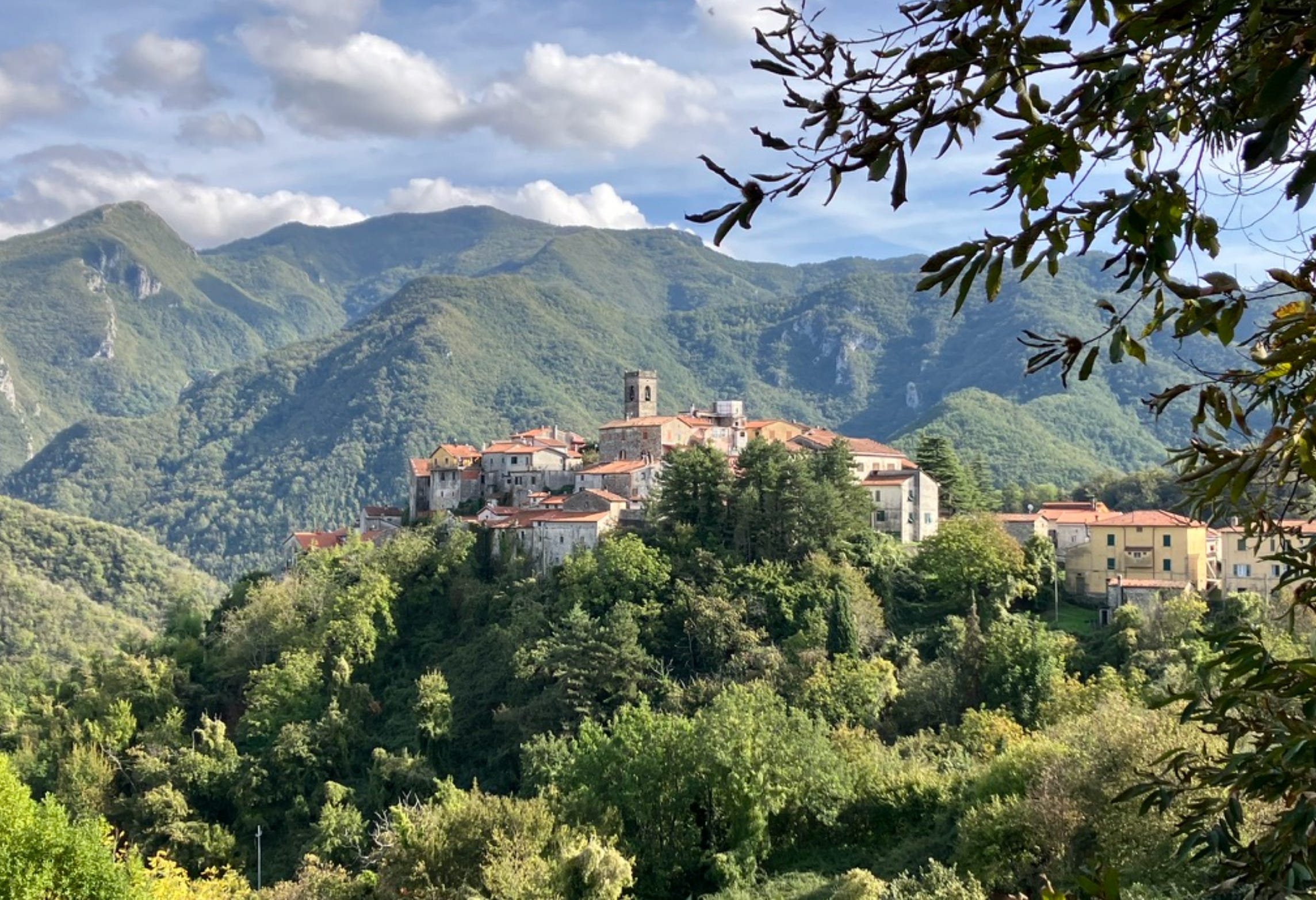
Close your eyes and picture an Italian town. I’d bet that 99 out of a 100 of you just saw the same thing: a medieval walled town sitting on top of a hill, or on the edge of a cliff, with a bell tower sticking out of the middle. The term “hilltop town” should be copyrighted to Italy. Yes, plenty of other European countries have fortified medieval towns on higher ground. But somehow, we associate this image with Italy and nowhere else.
In this piece, I’m not going to give you the single reason why, because I don’t believe there is one. I’ll give you a few candidates instead. The truth is probably all of them, doing their thing at the same time.
First of all, a confession. I didn't coin this (it probably belongs to Peter Zeihan or Jared Diamond), but you can explain all of human history and societal trends with two scientific practices: basic demography and geography. So, throughout this essay, you will find most of the references in basic demographic insights and geographical absolutes.
Second, a personal note. I grew up below the Mátra, the highest mountain range in present-day Hungary. I even carry the name. Benei means “someone from Bene.” Local legend says Bene was a Hun chieftain, a sort of junior Attila, who built a small fortress up in the Mátra. The ruins standing there today are medieval, so the legend is probably doing some heavy lifting. But the stream below still carries his name. Half of my family worked the valleys at the foot of the Mátra, and the other half came from the northern side of the ridge, proper mountain people.
What I’m trying to say is that I know both sides and both ways of thinking. There’s valley-thinking: abundance, anything goes, life is full of opportunity. And there’s mountain-thinking: everything has to be preserved, rationed and carefully managed, because nobody knows what tomorrow brings. The two are like yin and yang. Night and day. One of my grandmother peeled potatoes by scratching the skin off with a knife. The other carved the skin off, losing some of the outer rims of the potato. Guess which had the valley-thinking.
Valleys usually have a river. They’re easy to cultivate, they give constantly, and they allow an abundant life. As you learned in school, the earliest civilizations were river-valley civilizations, and even today, the most powerful cities are built along rivers. But valleys are hard to defend. Anyone who has read anything about military tactics knows that fighting a defensive battle on lower ground is a nightmare.
Mountains, on the other hand, lack resources, and the people who live there are used to a harder life. Some historians called the Mediterranean’s mountains a factory that produced men for other people’s use: soldiers, migrants, labourers, all sent down to the rich plains. Mountains are like deserts or steppes. They’re the edges, the margins of civilization.
As a Hungarian, I also know that sometimes people on horseback with arrows come out of those margins and conquer everyone living in the valleys. Almost every river-valley civilization ended up the same way: people from the mountains, deserts or steppes came down and installed a new order. The other way around is rare, slow and expensive, because there is no better place on this planet to defend than the top of a hill.
The clearest example is the first civilization of all: Mesopotamia. The core is the flat river valley between the Tigris and the Euphrates. Around it sit the margins: the Zagros mountains and the Iranian plateau to the east, the Anatolian highlands to the north, and the Syrian steppe and desert to the west.
The rivers gave water, so civilization grew along them first, with the Sumerians. Then the Akkadians, who lived in the same plain, united it into the first empire. Then people from the Zagros, the Gutians, came down and broke it. Then came the people of the steppe, the Amorites, whose most famous king was Hammurabi. Then the Hittites raided down from the Anatolian highlands, sacked Babylon, and went home. Then the Kassites came down from the Zagros again and stayed for about four hundred years. By then the valley had produced its own hardened warriors on its northern edge, the Assyrians, who conquered everything. Then the Persians came off the Iranian plateau. Then Alexander came from the west as an outsider, then the Parthians, then the desert people, the Arabs, and then the Mongols sacked Baghdad.
And here’s the funny part: almost every conqueror ended up adopting the valley’s gods, writing and laws. The margins won the wars, and the valley won the conquerors.
Italy is less tumultuous than the Middle East, thankfully. If I have to give you the TLDR version of hill vs river history here, it goes like this.
The first Italian civilizations started on hills overlooking rivers. The Etruscans, the Umbri, the early Romans, all of them.
Someone conquered it all: the Romans. Peace followed, and people came down from the hills. Many new Roman towns were built on lower ground, along the roads. Florence and Lucca both started on the flat.
Rome fell, and the peace was over. Towns on lower ground were easy to sack.
At first, people simply moved back up the hills. Then, long after the Lombards, around the turn of the millennium, it became clear that nobody was going to restore order any time soon, and the hill towns started walling themselves in.
For the next eight or nine hundred years, even as civilization carried on, the people who went uphill stayed uphill. Most of the hilltop towns you see today were shaped in this era, the medieval and Renaissance centuries.
The railways started pulling people back down in the 1800s, and after the Second World War the move became a flood. It’s still going, which is why so many hilltop towns are getting older and emptier every year.
In even shorter terms: in peacetime, valleys thrive. In wartime, hills are a matter of survival. And it doesn’t take a full war. In Italy’s case, the absence of anyone strong enough to keep order was enough. No war, just uncertainty, chaos and unpredictability, for centuries.
Historians have a name for the great climb: incastellamento, a term coined by Pierre Toubert. His point was that it wasn’t only about safety. With no king or emperor strong enough to keep order, local lords filled the gap. They built a castle on a hill and moved the peasants inside, because people behind a wall are easier to count, tax and put to work. Other parts of Europe have castle towns too: southern France, parts of Spain, Greece, the valleys of the Alps. But nowhere I know has them packed this close together.
In the north and the centre of Italy, the towns had one big advantage: the boss was away. The north technically belonged to the Holy Roman Emperor, a German king living on the far side of the Alps who showed up every few decades with an army.
The centre belonged to the Pope, who for most of the 1300s wasn’t even in Italy, he was in Avignon. So the towns ran themselves. The citizens elected their own consuls, raised their own militias, minted their own coins and built their own walls. These were the communes, little city-states, and they spent a good part of their energy fighting the next hill over.
Only later, as the communes decayed, did single families take over, like the Medici in Florence or the Baglioni in Perugia. Later still came the foreign dynasties, the Spanish Habsburgs in Milan and the Bourbons in Parma, and the popes came back to take their towns back one fortress at a time.
That’s why you can tell a Ligurian, a Piedmontese, a Venetian and a Tuscan hill town apart. Each one was shaped by whoever was fighting over it. The walls of most Tuscan towns? They’re the result of Florence, Siena, Pisa and Lucca spending three centuries trying to eat each other. Monteriggioni is Siena walling itself against Florence, and Lucca’s walls are Lucca making sure Florence never got in. The fortresses in the Apuan Alps and along the Ligurian coast? Those are what’s left of Pisa’s collapse and the rise of Florence and Genoa to fill the gap.
Almost everything on the postcards and in the tourism ads of northern and central Italy is a consequence of competing powers in the late medieval and Renaissance eras. And that competition existed because nobody had dominated this land since the Romans.
The south was different, because the king wasn’t away. He lived there. The Normans built a single kingdom in the 1100s, and after them came the Angevins, the Aragonese, the Spanish and the Bourbons. The south had hill towns, walls and castles too, plenty of them. But the town belonged to a baron, and defence was the king’s business. In 1231, Frederick II banned towns from electing their own magistrates, and feudalism in the south lasted until 1806. Same hills, different question: whose town is it? In the north and centre, the walls belonged to the citizens. In the south, the town belonged to the lord.
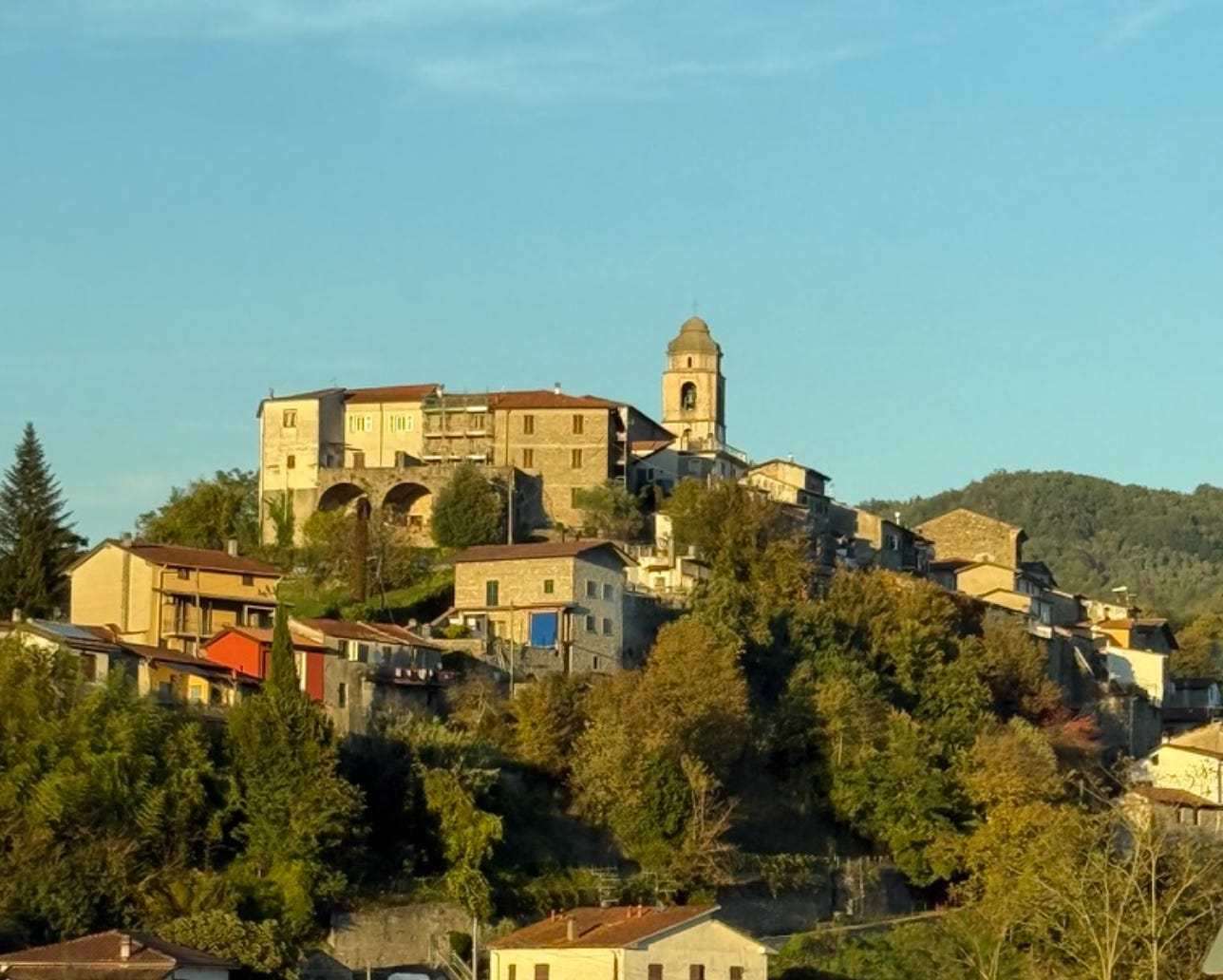
And here comes our friend, Mr. Geography. Look at a map of Italy, then at the baseline numbers. The country is about 42% hills, 35% mountains, and only 23% plains. The whole peninsula is one never-ending mountain ridge, with hills of every height, valleys in between, and the sea around the edges. Yes, the most prosperous periods in Italian history grew out of the valleys. But when things got a bit too chaotic, it was just so damn easy to retreat up the nearest hill.
Also, not many people know this, but malaria was a huge thing in Italy. Many valleys and coastal plains were marshes, and marshes meant malaria. It took centuries of drainage, then DDT after the Second World War, before the disease was gone. Italy was only officially declared malaria-free in 1970. I know this story well, because the history of Versilia, where I live, is full of malaria.
Then came the railways, which can’t climb, so they ran through the valleys. Stations were built at the bottom of the hill, sometimes several kilometers below the town, and a new settlement grew around each one. Then came the factories on the flat land, and after the war the cars and highways, which also follow the valleys.
This is why almost every hilltop town has a younger cousin down below. Same commune, just in the valley. Inland, it’s often called scalo, which means stop or landing: Orvieto Scalo, Narni Scalo. On the coast, once the marshes and the pirates were gone, it’s called Marina di Whatever. I live in one of these cousins myself: Marina di Pietrasanta, with the old town of Pietrasanta up against the hill behind me. Most of these lower towns are between a hundred and a hundred and fifty years old. Babies, by Italian standards.
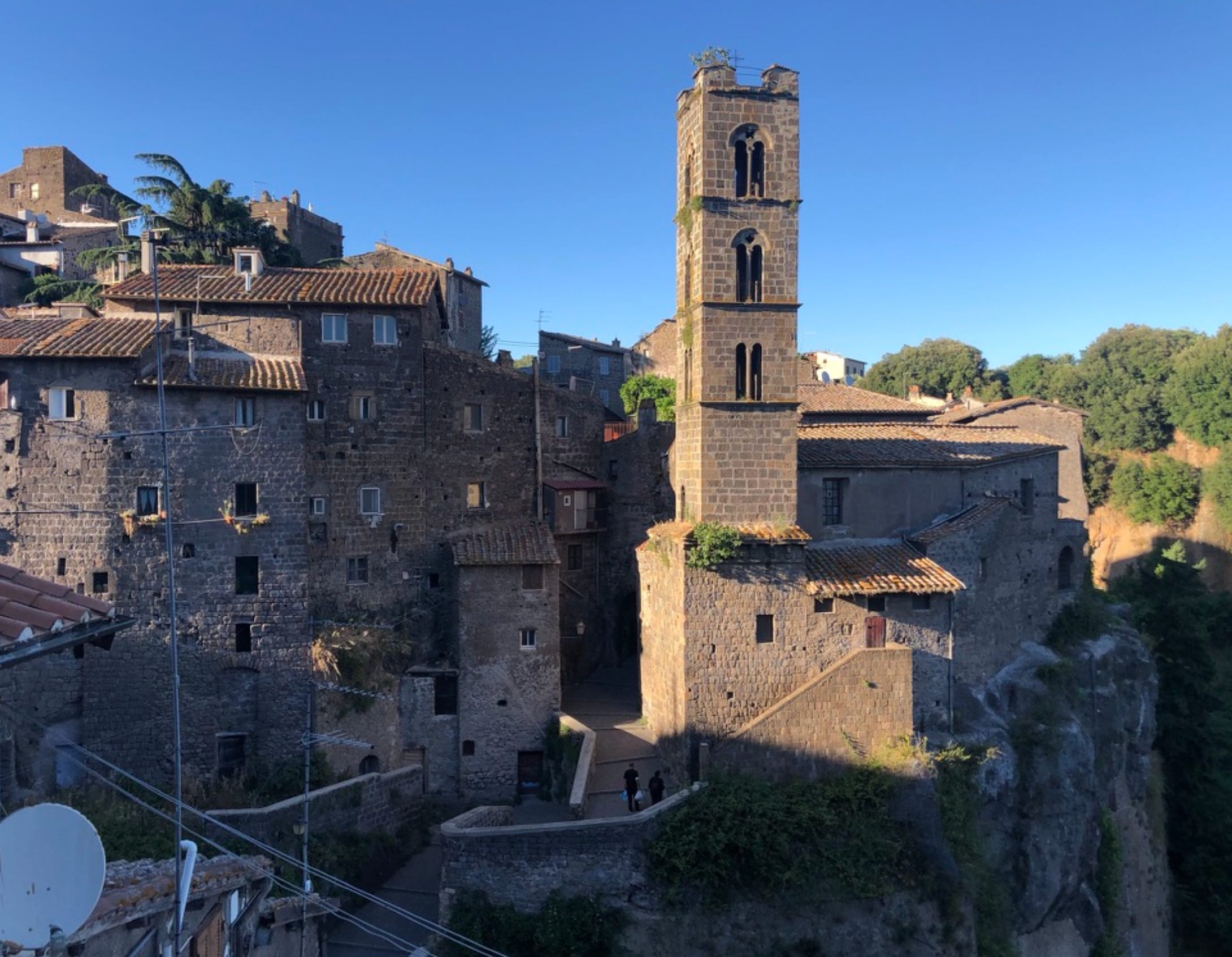
So why does Italy have so many hilltop towns, and why do they all look alike? As you can see (or read), there’s no single answer. The hills were safe during the chaos, the towns drove each other’s competition, and in a country where almost all livable land is either on a hill or next to one, it was the obvious place to build. It’s no wonder Rome was founded on hills.
The reason matters less, I think. The consequences matter more. Because these towns were close to one another, walled off from each other and competing, almost everything you love about Italy comes, directly or indirectly, from them.
The language is the most obvious. Italian is old as a written language. It’s basically Dante’s Florentine. But as a spoken language, most Italians only picked it up in the last seventy years, mostly from television. Before that, every town, every valley and every region had its own dialect. The differences are small between neighbouring towns, but put a Calabrian grandma in a room with a Piedmontese grandpa and watch them try to understand each other.
The food is the second most obvious. The shapes of the pasta, the type of bread, the salami, the pastry. As a foreigner, it’s funny to watch a town defend its pasta and insist it is soooo different from the pasta in the next town, when the real difference is the shape.
My best example is my local tordelli. Dare to call it tortelli! Since I’m a foreigner, this is not an identity question, so I’m happy to say that the Versilian tordelli is a meat-filled tortelli sold in Versilia. It’s like any other meat-filled tortelli. But I once got lectured by a waitress near Lucca that their tordelli is not Versilian, but Lucchesi tordelli. I tasted it. It’s the same. But I’m sure locals can name that 2-3 ingredients that are so totally different from the Versilian version…
But hey, I get it. For them, food is identity, and it’s a direct consequence of the hilltop mentality. The Italians have a word for that mentality: campanilismo, loyalty to whatever you can see from your own bell tower.
Art is another one, and I’d argue the Renaissance couldn’t have happened anywhere except Italy, for exactly this reason. Every town competed with the next, and when there was no war to fight, they competed in other ways. Art was one of them. I don’t know anywhere else on Earth where a town of barely two thousand people has world-class art and architecture at this density.
The piazza. Everyone says Italians treat the main square like their living room. Of course they do. In a hilltop town, the main square is the only flat surface on the hill. The whole town is narrow alleys and steep climbs, except that one square. So people flock to it, live on it, build their bars around it, and it wouldn’t be Italy if there weren’t a church there too. It’s the town’s living room because it’s the only room.
Then there’s the administrative chaos. I’m from Hungary, and I thought Hungarian paperwork was a horror story. Then I moved to Italy and learned what a horror story really is. I can’t even describe Italian bureaucracy properly. Imagine chaos merged with an immovable object, multiply it by a 1,000, and you’re getting close to an Italian municipality. The smaller, the worst. One of the roots is the hilltop mentality. Italy has almost 8,000 separate municipalities, and most of them have fewer than 5,000 people. No sane nation on this planet would keep a separate council and mayor in places that small. But try merging two Italian towns, or taking away their mayor, and they’ll feel annexed. Hilltop thinking again.
Cars. Italy has one of the highest car-ownership rates in Europe, and public transport is a joke of its own (though the railways are getting better). It’s easy to see why. Trains don’t go up hills. Everyone relies on their own wheels.
And then there’s family and community. This is an oversimplification, and plenty of Italians would argue with it today, but in most hill towns, family and the local community came before anything else: before the region, before the state, and obviously before Rome (Rome itself is universally either hated or ignored by Italians, except, of course, Romans, who are famously playing the same game with the rest of Italy). When these towns emptied out, with people leaving for the factories of the north or for America and Argentina, they organized themselves by village. In New York, whole streets were settled by people from the same village in Sicily or Calabria. The same happened in the northern Italian cities. Mutual-aid societies, hometown associations and a whole local civil society grew out of those old village loyalties. And I don’t even mention the word that you might be thinking, but yes, even that has its roots in the stateless hilltop ‘we are on our own’ mentality.
And lastly, yes, tourism. These towns are what everyone pictures when they plan a trip to Italy. But there’s an irony here. They were built to keep strangers out, and now they live off strangers. Another irony is how they were built: for mules, carts and horses. Today there’s usually one parking lot (always full), steep climbs (only the big ones like Perugia get escalators), narrow alleys and a small square. Visitors flood the 10 most photographed towns within easy reach of Rome or Florence, and those towns were simply never built for crowds. Their entire purpose was to keep people out, and now they’re drowning in them.
Meanwhile, aside from your usual San Gimignano, Montepulciano, Volterra, and other famous towns, most of the same-looking ones are still emptying out. Not that it would be my job to solve this problem, not that I can—but this is why Anywhere Italy was born anyway: to highlight the 1,000 towns most people skip on their trips. Check out our mission.
Frankly, I don’t care whether you have a good trip to Italy or not. To be even more frank, I think the country would be better off with fewer tourists. Since I can’t change that, all I can hope for is something more sustainable: visits that take pressure off the crowded towns and bring some life back to the skipped ones.
So visit the hilltop towns your hotel doesn’t market. Don’t just do the day trip. Sleep there, even for a single night, and watch the town close its shutters after dark and open them again in the morning, the way it has been doing for eight hundred years. These towns were built to outlast whoever was coming up the road. They’ll outlast us too.
