Italian salaries are low, but should you care about that as a foreigner?
Introduction to basic economics in Italy

Hi, I’m Peter, and you’re reading Anywhere Italy. Our mission is to cover the 1,000 Italian towns most travelers skip, in person, one at a time. Come along for free, or pay to keep us on the road.
If you believe in market economics, you arrived to this article with curiosity, even with a smile.
If you’ve read more Marx in your uni than you've read Milton Friedman, you arrived here with a slightly higher blood pressure.
If you are Italian, even the title makes your eyes roll.
I get it all, but fear not: all of you will be disappointed here.
So let’s begin. FYI, this is a sister article of my previous one on politics in Italy:

In my politics article, I argued (among many things) on one key theme: should you care about Italian politics at all?
My argument was this: as a tourist, visitor, traveler, and even a slow traveler who spends months here, you should care zero about Italian politics. You come for a visit, and even if you care, you couldn’t do anything about it during a short stay.
Think about it. If you visit Paris in October-November, do you care that the streets are burning every year? Well, maybe, but mostly because you want to avoid the riots on your way to the Louvre.
But if you are an expat who lives here, you should absolutely care, because it shapes your daily life, and if you stay long enough to become a citizen, you will vote on it.
Same goes for basic economics. You should know the baseline metrics, and what they mean in terms of the zeitgeist of the society. It also helps you to negotiate better prices on anything.
The format will be a new one: I will give you 5 charts on the Italian economy, and explain what they mean for you (not for Italians).
If it is not clear to everyone by now, I’m saying this clearly: this is an article for those who are wishing to move to Italy as a foreigner.
Disclaimer: I earn abroad and spend here, so I’m writing from the comfortable side of every chart below. Italians didn’t choose these numbers. They live with them, and nothing below is a joke at their expense.
And before anyone comments “go back to your shopping mall, expat”: I’m from Hungary. We didn’t have shopping malls until the late-90s, and trust me, our salaries are lower than yours.

Everything I write is free for its first four weeks. After that, only paid readers can access all the guides and dispatches, as well as the books I write, like these three, and the ones still to come.
To gain access, get the annual plan and pay 10% less, forever.
Budget for Italian salaries, not your home wages
Gosh, where should we start. Let’s start with the wages as it is in the title anyway. This is probably the most descriptive chart:
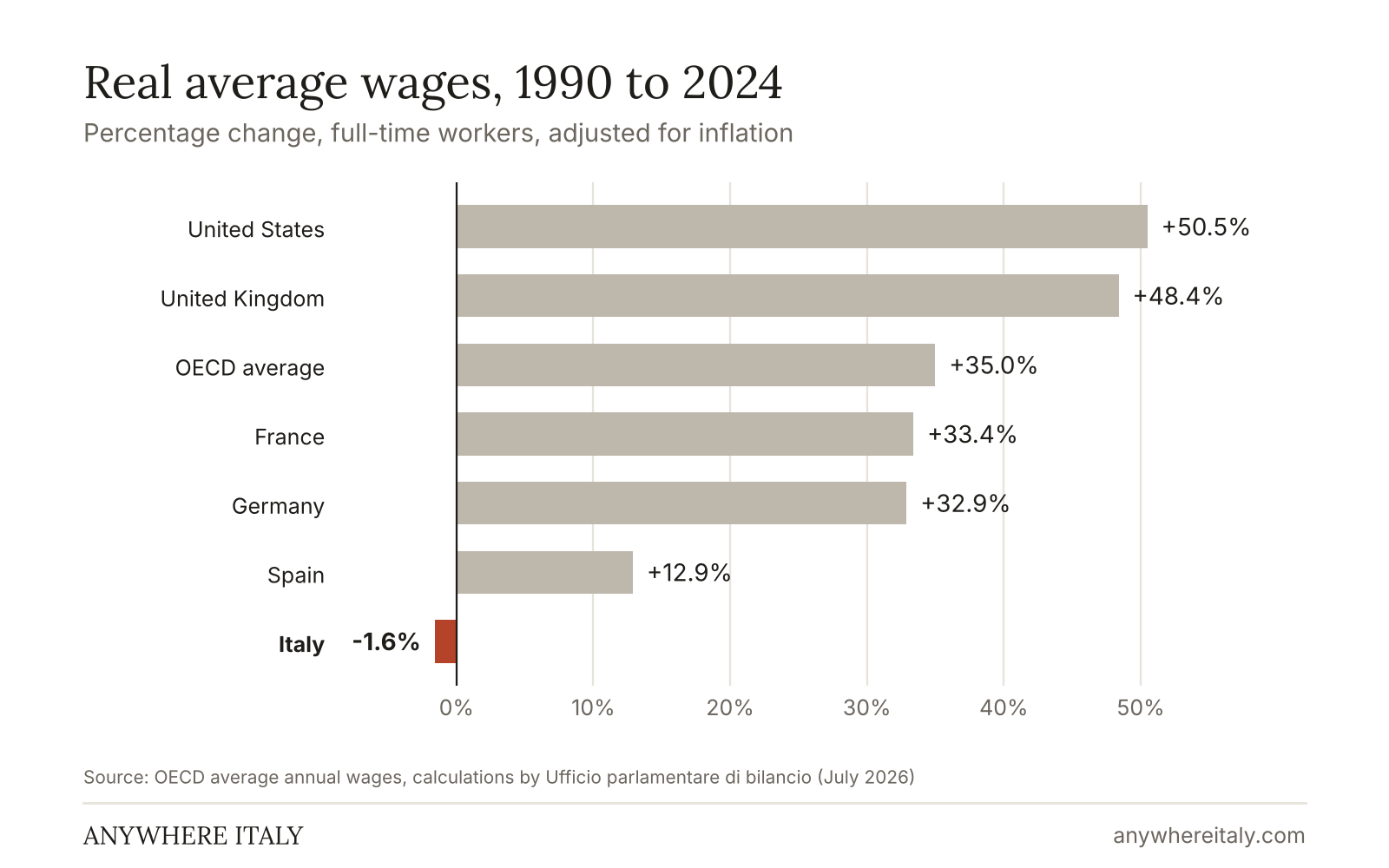
If you watch any news nowadays, it is filled with one core theme across the Western world: salaries are crap, they are not growing, who do we blame? Boomers bought their homes for pennies. Young people are stuck in shitty rentals or pay-till-you-die mortgages. The European protests you see are filled with the angst of young people who can’t afford the things they see online.
And even in countries where these themes are widely discussed, salary growth has happened, at least to some extent. Meanwhile in Italy, salaries are flat or even less for an entire generation. Italy is the only large Western economy where you earn no more than your parents did at the same age.
The chart doesn’t show it, but it is getting even worse. Since COVID, while most economies have managed to rebound, Italian wages lost 8% of their buying power. Insane.
A typical salary is about 1,500 EUR after tax per month. Yeah, it’s one thousand and five hundred. I didn’t miss a zero. I wish.
The reason behind it? Many, not that you as an expat can do anything about it. But it is mostly how the economy is built up from the ground. In Germany, mid-sized businesses are the backbone of the economy. In the US, it’s giant corporations.
In Italy? Famiglia! Micro-companies, otherwise known as family businesses. And family businesses are always cheap on cash, low on investment, thin on margins, and therefore low on productivity. Add astonishingly high taxes that obviously create a grey economy.
Also, it’s Europe, so the bigger your business, the more red tape you need, which is hated by everyone except government people. So your incentive is to stay small, family-small. Most businesses make money to keep a family afloat, maybe a bit more. The restaurant, the dentist office, the legal office, the architect studio, the bar, and the local handymen or arts & crafts whatever, are all family-run micro-companies.
What should you do with this information?
Your US or UK income has a big runway here. I’m Hungarian but only work with US/UK clients, which means a middle-class equivalent income via online contracts puts you into a very comfortable social status in Italy.
Low wages also explain the prices. Anything that is made of local labour is mindbendingly cheap. And because millions of family firms are competing with each other, everyone is doing their best, which means the local produce is always super cheap AND amazing quality.
Seriously, most of the things you buy with an Italian badge on it in your supermarket across the big waters cost 10X less here and taste 5X better.
Services too. I almost always default to “OK but is there a paid option?” Paid healthcare, your hairdresser, the gym, the cleaner, the plumber, anything that relies on wages is suspiciously cheap.
That said, anything that is priced on global markets is a serious offense to everyone living on Italian wages: cars, fuel and energy, electronics. Anything that has a ticker on the stock market is only affordable for the upper middle class of Italians.
So, some practical tips:
Bring your income with you. Rent out your house back at home. Rely on remote work, pension, or investment funds. Never rely on an Italian salary, because at best it is a bonus.
Budget for local salaries. If the town where you are trying to live eats up more than 3K EUR (with rent included), it is priced for foreigners, not locals.
Don’t show off. Most American and British people have far more spending power than any Italian. Try to hide it, never perform. Locals will notice if you do.
If you talk with Italians and notice some trends, this is why they exist. Young people move abroad (Germany, UK, and Switzerland are close) to earn more, not for adventure. This is why 30-40 year old people live with their parents. This is why two-income households count euros together.
Personal story: I come from Hungary, one of the poorest countries in the EU, so you can’t really say I was born with a silver spoon. Yes, I’ve spent years in the UK and I have worked online for more than a decade with US/UK clients. But I’m not price-blind, since I grew up in a country that was de facto Commie until 1990.
With that said, one of the biggest surprises to me in Italy was how affordable the country is.
I am not joking, I stopped with this now, but I used to send some grocery bills over to my friends in Hungary, saying that look at it, it’s almost half the price as you would pay in Budapest, and it is Italian quality.
Imagine the tragedy here, I’m not sending this to my friends in the US or UK, where it is obvious you pay 2-5X more on everything. I am sending this to a country that has one of the crappiest economies in Europe.
Quick share: our household (my wife & me) spends around 2-3K EUR per month. No rent, no mortgage, no credit, no lease, we own everything outright and we are not a big fan of credit cards either.
Largest slot is infrastructure. You know, fuel, gas, heating, net, mobile, water, condo cost, public transport, online services, etc. Basic things.
Groceries, we pay about 300-500 a month on it, and we only shop in the most premium grocery shops possible (Esselunga & NaturaSí), and cook a lot at home, so this is truly the max number you can spend… Buy from any discount shops, still totally OK quality most of them, you spend half of this number.
Eating out and shopping are there, sure, we are big there, but it is also the most flexible slot. If you don’t make much, you don’t eat out or buy much, simple. Services? Almost nothing, gym, haircut, some other minor things, but all of those are, sorry, but cost pennies. Anything that needs local labour is shamelessly cheap. Anything that is priced globally is expensive.
You will live in a region, not in a country
Everyone says that Italy is more about its regions than it is about Rome, and I agree. Especially when it comes to money. You can describe a region in many ways, but for the individual who lives there, GDP per person is the number that matters most. It is the GDP of the region divided by the people living there. In short: how much the region produces for each resident.
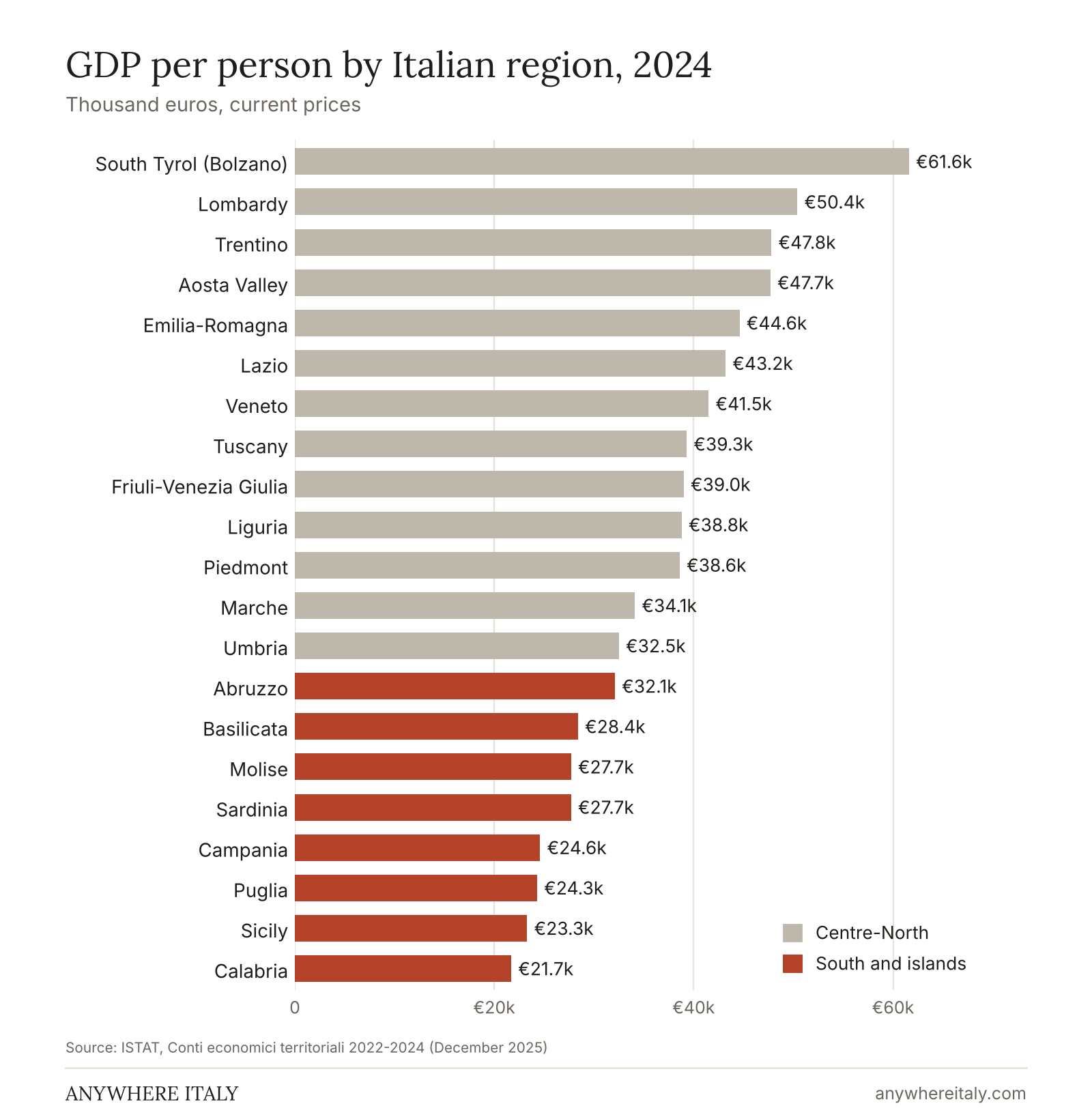
Why GDP per person? Because the more a region produces per person, the more it can spend on services for its residents. The higher you are up on this chart, the more likely the services and well… EVERYTHING will be better.
Now, this chart is still a bit unbalanced.
Some regions are autonomous, which means they keep more of their taxes. Trentino, South Tyrol, Friuli, Aosta are all autonomous. But so are Sicily and Sardinia, and no one would say they are doing economically great. So being autonomous means not much, unless you are in the North.
Some regions have key cities which produce a big share of the country’s GDP. Looking at you, Milan and Rome: their two regions make about a third of it. On the other hand, Turin is also a major city, with Switzerland and France close by, yet Piedmont as a region isn’t doing that great. So a big city doesn’t guarantee success on regional level either.
Spending power follows this trend, but it is less steep. People in the South have about 70% of what people in the Centre-North have to spend. Not a big difference from your POV, but it is a difference.
The shape of this chart is more than a century old. Numbers were different, but the trend was the same: the Centre-North produces almost twice as much per person as the South, and even the poorest regions of the Centre-North are richer than any of the South. Also, the closer you are to the Alps and the Po valley, the more likely you make more money.
What’s the deal with this for you?
If prices of services and goods follow the salaries, then the quality of services and real estate prices follow the GDP per person in each region.
In other words: expect far better services and pay extra for housing if you pick a region that is higher on this chart. It is not a coincidence that you don’t have 1 EUR housing programs in the North…
I can confirm this through my own examples. I’ve lived in Rome, spent time in the South, and lived for years in Tuscany. When I moved to Turin, I had to take care of many issues with public services: healthcare, residency changes, buying the property.
I did it all in a few days and everything just simply worked. I texted an Italian friend to tell him my astonishment, because I am always surprised when things just work in Italy… I still have the text message that I got back:
“Welcome to the North.”
Real example: any deal with the local council in the Centre-South takes 10 appointments, 5 letters (not email, because no one understands what an email is), 500 forms, and about 2 weeks of your time with 50+ more grey hairs grown on you. The same deal in the North is one appointment that is done in under 10 minutes, and you file all your crap online, like you would do anywhere in 2026. I’ve been there, done that, both.
Prices track this too, so you pay more for rent, housing, building costs, eating out. There are blind spots (Turin is mindblowingly affordable compared to any other Northern big city, yet provides Northern-level services), but this is generally true.
That all said, I wouldn’t write off the South:
Decide what you are buying. If you need international schools, specialist healthcare, fast trains, airports, and an efficient but still Italian life, go North. If you are healthy, want to retire and want big spaces on a budget, South is winning.
The best overlooked ones are in the Centre: Abruzzo, Marche, Umbria. Southern-level prices, but services are almost Northern-like. Also, don’t forget the blind spots in the North: Turin, small towns in Veneto and Piedmont and Tuscany, and overlooked port cities like Trieste or Livorno.
Hospitals above all. Before you buy your home, check not the real estate prices, but the local hospitals.
Tax and property incentives are there for a reason. The 7% flat tax for foreign pensioners applies only to Southern towns, and you can’t find 1 EUR houses in the North. There is a trade being made. But if you decide to go South, use all the incentives possible. Let the smoothness of a “damn good deal” ease you into the absence of well, most things, in the South.
This chart also explains what you might hear around the bars: young people moving to the North to work or have a family, while their parents stay behind in the South.
You buy a home, not an investment
This is the last chart that has a real connection to your own bank account, because the last two are more descriptive of the long term. So, housing prices. This is my favourite, because it tells you the most important lesson: buying a property in Italy is NEVER an investment decision.
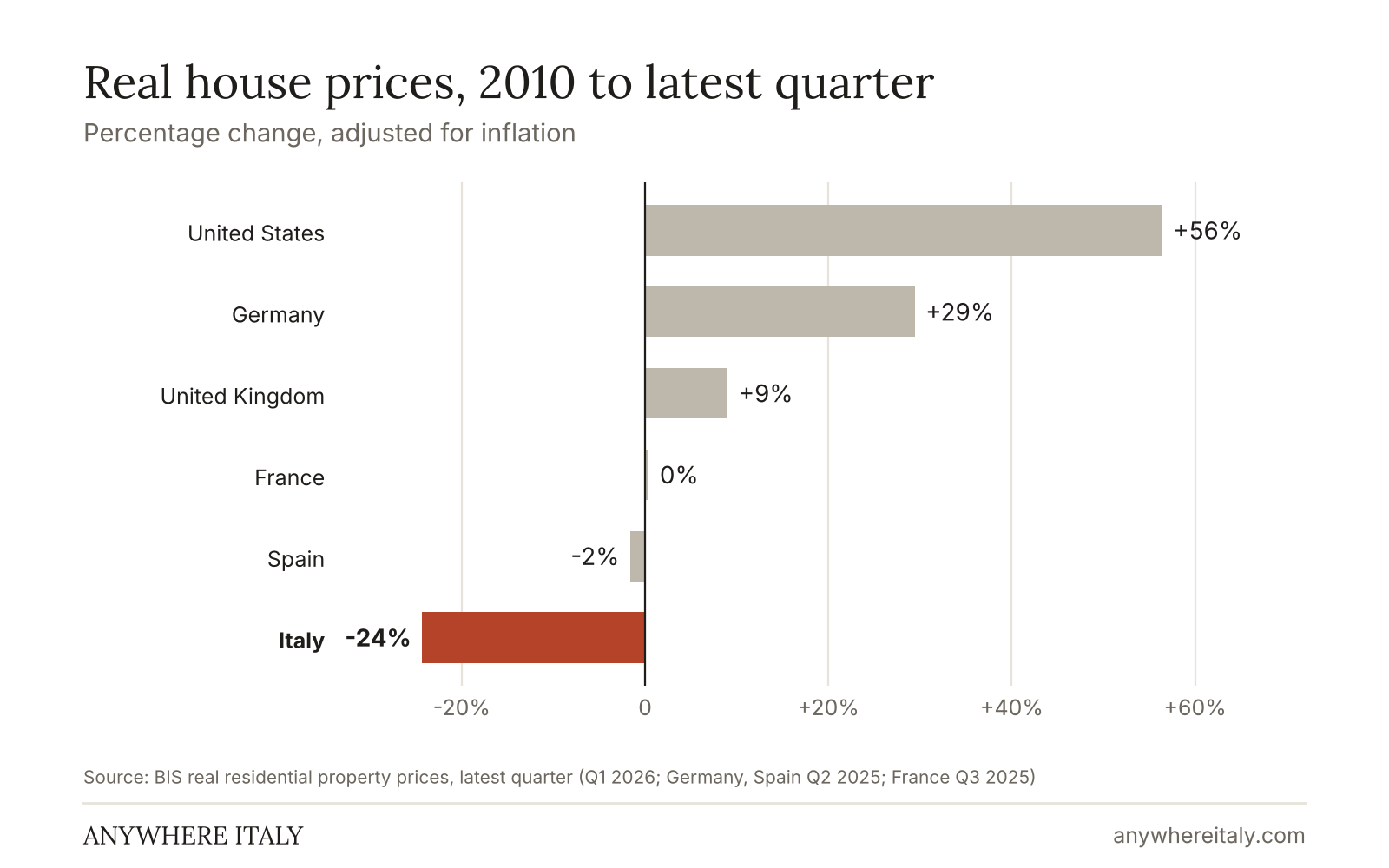
A little economics explanation is required here. That hilarious -24% you see is after inflation. In plain euros, prices are more or less where they were in 2010, which is its own kind of insane, because in most of this world real estate prices just grow, like, ever, everywhere, all the time. Real estate is a conservative, but predictable investment that produces real returns if flipped or turned into cashflow. Unless… you have it in Italy.
There are a lot of reasons why Italian real estate is going backwards. It’s a combination, as always: no salary growth (also look at 30-40 year old people living in nonna-hotel), declining birth rates (fewer young people to buy homes), high home ownership by default, and most real estate changes hands by inheritance, not sale.
Also, this is an average and it doesn’t show you the split. Remember the regional chart? Milan, Bologna, Florence, lakes, and famous coasts are rising. The rest? Flatline. Small towns in the Centre-South? Massive decline. The price of my apartment in Turin would buy me an entire villa in Sicily.
I started with renting. I paid around 1,500 EUR per month in Rome and also in Tuscany on annual contracts. All of my rentals were super modern condos with A/C and at least 3 bedrooms in prime central locations or less than 100 meters from the sea.
1,500 EUR per month is a huge number for most Italians. But I paid about twice this amount in London, in 2012, for a 1-bedroom damp hole in Camden.
The apartment that I own now in Turin is a penthouse, similar in size & quality to my rentals. The price was probably about the price of a 1-car garage in the outskirts of New York. My home comes with a garage, a 2-bedroom extra attic that I use for a home office and yoga room, a U-shaped panoramic balcony, and a large storage room in the basement... It was equivalent to a small shitty 1-bedroom condo in my home town Budapest.
I think you get the comparison here…
Ok, but how to use this information?
In short: you can afford to own everything outright. People worry about how to get a mortgage here. Good news: you don’t need to bother. If you sell your home in the US/UK, you will come with a multiple of what the same space costs here.
Know this also: the value of your home won’t grow much. Keep it forever. Sales are super slow (people sell their homes for years), and the cost of buying and selling is super high. You pay a lot of fees and taxes, and you have to deal with Italian real estate companies, which is a trauma on its own.
To all of you who watched the YouTube videos on “I renovated my Italian cottage into a dream villa”: the crappy ruin you buy for pennies will cost the same as the fully renovated villa next door after you count in the renovation. Oh, and you have to work with Italian renovation crews, which is, again, a trauma on its own.
I have heard horror stories that you can’t even imagine.
Me, I was lucky. My real estate guy was a boss, and my renovation crew wrapped everything neatly in a few weeks. Romanian guys, of course, so they knew how to work fast.
It was Turin, so the North wins on this as well, and I’m very sure that I paid the “foreigner tax” on prices. Even with that markup, it was affordable.
My tips with this topic are simple ones:
Rent first where you want to buy. Rent is cheap for you, and since sales are slow, I can guarantee that the villa you’ve been lurking around will still be there next year…
Buy until death and never pay full. Sounds grim, but yeah, buy to keep. And asking prices are just for the show, so negotiate. Especially on high-priced places, which sit on the market for years.
If you want to resell or rent it out, stay in liquid markets. Cities with universities, cities with jobs, or places where foreigners already buy. The entry price will be higher because getting out easily is already priced in.
Investment should be elsewhere. Anything that grows and anything that is outside of Italy. You still have to declare it if you live here, and you will pay some taxes on it. But keep it away from Italian banks and Italian real estate.
Last thing on this: the quality of real estate. Now, it’s a mixed bag and it is all anecdotal based on my own personal experiences mostly. But if you have regional differences in GDP, low income and salaries, and a devalued housing market, I’m sure it’s kinda easy to guess the quality of most properties. There are three main groups:
Premium homes. There are some amazing properties in Italy. Renovated medieval villas, countryside homes, old luxury apartments, etc. High life. Fact: almost all of them are priced for global buyers. So don’t expect good deals there. They come mostly above 1M EUR.
Normal people homes. The 100,000 - 350,000 EUR range, let’s say. This might be offensive to Italians, but again, I’m coming from Hungary, no one can say that I’m spoiled, but honestly, it is a miracle if you find a home that has proper living conditions. Compared to most European countries: OMG. And if you compare it to your home in the US or UK, well… you’ll need to make some adjustments…
The rest. I would argue that about a third of the homes are at medieval level. The cute apartment in your stone house in the coastal town? Sure, looks amazing and charming, but it had its last renovation around the 1700s. The villa in the countryside? Sure, the land is awesome, but wait until you check the roof and the walls, good luck fixing them. Any property in a medieval borgo? Jesus Christ in Heavens.
And building a fully new home? Well, tell me if you’ve managed to do that with Italians. With Italian construction team. With Italian council and its paperwork. Under 1M EUR. Under 1 year. I’m curious to hear your story. I’ll buy you a dinner probably, to show my forever respect.
You are wanted
Whatever Italians say about “rich expats playing with their money in Italy, while we Italians can’t afford basic things” (I’ve heard this 100 times from locals), you are wanted. Like a piece of cheese, like some salt in the Tuscan bread. You are wanted, and you are needed. You keep things alive here, literally. See this chart:
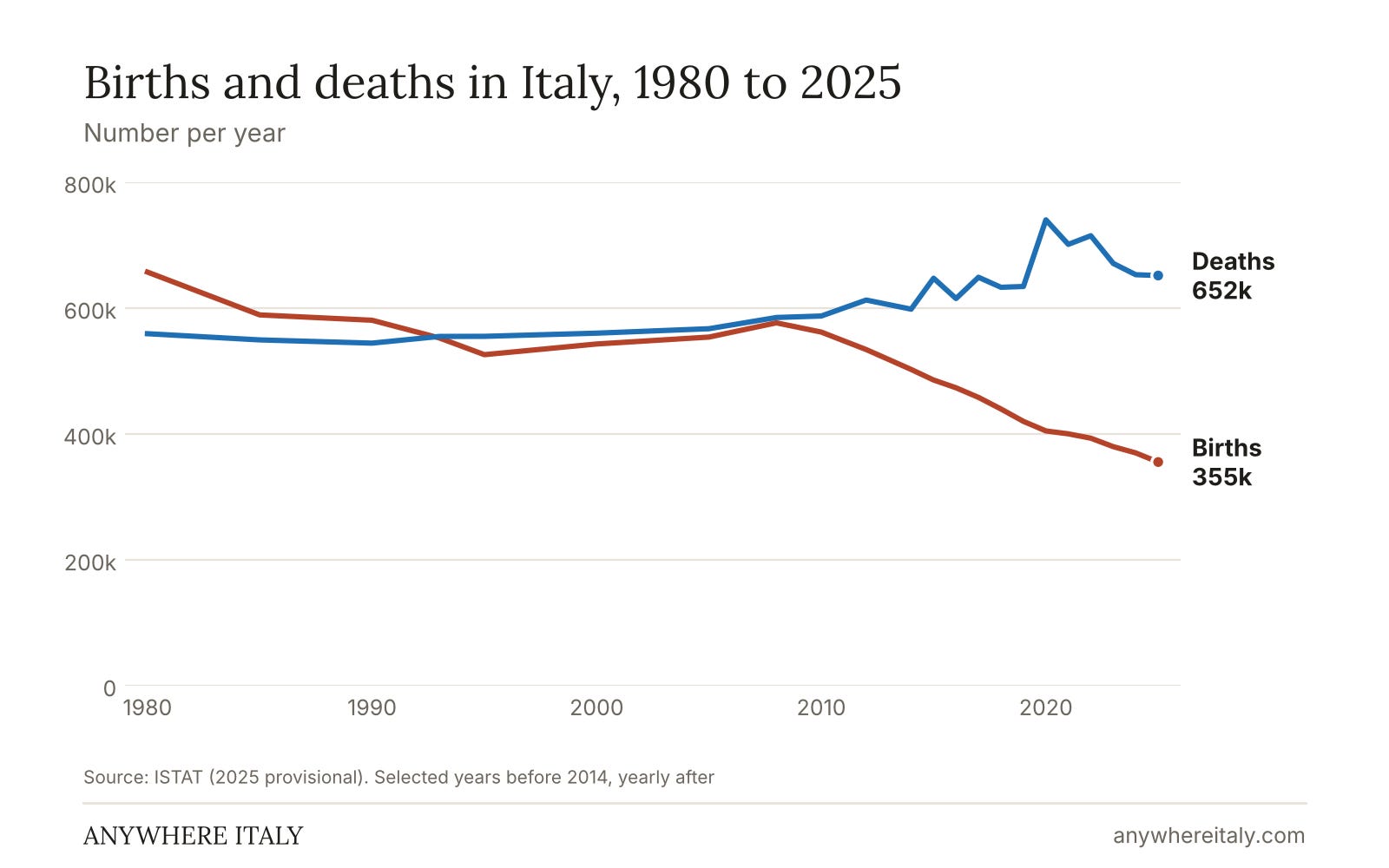
Italy is the second oldest large country in the world (again, Japan is here to claim the crown). A quarter of its people are above 65. Fertility is barely over 1.1 children per woman. A population needs 2.1 to stay flat.
Immigration is the only thing keeping the total flat right now. And don’t even get me started on whether Italy needs immigrants from poorer countries at all, because who else would come to work in the South anyway. Italian politics talks tough on this one, by the way, while the work-visa quotas quietly go up.
The declining birth rate is the real reason behind the decline in housing. It’s hard to sell fast if most of your country is pensioners. Towns are emptying out, homes are not built (there’s no one to build them for), and anything outside of university cities is in decline.
The services follow this trend. The more old people you have, the less you need schools, modern eating-out options, and shops.
In Tuscany, this was turned up high when I lived there. Bear in mind that I’m 44, my wife is 35, and we are somewhat active people.
Finding a proper gym or any kind of activity that is not geared to 70 year olds was hard in Pietrasanta. Once, my wife had some cramps in her shoulder, so we went to a local manual therapy service, which turned out to be basically a service for very old people, not for young people with sporting accidents.
Good luck finding shops for people under 60. We went shopping either to Pisa or Florence.
Modern international kitchen is non-existent outside of the cities. Old people want to eat what they ate for the last 80 years and most of them have no idea what an “izakaya” or a “pub” means.
One of the reasons why slow life exists in Italy is the endless old people. They take their time in offices and when they drive. They chitchat for days in the grocery shop lines. Getting anything done takes 10X more time than it should.
Now, before you say that I’m blaming old people, no. I love this slow life and I also love old people. I have also developed skills to do things my own, younger way. One example: ever noticed that the lines at human cashiers are always full of old people, but the automatic cashier is always, and I mean always, empty? There are shortcuts like this.
This is not the case in university towns, or in towns with a proper working economy. The slow life is mostly the countryside and small towns.
I never forget that after our first year in Pietrasanta, we visited Italian friends in Verona and went to a bar full of young people. I looked at my wife with despair: what do we do, I forgot how to talk to young people! (We managed in the end.)
On this and the last chart, I have fewer rules for you, sorry. The most important one: if the town’s majority is 65+, price in the time. The school, the bar, and the houses will be closed and empty within 20-30 years. Can you afford to deal with that?
Another one: stay close to a real city. We lived near Pisa, Lucca, and Florence. Keep the cheap prices and the calm where you live, but have options within an hour’s drive.
Everything I have said is 100X more important if you are younger. I’m not sure that anyone should move to Italy at 20-something unless there is a special case (marriage, amazing international job offer). I just don’t see why anyone would pick a town that is more like a retirement home in their 20s. You move to London for the opportunities. You never do that for Italy.
Taxes are insane
The last chart is an interesting one. The Italian state has one of the highest debts in the world as a % of its GDP. In nominal value, sure, the US and others owe larger sums, but Italy owes more compared to its GDP. But household debt is very low. I mean, very. Which paints an interesting picture.
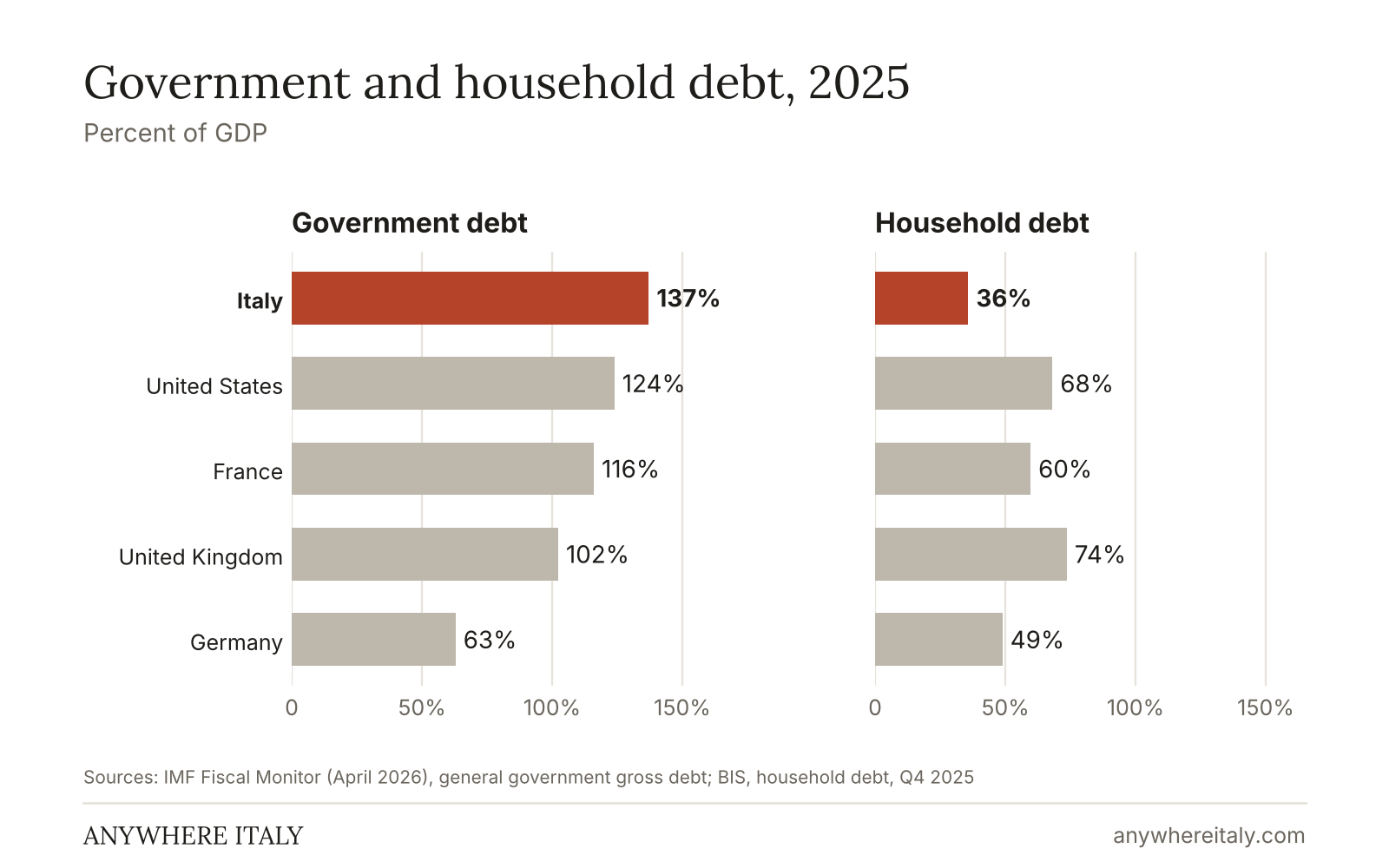
First, the state debt, because here the picture is black and white. It is frightening to look at. Greece is worse for now, but the IMF expects Italy to pass it by the end of this year. And it is still rising.
Why is not part of this essay, because people write PhDs on this topic. From what I can gather: when the post-war economic miracle ran out in the 60s, the state kept spending through the 70s and 80s as if it hadn’t. People retired in their 40s, everything was a public job. Free money.
Politics followed with unstable governments (Italy is famous for switching cabinets like you would switch pants), which didn’t help with long-term planning.
From the early 90s, to get into the euro, the state got more disciplined, but it didn’t matter much by then, because the economy had stopped growing, and debt means low spending, and thin government services fuel further inefficiencies. At least in Italy.
Japan has the same story on growth but a different one on efficiency: the highest state debt in the world, and one of the most functional governments. But, as we all know, Japan is on another planet.
As an expat, just know: anything that is public operates on a thin layer, with very limited money.
It also means that you will get taxed like crazy. As someone who lives here, oh boy, welcome to my life. Income tax, social tax, VAT, all super high, and there are extra taxes on property and financial assets, and they apply globally, no matter where you hold them.
But remember the previous chart. The state has no money and needs taxpayers, but there are no babies. Enter you, dear expat with money.
So you (or me) as a new person living here are wanted so badly that Italy offers special tax regimes for new residents. Ask your accountant, but there are several: a 7% flat tax for pensioners in small Southern towns, a big income-tax discount for workers who move here, a flat yearly sum for the very wealthy, and an investor visa.
I’m a freelancer here and it is not that complicated to do your taxes. Especially if you earn a lot via foreign clients. Also, as an expat freelancer, I pay less taxes probably than most local Italian freelancers, because I have tax regimes that are exclusive for new residents. Crazy.
When I signed up with my accountant, I showed her my first invoice (wanted to see if I did it correctly), and she asked if this was the full revenue for the month (it was a 1,200 EUR invoice). I said no, it’s just one of many. Interestingly, she became very motivated to offer further services to me… Since then, I don’t do my taxes, all is managed for me.
So how to budget this?
Hire a very good accountant when you land. Only a few speak English, so pay for the best. Whatever they ask will be a fraction of your monthly revenue and will pay for itself within the first year. Keep them, because a government this dysfunctional and in debt will change taxes every fiscal year…
Italy taxes global holdings. Whatever you have abroad, declare it. Penalties for not doing so are higher than the taxes.
On healthcare and pension: pay in whatever you must, but budget for private options. Private healthcare is dirt cheap compared to US standards and saves months of waiting. And pensions follow salaries, so you need your own plan.
The household debt is not really important for you, but it is the interesting part of this picture. It is oddly low. Which means a couple of things:
Italians own their homes outright. Almost every family has a house in a small town somewhere, because the nonna left it to the family.
Italians love to save, despite whatever you see. Wealth is kept within families, so it is generational and accumulated. Some banks are 500+ years old with continuously open accounts older than the state of Italy itself, managed for the same families. And don’t think about dukes and princes — these are everyday people mostly.
The slow life explains itself here. I have seen this only in Italy: people in their 30s and 40s casually open their shops only if they feel like it. Why? It’s a bonus, it won’t add to the bread. Houses are paid off and everyone inherits everything.
It also explains the housing weirdness. People without a mortgage are never forced to sell. And the long-term rental market is small, because, yes, you’ve guessed it, most people own outright.
Lastly, when everyone has homes and savings, banks are more conservative than a Tea Party member.
Cheap but fully owned housing, slow life due to an aging population, an inefficient state in huge debt, and low household debt together mean that even if the salaries are low, people don’t really care.
Well, one demographic really cares: young people. This is why you see student protests and riots nowadays. Will it stay and become a trend? Maybe.
For the expat, you, Italy is one thing for sure: an affordable way to buy a very, and I mean very, comfortable lifestyle in the most beautiful country on the planet. Just keep in mind that you are on the top of the crème, upper middle class at least, just by selling your home in the States.
Just to compare in a funny way.
I opened my first UK bank account at HSBC, because it was the closest to my home (10 steps from the door, Lloyds was 20). I had an annual rental contract and nothing else, no job, no salary, and maybe 5K GBP cash.
The clerk asked what I do, I said I’m in advertising. He said wonderful, that pays well, let’s open the account and start with an optional 50,000 GBP credit line. For personal use. This was more than 14 years ago. About 5% of Italians earn in a year what a random Eastern European dude with no job got offered as free credit in the UK, more than a decade ago.
To me this says two things:
I should have gone to Lloyds first, because a year later I got 2X more there as an offer, bloody wankers.
I’m almost 100% sure that you can afford to buy and live your dream in Italy. Just price in the reality of the local life, as that will be the trade you will deal with.

Discussion about this post