

Hi, I’m Peter, and you’re reading Anywhere Italy. Our mission is to cover the 1,000 Italian towns most travelers skip, in person, one at a time. Come along for free, or pay to keep us on the road.
I’ll be moving to Turin in a couple of weeks, so I am wrapping up my life here in Versilia. Aside from logistics, I have realized I have never written about the mountains above Versilia, even though we have visited them countless times. I once wrote about Carrara and the marble, and also about the lardo in Colonnata. And I also did a documented roadtrip through Lunigiana and Garfagnana, but those are the other side of the mountains here in Versilia, running through the valleys.
So, where are we? We are in Pietrasanta. I’ve been living here for the last three years. In front of me is the sea. Behind me are the mountains. Almost everything is about these two things. The sea gives you food (the best seafood ever) and tourism. The mountains give you mostly marble. Carrara marble is world-famous, extremely expensive, and has a heritage traced back to the Roman Empire. Which means, around here, most people either mine, package, ship, trade, or sell the marble. Or they are artists who create beautiful marble sculptures from it. Pietrasanta is the capital of sculpture, with modern art exhibitions, operating galleries, and still-functioning workshops. Forte dei Marmi is like a fashion-nerd festival from Milano, with a pop-up town by the sea, luxury brands, and excessive lifestyle.
And you have the working towns and villages. The ones who make this lavish life possible for hundreds of years. No songs are written about them, and rarely does anyone visit them who is not local. Colonnata somehow got its fame because of its lard. But almost no one knows about Seravezza or Stazzema. Maybe some people saw The Miracle at St. Anna, a Spike Lee war movie. Which was universally hated here, by the way, but more on that later.
A note before we go up. Seravezza and Stazzema are two separate towns, two separate communes, two separate mayors. I am going to treat them as one place in this piece, because they share one valley, one mountain range, one economy, and one road, and because nobody who lives here thinks of them separately either.
First, the why. You might have a different why than us. We go up to these towns for the same reason: to escape. There are bus routes, but trust me, you need a car to go up there. The roads are super windy, curve after curve, and locals drive 3x as fast as the speed limit, and it is a miracle that only a few people die on these roads. In places, the road goes straight into the mountain, through unlit tunnels cut for marble trucks, wide enough for a truck and nothing to spare, and you come out the other side with the drop on your side. Seravezza is at the bottom of the mountains, so it is easier to reach. Stazzema and especially its little villages are almost an hour’s drive from the sea. So you have to be really committed to going there. Which makes it an escape.
Once you are there, three things alone make it worth the hassle. First, the absolute drama of a view.


You mostly see two different mountains, both of them worked for marble. One is Monte Altissimo, cut into the rock on its flanks, above Seravezza. The other is Monte Corchia, above Levigliani, worked on the outside and hollow on the inside: the largest cave system in Italy runs through it, and water made that one, not us. Both mountains give up more than marble. Under Levigliani, mercury workings were already written down in the twelfth century, and the mercury sits in the rock there as liquid metal, which is close to unique in the world. Everyone in these towns either works the mountain or works for it: logistics, yards, management. The only tourism here is the guided tours into the mine and the cave. Whichever town you climb up to, the views will be extreme.
The second reason for a visit is the food. You know about the lard of Colonnata. That describes the food that is eaten here: fatty, hearty, meaty, and meant for locals to serve as fuel for work. There are also mushrooms, I went to a restaurant in Seravezza once and wrote about their mushroom menu. Here, there is no room for plating and design. Also, don’t expect small portions or anything fancy. If it says “grilled meat mix,” you will get some sausages, pork, and chops, grilled, salt and pepper, ciao. No salads or whatever, it comes with potato and bread, what more do you want? Also, you want seafood? Not here.
The third is the people. I think I mentioned it in my Carrara piece, but anarchism in Italy took root among the quarrymen of Carrara, and the national federation was founded there after the war. Not a coincidence. On the other side of the mountain, in Stazzema and Seravezza, it’s more like red shirts. But honestly, it’s the same: you don’t get to tell us what to do, we are living on our own terms here. Rules are the rules that we think are the rules, not what the region, the provincial capital, or whatever Rome wants. What is Rome anyway? We don’t know, we don’t care. I’m exaggerating, but you get it: people here are very straightforward, zero flattery, and live a much simpler life. I personally love this and prefer it over snobbery, but I know it is not everyone’s cup of tea.
And it is not only a temperament. In 1794, sixty-seven heads of household in Levigliani bought the Corchia and its woods from the Grand Duke of Tuscany and decided to hold the mountain in common rather than divide it among themselves. That arrangement is still running today, two hundred and thirty years later. The quarries, the mine, the cave, the museum, all of it is worked by a cooperative that the villagers own. Three hundred and fifty people up there, and no unemployment, on a mountain where every other village has been emptying for fifty years. They did not wait for anyone to come and fix it. They bought the mountain.
Now, the entire Alta Versilia, the mountains above Versilia, is mainly about two towns: Seravezza and Stazzema. Carrara and Massa are on the other side, not really part of this map, and anything east of Camaiore is mostly part of Lucca anyway. So, let’s go to these towns.
Seravezza
As said, the entire region is about the marble. But you can go up to these towns now largely because of Michelangelo. No joke.
Michelangelo’s sculptures, the Pietà or the David, are all made from Carrara marble. Florence paid the principality of Massa and Carrara for it, an independent principality from the fifteenth century until Napoleon, which is very, very rare, since almost all of this area was ruled by Pisa, Florence, or Genoa. Then, after Michelangelo became famous for his work, they asked him to do the facade of the Medici family church in Florence, San Lorenzo. Since it’s a church, the Pope paid for it, who, by the way, was also a Medici (Leo X, Giovanni de’ Medici), and he had just handed Pietrasanta and the surrounding villages, including Seravezza and Stazzema, over to Florence. So our boy Mickey was asked to source the marble from Pietrasanta’s villages, not from Carrara. Spend the money in the Pope’s new country. Nothing is funnier than Renaissance meritocracy.
So he did. But the problem was that Massa and Carrara had the infrastructure, roads, a port, centuries of practice, while Seravezza and Stazzema had the same rock and nothing else. There wasn’t a road, and there wasn’t a loading bay at the sea. So Michelangelo spent three years up in the mountains, basically acting like a foreman, building a road system that could get that quantity of marble out of the mountain and down to the water. The end of the marble road became the town now called Forte dei Marmi, because hundreds of years later they built a fort there to protect the loading bay. The fort is still there and currently serves as an exhibition space. The contract for the church was cancelled, so Michelangelo spent three years for nothing, and San Lorenzo still stands in Florence today with a bare brick face, five hundred years later. But at least Seravezza and Stazzema got connected, the marble had a way down, and Versilia as a whole got a big economic boost.
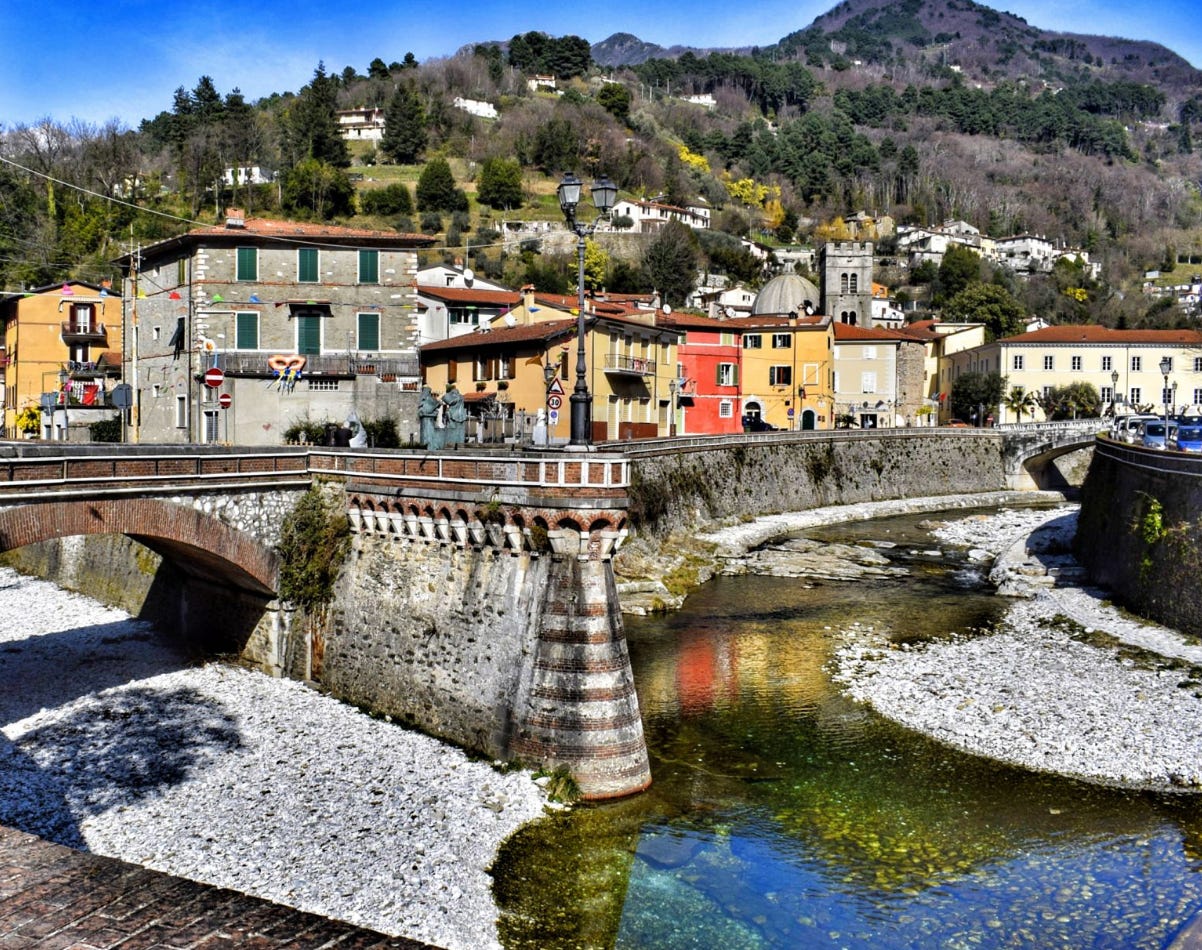
Seravezza sits where two mountain torrents meet, the Serra and the Vezza. What comes out of the joining is the river Versilia, which gave the whole region its name. A Medici villa sits on the bank, built because the family had no suitable palazzo to stay in when they came up to inspect the quarries. Again, the whole town was about the marble, so the houses were all workers’ houses, unsuited for royalty. The places here are also this simple. No wine bars, but it is one of the few places up here with a beer terrace (Birreria la casa sul fiume, literal translation: pub in the house by the river). The mushroom restaurant I mentioned, Ulisse, is here too. Pizzerias. The fanciest place is on the main square, La Forchetta (the fork), and you know it’s fancy because it serves seafood.
There are many little hamlets belonging to Seravezza as you drive up toward Monte Altissimo, their mountain. The best views are in Azzano and Basati. Also, don’t be surprised if half of the bars, cafés, and restaurants are called Michelangelo. You know the story of why. You can’t miss with any of them. All of them serve local food for local people, so it is amazing.
Stazzema
Stazzema is a different beast. It’s much higher up, and it requires real commitment to drive up there. If you look on the map, Stazzema as a town sits off the main road that runs through the mountains. It is up, way up, and you can reach it only by driving through back roads. When I said “main road,” I have to note that even that road is extremely curvy and narrow.
The town of Stazzema is small, much smaller than Seravezza. It is also very old, mostly empty, and the only people you might see here, aside from the few locals, are hikers. The air is as fresh as it can be. If you are coming here in summer, as we always do, you step out of the car and the temperature drops ten degrees, and after weeks of humid nights by the sea, that alone is worth the hour of driving.
Two of Stazzema’s hamlets sit on the road up, Levigliani and Terrinca, and both are worth parking and walking into. Retignano is off on its own spur, higher again, and you go there on purpose or not at all. On the road there is an amazing restaurant, simply called L’Osteria. Definitely plan your time to visit. The mixed grill plate is amazing, and so are the mountain views.
Stazzema is semi-famous for what happened at Sant’Anna, a hamlet above the village. In August 1944, the Germans had declared the whole area a safe zone, so refugees from the bombed coast went up there with their children. Then German troops climbed the mule tracks and killed more than 500 of them in a morning. The youngest was twenty days old. It was premeditated, meant to teach the mountain communities what helping the partisans cost.
Because it happened up here, it stayed buried. The files sat forgotten in a cabinet in Rome for fifty years and were found by accident, which is why Italians call it the cabinet of shame. Ten SS men were finally convicted in 2005 and sentenced to life. None of them served a day because Germany refused to extradite them. How charming… There is a memorial and a museum at Sant’Anna now.
Spike Lee made a film about it, and being Spike Lee, he made it about Black American soldiers who were not in these mountains in August 1944. You can’t blame the man for being unable to shoot a film without blacks, right? But the reason the film is hated here is different: in his version, the Germans came up because a partisan betrayed the village. That never happened. Nobody had to tell them anything, they came up anyway to set an example.
The partisans’ association protested during the film’s premiere. Lee refused to apologize and, being Spike Lee, acted like an arrogant American with little to no respect (or knowledge) for history, lecturing Italians about the parts of their history they had yet to come to grips with.
At least the film bombed, and critics buried it.
And then there is what the mountain did on its own, on the nineteenth of June, 1996. A storm parked itself over these slopes and did not move for eight hours. Nearly half a metre of rain fell on Pomezzana. The hillsides came down and dammed the streams above Cardoso, one of Stazzema’s villages, and in the early afternoon all of the dams let go at once. The wave took Cardoso apart. Twelve people died there, fourteen in all, and one of them was never found. Then the water carried on down through Pontestazzemese and Ruosina and Seravezza, out across the plain, and broke the banks near Pietrasanta, and reached the sea at my beach and at Forte dei Marmi. Thirty years this June. Every year on the day, they run a torch relay from the river mouth up to the mountain, and light the Monte Forato above the valley.
You drive past Cardoso to get to Levigliani. It looks rebuilt, because it was rebuilt, by the people who were still there.
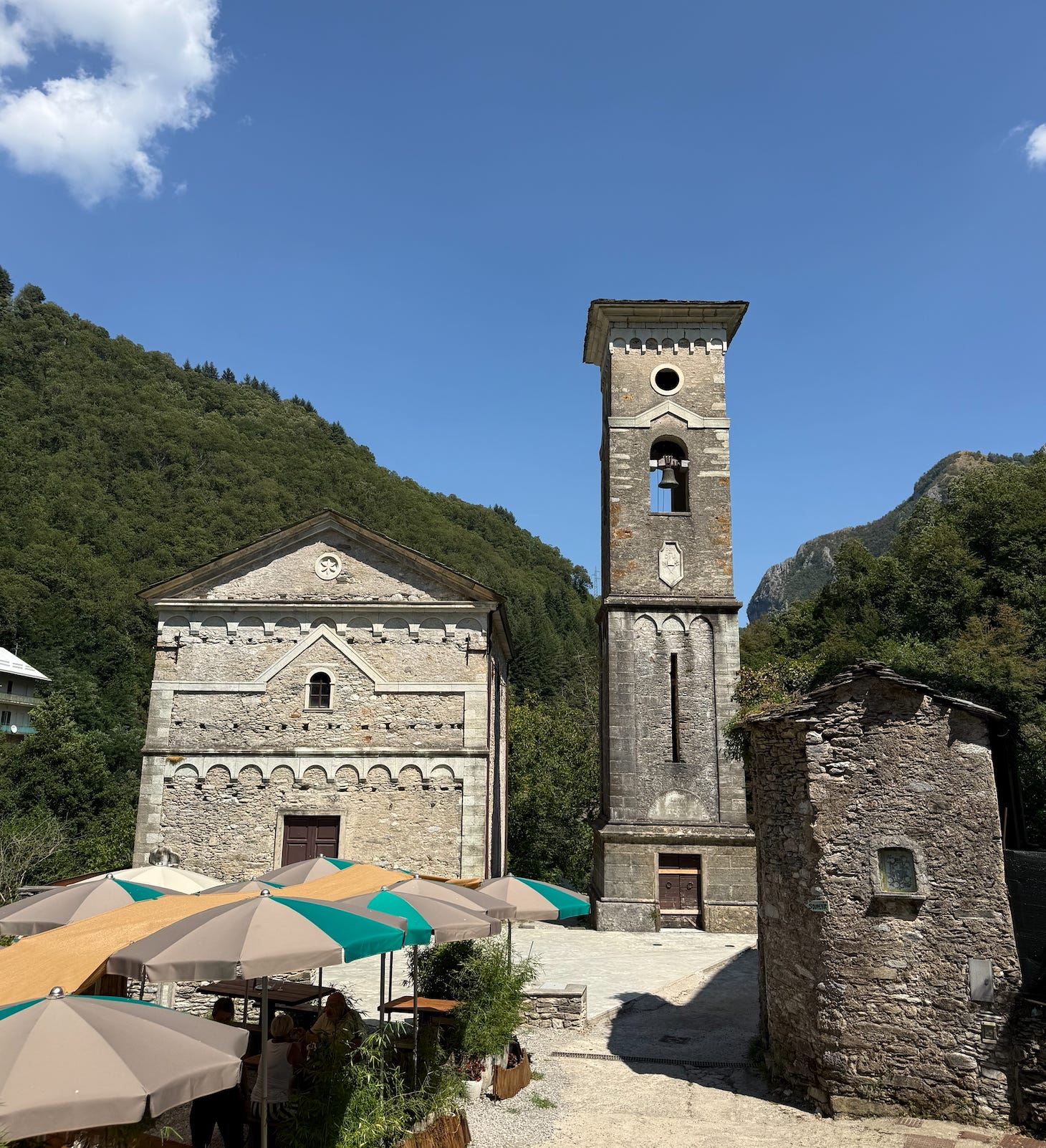
If you need a destination, I recommend Isola Santa. It's past some of these villages, even deeper in the mountains. It's a small village that was flooded halfway by a nearby dam, so only a couple of houses remain. It's the most secluded place there, worth a visit. Also, there is no point returning from there; just drive up toward Garfagnana until you reach Castelnuovo di Garfagnana. Then, as I detailed in my trip article, turn east and continue the road down to Lucca.
Whichever way you go, the two towns with their two mountains should stay with you. Everything comes and goes here. The mountain takes, and the mountain gives. Life is not that complicated, but it is hard to drive through.
