

Hi, I’m Peter, and you’re reading Anywhere Italy. Our mission is to cover the 1,000 Italian towns most travelers skip, in person, one at a time. Come along for free, or pay to keep us on the road.
I wanted to write about Peccioli for so long, not just because it was so great when we visited this town, but also because it is a great story to tell if you are into urban planning and community management. The story also has giants.
A disclaimer first, mostly for the Italians reading: nobody in Peccioli pays me, sponsors me, or has any hold over me. So when I write that Renzo Macelloni, the mayor, is a genius of the giant-sized kind, I mean it. This piece is about a town with giants that won Best Village in Italy two years ago. It is also about what happens when a small town dares to dream big.
Our story begins in the late 1980s. Peccioli was a small farming village in Tuscany with a badly managed landfill on one of its slopes. This was the 1980s, so no Eat Pray Love and no one wrote about the cedar trees, hilltop towns, and olive groves in that cheesy romantic way. Tourism was almost non-existent, at least not in Peccioli. It was also closer to Pisa, and I wrote about a road trip before, on the road to Siena, where you can drive to Siena in two ways. One of them is truly beautiful, the other is… well, Peccioli is on this other way. Industrial area, farming, working, fewer cedar trees and more John Deere. Nothing romantic here. It still isn’t, to be honest, but imagine it in the 1980s, before fridge magnets.
Florence closed its landfill, and the entire Tuscany region wanted to close all non-functioning landfills. This was when the North started shipping trash to the South because, I don’t know, this is one of the few feuds between Northern and Southern Italy. But then came Renzo Macelloni, who was the mayor of Peccioli, even back then, a local dude, and he said to the Regional board: “Give me the money that you would pay for shipping your junk. I will rebuild my dump, expand it, and take your trash for a fee.”
Tuscany said yes. And ever since the early 90s, Peccioli has been taking in almost half of Tuscany’s trash, putting it into a modern landfill, generating energy from the rotting waste in the form of biogas, more than the community needs, and also collecting a fee for handling the waste from the government and trash companies. The landfill paid the town millions of euros. Even some of their citizens- around 900 of them are shareholders in the landfill itself. Renzo Macelloni is the CEO of the company that manages the landfill and, as of today, the town's mayor.
Of course, every brave dreamer has to fight shortsighted people, so Renzo got some criticism that this mayor-CEO duo-in-one might not be the best idea. Also, the landfill recycles less trash than regional laws require. If you’ve spent any time in Italy, you would know that recycling and selective waste collection are like a religion around here. Renzo says he doesn’t care because the trash is properly buried, and he believes in landfill mining when the technology is there. Basically, in 10-20-30 years, they will mine the trash for gold, copper, and other precious metals left in old electronics that didn’t get recycled. It’s debated, landfill mining in general, but he is a dreamer who clearly gives zero f—s about local laws, and for that, all I can say: cheers!
Now, until this, this is a great management story, nothing to do with you visiting a town in Tuscany. But, as said above, the landfill paid millions to the town, and it is still paying millions. So, as a mayor, what would you do with all that money? Of course, first you'd renovate the entire village, lower local taxes to almost nothing, and make sure all services are spot on. The town is small, it has only about 5,000 people. But once you have made the town nice and tidy, what then?
You pay for the giants. Yes. Giants.
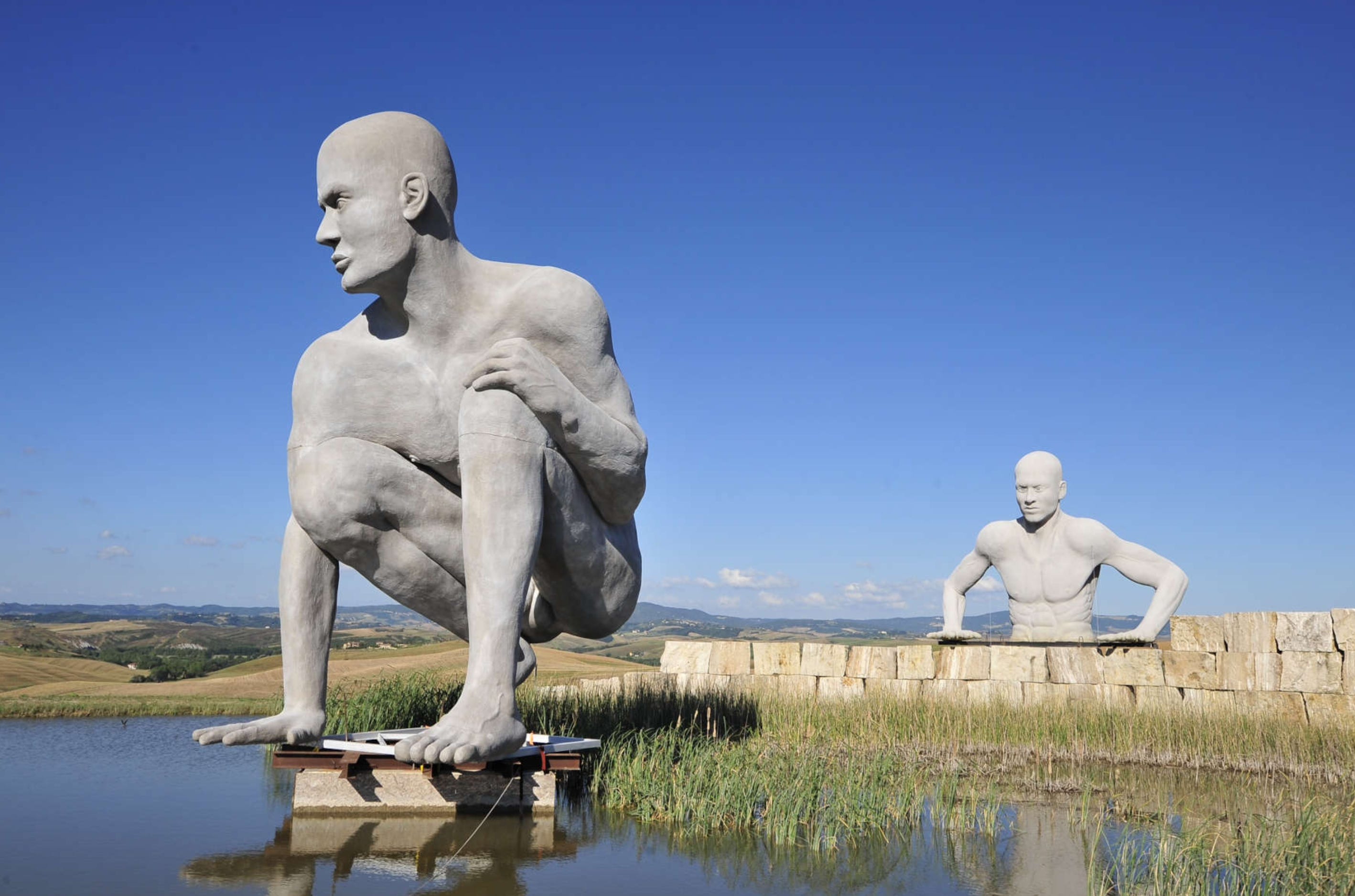
I can’t even guess what has crossed the minds of the locals. Truth is, there was a dinosaur park with giant dinos in the woods near the village. It brought in some revenue and drew visitors. Maybe that is where the idea came from? The manufacturing company of the giants is a local art company, maybe they did the dinos as well? I don’t know. Doesn’t matter.
Long story short, the town spent a fortune on creating giant sculptures. First, they created them in the landfill itself. Then they built an amphitheater with giants, which now serves as an event space. Then they built an airwalk lookout that is huge compared to the village, and from there, you can look down at the valley and the giants. The first giant is more than 15 years old, but the town hasn’t given up on them, the latest one is crawling out of an old house in Fabbrica, one of Peccioli’s little hamlets, a short drive from the town.
The giants brought in visitors. The town then invested even more in public art. Now Peccioli looks like a public art festival. After 15 years since the first giant crawled out of the landfill, the town won a contest in Italy for the “Village of the villages,” where they find the best town in Italy. They took the title away from Ronciglione, by the way, which was my first inspiration for this publication. We found the town online, since the giants are highly photogenic, many people come there and take pretty insane pictures. We’re used to this in Pietrasanta. It’s the same here: a medieval village with old stone buildings, and then a public modern art piece in the main piazza, carved from marble. The contrast between the two is astonishing. We even have a Roman-style non-functioning church as an art exhibition space. Peccioli did the same, combining their medieval hilltop town with modern art, but they applied this concept to the Tuscan landscape. The giants are mainly crawling on the slopes around the town, not inside the town, where there is no space for them.
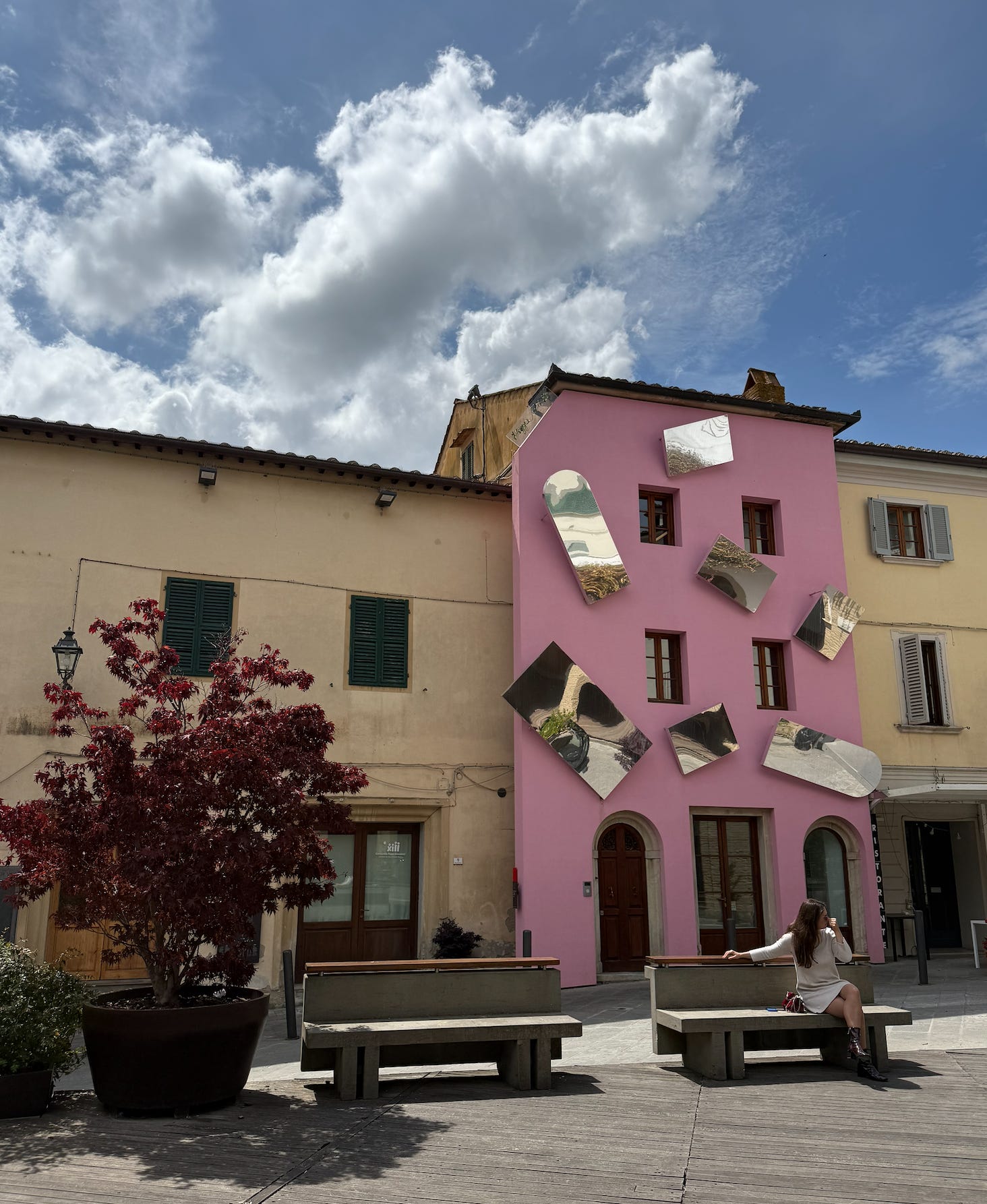
In the town, the art is in separate pieces. Mirrors on buildings that reflect your visions onto you. Entire buildings decorated with eyeballs, citizens looking at you while you walk into the old town. Sometimes they have laser shows or visual art performances. The airwalk and the road to it are an art exhibition in themselves. And don’t forget, before art, the town spent the trash money to fully renovate the entire village. The town is in impeccable condition, fully preserved.
And this is the thing. This is why the entire story is genius. If you come here, you are looking for that Tuscan hilltop town experience. Medieval old town, ideally with walls, a big church, a piazza, cafes and bars around it, tranquility, and the Tuscan landscape. Most people get this experience from tour operators, visiting Disneyland towns like Montepulciano, San Gimignano, or Volterra. There's nothing local there, or very little is left. But what if you are not in one of those highly popular towns? I live here, I can tell you that the hilltop town experience has around 100 more applicants. Almost all towns here look like this. It’s nowhere near as unique or special. So how can you stand out?
I wrote about this in the very first article of this publication. There is a town called Casoli. It’s actually part of a town, Camaiore. It’s insanely small, like, 2-3 streets or so. But it lets artists paint the town’s buildings with giant murals, kinda like graffiti. There is an annual art festival there, and the town has visitors. They spend their money in the local bar, which is also a grocery shop, probably wouldn’t be open if it weren’t for the visitors. Almost no one lives up there anymore.
But this is how you stand out. Do something big, unique, that moves you out from the “old borgo on top of the mountain,” which is a title for 100+ other towns like you. The graffiti route, by the way, is used by many other towns in Italy. The giants, though, as far as I know, are only in Peccioli.
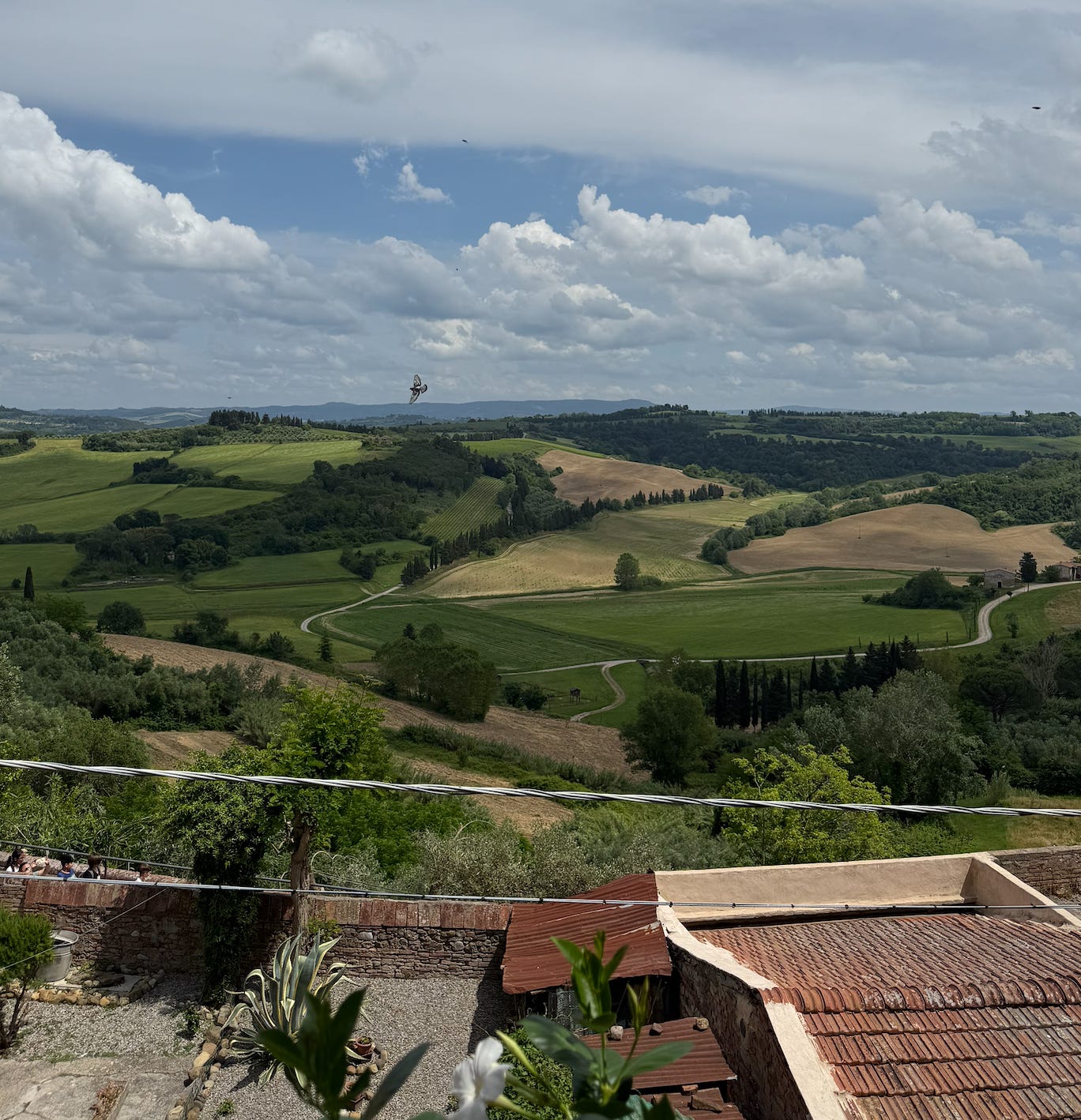
I don’t know how much money the town makes from tourism. But for a town with only 5,000 people, it has quite a lot of bars and restaurants. We had a really nice steak at Ristorante Ferretti, right on the main square, and washed it down with a glass of something at the bar called La Terrazza, which, as its name suggests, has a large terrace overlooking the same valley you can see from the airwalk.
If you have kids, the dino park is fun. But I would end the day at Montecchio, a small hamlet on the hill in front of Peccioli. Administratively, it belongs to Peccioli, so they are the same town. Montecchio has an old church and maybe two streets in a very old, almost empty borgo. It’s amazing during the golden hours, and it offers the same panoramic views of the valley, just from a different direction, facing west, so it's perfect for watching the sunset.
Standing out is relative. In Tuscany, almost all villages and towns look beautiful. Especially if you are coming from a not-so-inspiring environment, like a classic American suburb. Some are unique in their own way, like San Gimignano, which has preserved medieval skyscrapers. Others are unique because they are on a route, the roads of Val d’Orcia, that are visited by everyone.
Others have giants crawling out from landfills, reminding you that dreaming big sometimes pays off in decades. But it pays off.

Ok how much? How much did they pay you for this? 😎